

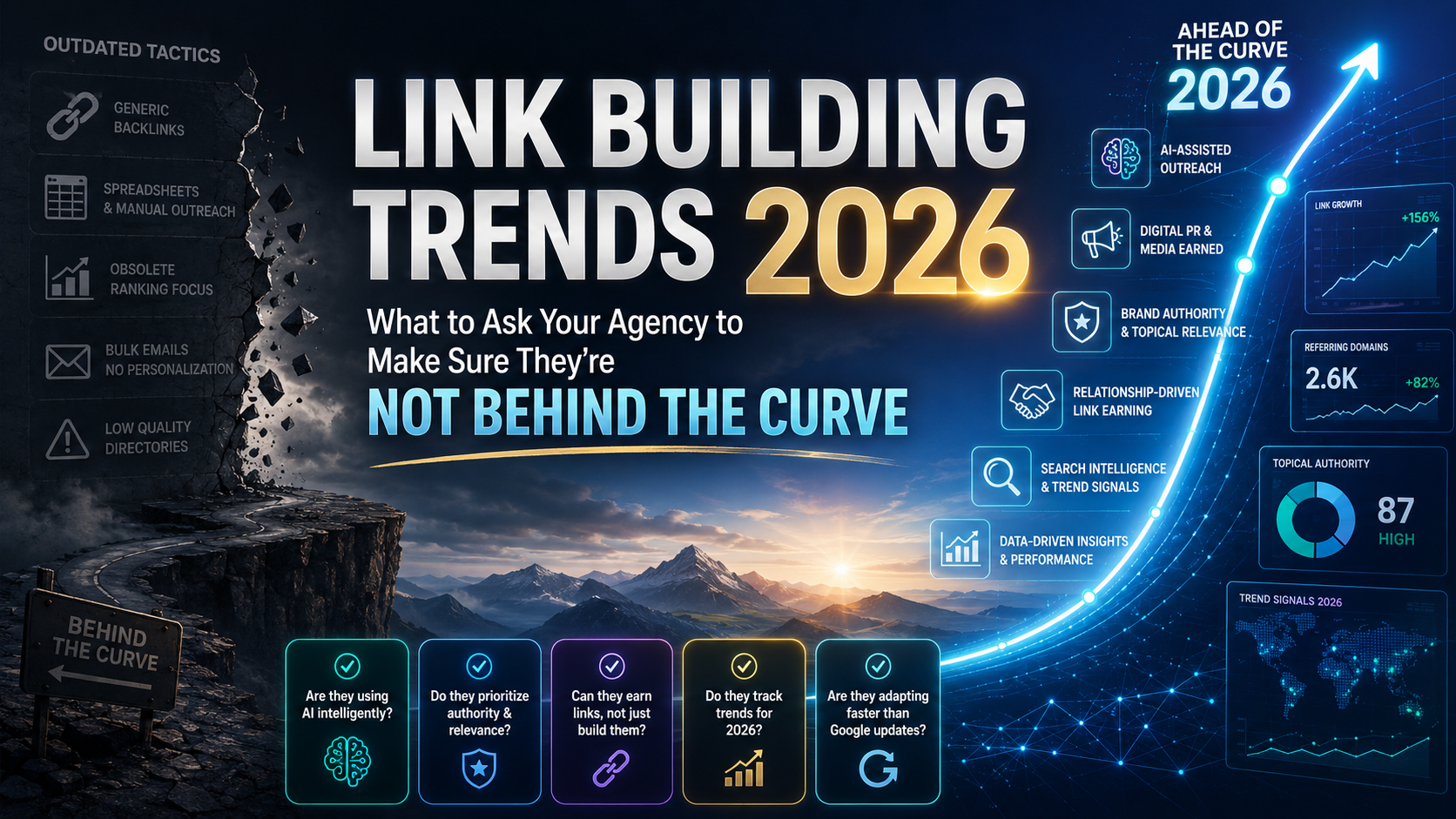
If you’re paying an agency to build links for your site in 2026 and you haven’t asked them the right questions lately, there’s a very real chance you’re funding an outdated strategy. The SEO landscape has shifted dramatically-and link building, once considered a numbers game, has evolved into something far more nuanced, technical, and brand-centric.
The link building trends 2026 points toward a world where Google’s AI-powered systems can detect the difference between an earned editorial mention and a manufactured placement. Agencies clinging to 2020 playbooks-mass outreach, low-quality guest posts, PBN shortcuts-aren’t just wasting your budget. They’re potentially putting your entire organic presence at risk.
This article breaks down what’s actually working today, what’s clearly dead, and-most importantly-the exact questions you should be asking any link building partner right now. Whether you’re evaluating a new agency or auditing your current one, this guide will help you separate the sharp from the stale.
| ⚡ TL;DR – Key Takeaways Link building in 2026 is about authority, relevance, and AI-visibility-not volume. Digital PR, entity-based linking, and E-E-A-T alignment are non-negotiable. Any agency that can’t explain how they get clients mentioned in AI Overviews or LLM outputs is operating with a five-year-old strategy. Ask hard questions. Demand transparency. And if they flinch-walk. |
Why the Old Link Building Playbook Is Dead
Let’s not sugarcoat it: the tactics that drove results between 2015 and 2020 are now liabilities. Bulk link packages, private blog networks (PBNs), generic guest post farms-Google’s SpamBrain AI has become sophisticated enough to detect unnatural link patterns at scale, and the penalties are real.
According to recent industry data, 95% of all web pages have zero backlinks, and a staggering 94% of content published online never earns a single external link. That’s not because link building is dead-it’s because most people are still chasing links the wrong way.
Google no longer counts links like votes in a popularity contest. It now reads links as endorsements between verified entities. That’s a foundational shift, and agencies that haven’t internalized it are selling you yesterday’s solution at today’s prices.
Figure 1: The State of Link Building – 2026 Statistics at a Glance
| Metric | Data Point | Source |
| Pages with zero backlinks | ~95% of all indexed pages | Ahrefs / DemandSage 2026 |
| Content that earns no external links | 94% of published content | DemandSage 2026 |
| Cold outreach link acquisition rate | Only 8.5% of emails convert | Frank Agency 2026 |
| Digital PR adoption among marketers | 67.3% now use it as primary method | DemandSage 2026 |
| Long-form content (3,000+ words) backlink advantage | 3.5x more links vs. short content | DemandSage 2026 |
| Typical campaign result timeline | 3–6 months to see meaningful results | BuzzStream 2026 |
| AI Overview appearance in Google searches | 15–25% of search queries | Stridec / SEJ 2026 |
Note: Statistics drawn from multiple 2025–2026 industry reports and research publications.
The Top Link Building Trends 2026 You Need to Know
The most effective agencies in 2026 have reorganized their entire service model around these core shifts. Here’s what’s driving results right now:
1. Digital PR Has Replaced Traditional Outreach as the Gold Standard
Digital PR is now the dominant link acquisition strategy, used by 67.3% of marketers as their primary method. Unlike cold outreach-which sees just an 8.5% success rate-Digital PR generates high-authority editorial mentions from outlets that journalists already trust. Think original research, industry surveys, reactive expert commentary, and data-led campaigns that newsrooms genuinely want to cover.
This matters for two reasons: Google values these links highly because they’re earned organically, and they generate real referral traffic-not just SEO juice.
2. E-E-A-T Is Now the Lens Through Which Every Link Is Evaluated
Google’s E-E-A-T framework-Experience, Expertise, Authoritativeness, and Trustworthiness-is no longer just a content metric. It now directly influences how much weight a backlink carries. Links from verified experts, credentialed authors, and established institutions pass significantly more equity than links from anonymous guest contributors or generic blogs.
In practical terms: a single link from an industry-recognized publication will outperform twenty links from unvetted niche blogs. Quality has mathematically replaced quantity as the defining variable.
3. Entity-Based Linking Is Reshaping How Google Reads Backlink Profiles
Google now views your website as an entity, not just a URL. It maps relationships between trusted entities across the web. Getting linked by established entities in your niche-those that Google already uses as primary sources-validates your brand in the knowledge graph.
This is why agencies now talk about “entity positioning” rather than just link acquisition. If an agency can’t explain what entity building looks like or how they approach it, that’s a significant knowledge gap.
4. AI-Powered Link Prospecting Is Changing the Speed of Outreach
AI tools like Ahrefs Insights, ChatGPT-powered automations, and machine-learning prospect scoring systems now allow link builders to process thousands of domains in the time it used to take to manually review a few hundred. This is one of the biggest operational link building trends 2026 brings to the table.
But AI at the front end means the filtering criteria at the back end must be tighter. Agencies using AI should be vetting for relevance, traffic quality, editorial standards, and spam signals-not just domain authority numbers.
5. AI Search Visibility Is the New Ranking Metric That Matters
This one is the real differentiator between modern agencies and outdated ones. Google AI Overviews, ChatGPT, Perplexity, and other LLM-powered search tools are now answering queries directly-often without a click to any website. For your brand to appear in these answers, it needs to be cited by trusted sources that AI systems already use.
A backlink from a credible source isn’t just a Google ranking signal anymore-it’s a citation that trains AI engines to recognize your brand as an authority. Elite agencies in 2026 track brand mentions in LLMs, not just SERP positions.
Figure 2: Old vs. New Link Building Approach – 2026 Comparison
| Tactic | Old Approach (Pre-2023) | Modern Approach (2026) | Risk Level |
| Guest posting | Mass outreach to any site | Targeted editorial on vetted, topically relevant sites | Low if done right |
| Backlink volume | More links = better rankings | Fewer, higher-authority links win | High if volume-focused |
| Outreach method | Generic email blasts | Personalized, relationship-based pitches + Digital PR | Low |
| Link metrics used | Domain Authority (DA/DR) | Traffic, topical relevance, entity authority, E-E-A-T | Medium |
| AI search visibility | Not a consideration | Core KPI tracked alongside Google rankings | High if ignored |
| Success measurement | Number of links built | Referring domain growth, traffic, AI mentions, conversions | Medium |
| Content strategy | Thin guest post articles | Original research, linkable assets, expert commentary | Low |
| PBNs / link networks | Common tactic | Penalized; avoided by reputable agencies entirely | Very High |
The Questions You Need to Ask Your Link Building Agency Right Now
Armed with an understanding of where the industry is heading, here are the questions that will quickly reveal whether your agency is leading the charge-or lagging behind it. These aren’t softballs. They’re designed to surface real answers, not polished sales talk.
❓ Question 1: “How do you vet the sites you build links on?”
A legitimate agency should be able to walk you through a clear publisher qualification process. They should check for organic traffic (not just DA), editorial standards, topical relevance, spam history, and whether the site is indexed properly. Vague answers like “we use the best sites” or “we have a network of publishers” are red flags.
| ✅ Green Flag Answer:“We verify every site for real organic traffic using tools like Ahrefs or Semrush, confirm editorial guidelines, check keyword rankings for signs of spammy history, and ensure thematic alignment with your niche.” |
| ❌ Red Flag Answer:“We have relationships with hundreds of high-DA sites.” (No mention of traffic, relevance, or vetting process.) |
❓ Question 2: “Can you show me examples of clients appearing in AI-generated answers?”
This question alone will cut your shortlist in half. Modern link building isn’t just about Google SERPs-it’s about building the kind of authority that gets cited by AI systems like ChatGPT, Perplexity, and Google AI Overviews. If your agency gives you a blank stare, you have your answer.
Ask for a live demonstration-not a PDF case study. Have them pull up ChatGPT or Perplexity and run a query relevant to a client’s niche. If the client appears in the AI-generated answer, that’s proof of real authority. If they can’t demonstrate this, they’re not equipped for the current search environment.
❓ Question 3: “What does your outreach process actually look like-and who does it?”
The bait-and-switch is one of the most common complaints in the agency world: you’re sold by a senior strategist and handed off to a junior coordinator who runs cookie-cutter campaigns. Ask specifically who will be executing your outreach, how they personalize pitches, and what their response rates look like.
Outreach saturation is real. Cold emails for link building achieve a success rate of just 8.5% on average. Agencies that don’t personalize, don’t segment by niche, and don’t build relationships are fighting an uphill battle with your budget.
❓ Question 4: “What types of links are you going to build-and why those specifically?”
A credible agency will tailor their link mix to your specific industry, competitive landscape, and authority gaps. They should discuss editorial placements, Digital PR, resource link building, expert roundups, data-driven content, and possibly broken link building-all calibrated to your niche.
What you don’t want to hear: “We do guest posts on high-DA sites” with no further context. That’s a commodity service masquerading as a strategy.
❓ Question 5: “How do you measure success beyond the number of links built?”
Vanity metrics are the enemy of ROI. Raw backlink counts mean nothing if those links come from low-traffic, irrelevant sites. Ask about referring domain growth trends, keyword ranking movement tied to link acquisition, organic traffic changes, and whether they track AI search visibility.
A healthy campaign adds 10 to 40 new referring domains per month depending on budget and niche. Sustainable growth should show as a steady curve-not a spike followed by months of silence.
❓ Question 6: “Can I see a sample report from an active client campaign?”
A sample report reveals more than a dozen sales calls combined. Look for clarity, actual data tied to business outcomes, and evidence of transparent communication. If a report is nothing more than a list of URLs and DA scores, that agency is tracking the wrong things entirely.
❓ Question 7: “What is your timeline expectation, and how do you handle slow periods?”
Most legitimate link building campaigns deliver meaningful results within three to six months. Anyone promising dramatic results within the first 30 days is either working with black-hat tactics or overselling. Equally important: what happens when placements slow down? Does the agency proactively communicate, adjust strategy, or go quiet?
❓ Question 8: “Do you use PBNs, link networks, or paid link schemes?”
Ask this directly. A reputable agency will have no issue saying no and explaining why. If you get defensive deflection, euphemisms like “premium publisher networks,” or vague “propriety systems” talk-run. These schemes may move rankings short-term but they create a penalty time bomb buried in your backlink profile.
Figure 3: Agency Vetting Scorecard – Questions, Green Flags & Red Flags
| Question | Green Flag | Red Flag |
| How do you vet sites? | Checks traffic, relevance, spam history | “We use high-DA sites” |
| AI visibility examples? | Live LLM demo with client mentions | Blank stare or PDF only |
| Who does the outreach? | Named team, personalized approach | Junior team, template emails |
| What links will you build? | Strategy tailored to niche + goals | “Guest posts on high-DA sites” |
| How do you measure success? | Traffic, rankings, AI mentions, conversions | “We deliver X links per month” |
| Can I see a sample report? | Clear, business-context metrics | Colored charts with no context |
| Timeline expectations? | 3–6 months, honest projections | “Results in 30 days” |
| Do you use PBNs? | Clear “No” with explanation | Deflection or vague network talk |
| Contract terms? | Month-to-month or short-term options | 12+ month lock-in upfront |
What Modern Link Building Actually Costs in 2026
Budget transparency is another area where agencies separate into two camps. Here’s a realistic pricing benchmark so you can evaluate whether what you’re being charged aligns with what you’re getting.
| Service Type | Typical Price Range | What You Should Expect |
| Quality editorial placement (single link) | $1,000 – $2,000 per link | Vetted, real publisher with genuine traffic |
| Monthly retainer (small business) | $1,000 – $3,000/month | 5–10 quality links, reporting, outreach |
| Monthly retainer (mid-market) | $3,000 – $7,000/month | 10–25 links, Digital PR, content creation |
| Digital PR campaign (standalone) | $5,000 – $15,000/campaign | Original research, media pitching, earned coverage |
| Full-service link building (enterprise) | $8,000+/month | Integrated strategy, AI visibility tracking, executive reporting |
| Cheap link packages (to avoid) | Under $500/month for 20+ links | PBNs, link farms, spam risk, penalties |
Pricing benchmarks based on 2026 industry reports. Actual costs vary by agency, niche, and campaign scope.
How to Find a Link Building Agency That Actually Gets It in 2026
The agency market in 2026 has a serious credibility problem. Traditional SEO agencies are rebranding overnight with new logos, updated websites, and AI-forward language-while running the same playbooks under the hood. Here’s how to cut through the noise.
• Demand verifiable case studies. Not anonymized. Real clients, real metrics, real timelines. If an agency can’t share a named example, ask why.
• Look for proprietary methodology. The best agencies have documented processes for publisher vetting, outreach personalization, E-E-A-T alignment, and AI visibility tracking.
• Check their own authority. Does the agency appear in searches relevant to their niche? Do they show up in AI-generated answers when you search for link building or SEO services? Apply their own medicine to their brand.
• Ask for month-to-month options. Confident agencies earn your continued business through results-not through 12-month lock-in contracts. A long initial commitment is often a sign they expect dissatisfied clients.
• Test their communication upfront. How responsive are they during the sales process? Agencies that go quiet or give vague answers before you’re a client almost always get worse once you are.
One service that has been gaining recognition for its transparent approach and modern methodology is
One service that has been gaining traction for its transparent, results-first approach is Outreachz. Outreachz operates as a managed link building platform built around white-hat outreach, publisher quality control, and clear campaign reporting-making it a practical option worth evaluating if you’re in the market for a new link building partner that aligns with 2026 standards. It’s worth running through the vetting questions above with any agency, including them, to ensure the approach fits your specific goals.
Emerging Link Building Tactics Worth Watching in 2026
Beyond the core trends, several emerging tactics are gaining traction among forward-thinking SEO teams. These aren’t fully mainstream yet, but agencies at the leading edge are already deploying them:
Reactive Digital PR (Newsjacking Done Right)
Quick-response media commentary-where your brand’s expert speaks to a breaking industry story-is generating some of the highest-authority editorial links available right now. It requires speed, media relationships, and credentialed spokespersons. Agencies that can execute reactive PR campaigns are earning links from national publications that no amount of traditional outreach could buy.
Linkable Asset Creation: Tools, Data & Calculators
Original data studies and interactive tools (salary calculators, industry benchmark reports, ROI estimators) are among the most consistently link-earning content formats available. A well-designed linkable asset can generate dozens of natural editorial links over 12–18 months-far outperforming any manual outreach campaign of the same budget.
Podcast and Media Appearance Link Acquisition
Every credible podcast appearance, webinar keynote, or industry panel generates a natural backlink from the host’s platform-often with genuine topical relevance and audience trust. Agencies that build media appearance pipelines for clients are creating link acquisition channels that also improve brand recognition, referral traffic, and E-E-A-T signals simultaneously.
Collaborative Content and Co-Citation Strategies
Partnering with complementary (non-competing) brands to co-produce research, guides, or tools creates mutual linking opportunities that both parties benefit from. These links carry high relevance, are completely white-hat, and generate co-citation authority that reinforces your entity relationships in Google’s knowledge graph.
What Great Link Building Reporting Looks Like in 2026
Reporting is where the gap between performative agencies and genuine partners becomes most visible. Here’s what modern, high-quality link building reporting should include-and what it should never look like.
| Report Element | What Good Looks Like | What Bad Looks Like |
| Link inventory | URL, publisher DA/DR, traffic, placement date, anchor text | List of URLs with no context |
| Referring domain trend | Monthly growth chart showing trajectory | One-time count with no historical comparison |
| Keyword ranking movement | Rankings tied directly to link acquisition periods | Generic ranking report with no link attribution |
| Traffic correlation | Organic traffic changes overlaid with campaign milestones | “Traffic is up”-no data shown |
| AI search visibility | Brand mentions tracked in ChatGPT/Perplexity/AI Overviews | Not mentioned at all |
| Campaign narrative | Explanation of wins, setbacks, and next-step strategy | Data dump with no commentary |
| Outreach metrics | Pitches sent, responses, placements, conversion rate | “We sent outreach this month” |
The Honest Truth About Link Building in 2026
Here’s what most agencies won’t say out loud: link building is harder than it’s ever been, it takes longer than most clients expect, and the cheap option almost always costs more in the long run when you factor in the risk of penalties and the lost time of starting over.
The link building trends 2026 makes one thing unmistakably clear-the industry is bifurcating. On one side, there are agencies doing the slow, credibility-building work of Digital PR, entity positioning, and earned editorial placements. On the other, there are link farms operating with new branding and lower prices. The gap in outcomes between the two is widening every quarter as Google’s AI systems get better at distinguishing merit from manipulation.
The questions in this guide are designed to help you tell the difference before you sign anything-not after you’ve wasted six months of budget and need to start a disavow campaign.
Final Checklist: Is Your Agency Keeping Up with 2026?
Run your current or prospective agency through these quick checks:
• They explain a clear, documented publisher vetting process
• They can demonstrate AI search visibility results (not just SERP rankings)
• They track referring domain growth trends, not just link counts
• Their reporting ties link acquisition to traffic and ranking movement
• They use Digital PR and content-driven strategies alongside traditional outreach
• They discuss E-E-A-T alignment and entity positioning naturally
• They offer month-to-month or short-term contract options
• They’re transparent about who executes your campaign
• They have no problem with direct questions about PBNs or link schemes
• They apply their own methodology to their own brand-and it shows
Bottom Line
The right link building agency in 2026 won’t just build links-they’ll build authority. The difference is visibility, trust, and sustainability. Ask the hard questions, demand the right answers, and don’t settle for an agency selling last decade’s playbook at today’s prices.