

Let’s be real for a moment. If you’re still building backlinks the same way you were in 2022, you’re not just behind – you may be actively working against yourself. The future of link building has arrived faster than most SEO professionals anticipated, and it looks nothing like the era of mass outreach, directory submissions, and private blog networks that once defined the discipline.
This isn’t a doom-and-gloom piece. Links still matter – a lot, in fact. What’s changed is the why, the how, and the where. Google’s AI-powered algorithms, the explosive rise of AI Overviews, the collapse of zero-click workarounds, and the growing dominance of entity-based authority signals have turned link building into something far more nuanced – and, frankly, far more interesting.
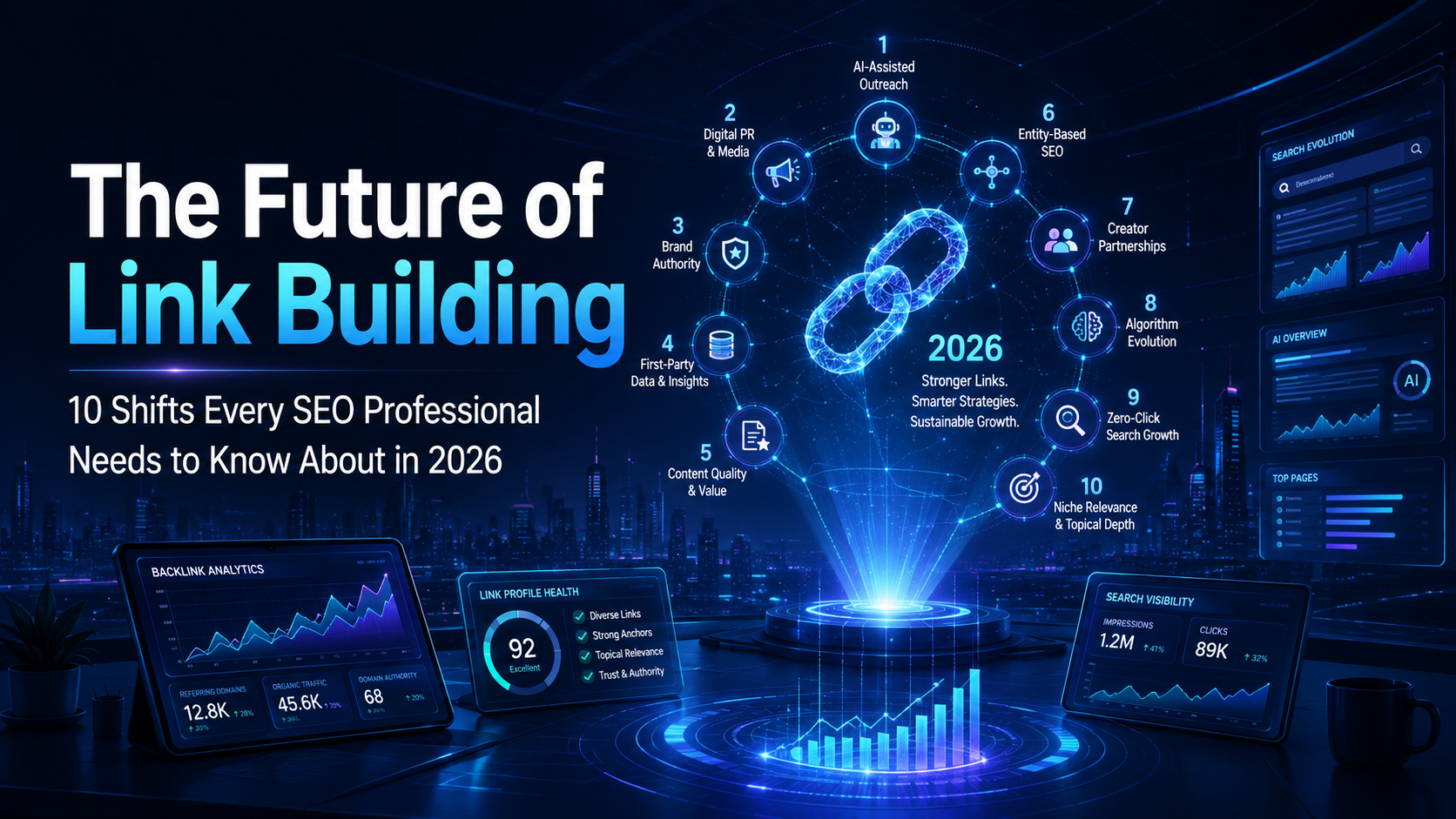
Below, we break down the 10 most consequential shifts redefining link building in 2026, backed by current data, real-world context, and actionable guidance. Whether you’re an in-house SEO lead, a freelance consultant, or the head of a digital agency, these are the shifts you need to understand – and act on – right now.
| 73.2% | of SEO professionals confirm that backlinks directly impact AI search visibility, per a 2025 survey of 518 practitioners (Editorial.Link). |
| 76.1% | of pages cited in Google AI Overviews also rank in the top 10 – meaning traditional SEO authority still forms the foundation of AI search presence. |
| 67.3% | of marketers now say digital PR is their primary link building method – a seismic shift from the guest post era of just three years ago. |
Shift #1: From Link Counting to Link Credibility
For years, the game was volume. More links meant more authority – or so the conventional wisdom went. Google’s SpamBrain AI has largely made that thinking obsolete. In 2026, the search engine can distinguish between a link that was earned through genuine editorial merit and one that was manufactured purely for ranking purposes.
The result? A fundamental pivot from quantity-obsessed link building to credibility-first link earning. Your backlink profile is no longer evaluated as a raw count. It’s assessed for source authority, topical alignment, editorial context, and the trust signals surrounding each placement.
TL;DR
- Google’s SpamBrain now detects manufactured links with high precision.
- Source credibility and topical relevance outweigh raw link volume.
- Auditing your existing backlink profile for low-quality links is now a defensive necessity.
Old vs. New Link Building Mindset
| Dimension | Old Approach (Pre-2024) | New Standard (2026) |
| Primary Goal | Maximize link volume | Maximize link credibility |
| Success Metric | Number of backlinks | Domain authority + topical relevance |
| Link Source | Any site with decent DA | Editorially vetted, niche-aligned sites |
| Anchor Text | Keyword-rich anchors | Diverse, natural anchor text mix |
| Risk Tolerance | High (PBNs, directories) | Low (white-hat only) |
| ROI Timeline | Short-term spikes | Long-term compounding authority |
Shift #2: Entity-Based Linking Is Now the Architecture of SEO Authority
Google no longer evaluates your website as a collection of URLs. It evaluates your brand as an entity – a recognized, structured concept within its Knowledge Graph. Google’s February 2026 Discover update made this explicit: site authority is now assessed topic by topic, not domain-wide.
Entity-based linking is the practice of earning links from other recognized, trusted entities within your niche. When authoritative entities link to you, Google’s AI interprets it as semantic confirmation that your brand belongs in that industry’s “topical map.” This matters enormously for AI Overviews, where entity recognition directly influences citation probability.
Practical steps include securing a Wikipedia or Wikidata presence, consistently publishing under verified author bylines, earning brand mentions on established industry publications, and building structured data that reinforces your entity profile. It’s less about PageRank and more about Knowledge Graph inclusion.
TL;DR
- Google now evaluates authority by topic and entity, not just domain-wide.
- Wikidata/Wikipedia presence is among the top citation drivers for ChatGPT and Google AI.
- Links from established, same-niche entities carry more semantic weight than generic high-DA links.
- Structured data markup helps search engines properly categorize your entity.
Shift #3: Digital PR Has Replaced Guest Posting as the Gold Standard
If you polled the top-performing SEO teams across the country right now, you’d find most of them talking about campaigns rather than placements, stories rather than posts, and editorial coverage rather than content syndication. Digital PR – the practice of earning links through newsworthy, data-driven stories placed in authoritative media – has officially unseated guest posting as the dominant link building tactic.
The data backs this up. According to industry research, 67.3% of marketers now cite digital PR as their primary link building method. Why? Because a single editorial placement in a major publication like Forbes, TechCrunch, or an industry trade journal can deliver the kind of E-E-A-T (Experience, Expertise, Authoritativeness, and Trustworthiness) signal that would take dozens of guest posts to approximate.
Guest Post vs. Digital PR: Head-to-Head Comparison
| Factor | Guest Post | Digital PR |
| Link Type | Sponsored/contributed content | Editorial (unsponsored) |
| Average DA/DR | Moderate (30–55 typical) | High (60–90+) |
| E-E-A-T Signal | Moderate | Very High |
| AI Overview Citation Potential | Low–Medium | High–Very High |
| Scalability | High (can outsource) | Medium (requires PR strategy) |
| Cost per Link | $150–$500 avg | $800–$3,000+ avg |
| Longevity | Moderate | Very high (news archives persist) |
| Referral Traffic | Low–Moderate | High (direct from media audience) |
Shift #4: AI Overviews Are the New First Page – And Links Drive Who Gets Cited
Google AI Overviews now appear on a significant portion of commercial search queries, with more than 2 billion monthly users interacting with AI-generated answers. Here’s the critical insight that too many SEOs are still sleeping on: getting cited inside an AI Overview has become the new version of ranking #1.
Research confirms that 76.1% of pages cited in AI Overviews also rank in Google’s top 10. That means AI citation isn’t replacing traditional SEO authority – it’s layering on top of it. The brands earning AI citations are those with strong backlink profiles from sources that AI systems already treat as high-trust references.
This has profound implications for your link acquisition strategy. You’re no longer just building for PageRank. You’re building for what machine learning models classify as credible, authoritative, cite-worthy content. The publishers you target, the editorial standards of the sites you’re featured on, and the topical coherence of your backlink profile all feed directly into AI citation probability.
TL;DR
- AI Overviews appear on a growing share of commercial Google searches.
- 76.1% of AI-cited pages also rank in the traditional top 10.
- Links from high-authority editorial sources increase AI citation probability significantly.
- Structuring content with clear answers, lists, and data makes it more AI-extractable.
Shift #5: Brand Mentions Now Carry Independent SEO Weight
Here’s something that would have sounded like heresy in 2019: unlinked brand mentions are becoming measurable SEO signals. As AI systems like Google Gemini, Bing Copilot, ChatGPT, and Perplexity crawl and process the web to build their knowledge bases, they don’t just look at hyperlinks. They look at entity co-occurrence – how often and in what contexts your brand name appears alongside relevant industry terms and authoritative concepts.
The more consistently your brand is mentioned in trusted, relevant publications – whether or not a hyperlink is attached – the more clearly AI systems understand who you are, what you do, and how credible you are. This means your link building strategy in 2026 needs to include a brand mention monitoring component. Track where you’re being cited, pursue unlinked mention reclamation (converting brand mentions into backlinks), and build digital PR campaigns with dual goals: earn the link and the mention.
The Link vs. Brand Mention Spectrum
| Signal Type | Traditional SEO Value | AI Search Value | 2026 Priority |
| Followed backlink | Very High | High | Essential |
| Nofollow backlink | Medium | Medium–High | Valuable |
| Unlinked brand mention (high-authority site) | Low (historically) | Medium–High | Growing |
| Co-citation (mentioned alongside competitors) | Low | Medium | Increasing |
| Social brand mention | Very Low | Low–Medium | Supplementary |
Shift #6: Original Research Has Become the Ultimate Linkable Asset
Want to earn links without begging for them? Produce data that people need to cite. Original research – surveys, proprietary datasets, annual industry reports, case studies with real numbers – has emerged as the highest-converting linkable asset type in 2026. Long-form content exceeding 3,000 words earns approximately 3.5 times more backlinks than shorter pieces, but content anchored in original research earns backlinks at an even greater multiplier.
The logic is simple: journalists, bloggers, analysts, and fellow SEO professionals all need data to support their claims. If your brand is the source of that data, you become the mandatory citation. This is how the future of link building increasingly operates – not through transactional outreach but through positioning your brand as an intellectual authority that other credible sources naturally point to.
This approach also benefits from a compounding effect. An annual industry report that gets cited in year one continues collecting backlinks through the following year as new content references it. The initial investment in producing original research pays dividends for years.
TL;DR
- Original research-based content earns backlinks at a 3.5x+ multiplier versus standard long-form content.
- Annual industry reports, salary surveys, and original datasets attract editorial coverage naturally.
- Data assets have a compounding link-earning effect that stretches well beyond the publication date.
- Pair original data with proactive PR outreach for maximum link velocity.
Shift #7: The Rise of GEO – Generative Engine Optimization
Search engine optimization has a new sibling, and it’s growing fast. Generative Engine Optimization (GEO) refers to the practice of structuring your content and authority signals so that AI generative engines – ChatGPT, Perplexity, Google AI Overviews, Microsoft Copilot – include your brand in their answers. And link building is central to GEO success.
AI systems use Retrieval-Augmented Generation (RAG) to pull real-time data from their index and generate conversational summaries. They privilege sources that are heavily cited by other authoritative sources. In other words: the brands with the strongest backlink profiles from trusted sources are the brands most likely to appear in AI-generated answers, regardless of whether a traditional search ranking is involved.
GEO-friendly link building prioritizes placements on sites that AI crawlers treat as high-authority references: major news outlets, academic or research-adjacent publications, well-known industry trade journals, and vetted review platforms. The overlap between “great for SEO” and “great for GEO” is high – but the intentionality required is greater.
GEO vs. Traditional SEO Link Building Priorities
| Priority | Traditional SEO Link Building | GEO-Optimized Link Building |
| Target Sites | High DA/DR sites in niche | Sites AI models treat as authoritative sources |
| Content Format | Optimized articles | Structured, answer-rich content AI can extract |
| Anchor Text Strategy | Keyword anchors | Branded + contextual anchors |
| Measurement | Ranking position, organic traffic | AI citation tracking + SERP visibility |
| Timeline | 3–6 months for ranking impact | Ongoing; AI citations compound with authority |
| Schema/Structured Data | Helpful | Essential for entity recognition |
Shift #8: The Death of Shortcut Tactics – And What Happens If You’re Still Using Them
Private blog networks. Link farms. Paid link injection. Footer links. Sponsored roundups with followed links. The list of tactics that once worked and now carry serious ranking risk reads like a greatest hits album of old-school SEO. In 2026, these aren’t just ineffective – they’re active liabilities.
Google’s SpamBrain AI has become sophisticated enough to distinguish between a link earned through merit and one manufactured for SEO benefit. This isn’t theoretical. SEO practitioners who inherited strategies built on PBNs have reported recovery timelines of six to twelve months, and in some cases required full domain migrations to escape the associated penalty signals.
The uncomfortable truth is that shortcut tactics often don’t fail immediately. They create the illusion of progress – rankings tick upward, traffic improves – right up until an algorithm update delivers a correction that can erase months or years of work overnight. The future of link building is built on tactics that survive algorithm updates precisely because they’re built on genuine editorial value.
TL;DR
- PBNs, link farms, and mass directory submissions are active ranking liabilities in 2026.
- Recovery from spam penalties now averages 6–12 months minimum.
- SpamBrain can identify manufactured links even when they appear editorial on the surface.
- White-hat, editorial link building is the only strategy with a positive long-term risk/reward profile.
Shift #9: In-House vs. Agency Link Building – The Calculus Is Changing
For years, the conventional wisdom was: build what you can in-house and outsource the grunt work. In 2026, that equation is getting more complex. Quality link building requires relationships with publishers, editorial credibility, outreach infrastructure, content production capacity, and real-time knowledge of which sites AI systems treat as authoritative. That’s a significant operational overhead for most internal teams.
On average, companies now allocate 32–36% of their total SEO budget to link building – a figure that reflects just how central it has become. And approximately 57% of businesses see measurable results from link building within one to three months, though campaigns with compounding authority typically show their most significant impact at the 6–12 month mark.
This has fueled demand for specialized link building services that offer publisher-level transparency, AI-optimized placement targeting, and white-hat methodology at scale. Platforms like
This is where platforms like OutreachZ have earned a strong following among US-based digital agencies. Rather than operating as a black-box fulfillment service, OutreachZ functions as a fully transparent publisher marketplace where buyers can browse, filter, and select from a curated network of 25,000+ vetted websites before committing. The platform bridges traditional SEO link building with AI search optimization – ensuring placements land on editorial sources that AI crawlers recognize as high-authority references, increasing citation probability in Google AI Overviews, ChatGPT Search, and Perplexity.
In-House vs. Agency Link Building: 2026 Cost-Benefit Snapshot
| Factor | In-House Team | Agency / Platform |
| Publisher Relationships | Build from scratch | Established network (immediate access) |
| Monthly Cost | $5,000–$15,000+ (salary + tools) | $700–$5,000+ (retainer or per-link) |
| AI-Aware Placement Targeting | Requires specialist knowledge | Built into platform methodology |
| Scalability | Limited by headcount | On-demand scaling |
| Transparency | Full internal visibility | Varies (top platforms offer full dashboards) |
| Turnaround Time | Slow (outreach cycles: 4–8 weeks) | Fast (pre-vetted publisher lists) |
| Best For | Enterprise brands with SEO teams | Agencies, SMBs, SaaS companies |
Shift #10: Measurement Is Evolving – And Vanity Metrics Are Getting Exposed
One of the most overdue shifts in link building is in how we measure its impact. For too long, the industry relied on proxy metrics – Domain Authority, Domain Rating, referring domains – as the primary performance indicators. Those metrics still matter as directional signals, but they tell an incomplete story in 2026.
Today’s most sophisticated SEO teams measure link building impact across a broader dashboard: organic traffic changes at the page level, keyword ranking velocity, referral traffic from linked domains, brand mention growth, and – increasingly – AI citation presence. That last metric, tracking where and how often your brand appears in AI-generated answers, is emerging as a critical KPI that most traditional SEO reporting tools haven’t fully caught up to yet.
The other measurement evolution? Attributing link building ROI more directly to revenue. Predictive SEO analytics, powered by machine learning, is now allowing enterprise SEO teams to model the likely revenue impact of authority improvements before campaigns are even launched. The C-suite no longer wants to see “we gained 12 new referring domains last month.” They want to see projected traffic and conversion outcomes tied to specific link acquisition milestones.
TL;DR
- Move beyond DA/DR: measure organic traffic impact, referral traffic, and AI citation presence.
- AI citation tracking is the emerging KPI that separates 2026 SEO leaders from laggards.
- Predictive SEO analytics allows teams to model the revenue impact of link building campaigns.
- Monthly reporting should connect backlink gains to actual ranking and traffic improvements, not just counts.
The Full Picture: 10 Shifts at a Glance
Quick Reference: 2026 Link Building Shift Summary
| # | Shift | From | To |
| 1 | Link Credibility | Volume counting | Editorially earned authority |
| 2 | Entity-Based Linking | URL-level PageRank | Knowledge Graph entity validation |
| 3 | Digital PR Dominance | Guest post campaigns | Earned media / editorial coverage |
| 4 | AI Overview Citations | Blue-link rankings | AI-cited authority signals |
| 5 | Brand Mentions | Link-only tracking | Mention + link monitoring |
| 6 | Original Research Assets | Generic blog content | Data-led linkable assets |
| 7 | GEO Optimization | Traditional SEO only | Generative Engine Optimization |
| 8 | End of Shortcuts | Risk-tolerant tactics | White-hat, algorithm-proof strategy |
| 9 | Agency vs. In-House | Cost-focused outsourcing | Transparency + AI-readiness |
| 10 | Measurement Evolution | DA/DR vanity metrics | Revenue-attributed, AI-aware KPIs |
How to Evaluate a Link Building Service in 2026
If you’ve read this far, you’re probably wondering how to put all of this into practice – especially if you’re not building links entirely in-house. The market for link building services has grown dramatically, and the quality variance is enormous. Here’s what separates a service worth trusting from one that will leave you cleaning up a mess six months later.
• Publisher Transparency: Publisher transparency: Can you see exactly where your links will be placed before committing? Platforms that operate as black boxes are a red flag.
• Methodology: White-hat methodology: Manual outreach and editorial placements only. If a service promises hundreds of links per month at suspiciously low prices, walk away.
• AI-Readiness: AI-readiness: Does the service understand which publishers AI systems treat as authoritative? In 2026, this is a non-negotiable consideration.
• Topical Relevance: Topical relevance filtering: Links should come from sites that are contextually related to your niche, not just any high-DA domain.
• Reporting: Reporting and attribution: Look for dashboards that track placed links, traffic impact, and ranking changes – not just a list of URLs.
Among the platforms that meet this bar in 2026, OutreachZ stands out for its curated network of 25,000+ vetted publishers, transparent pre-approval workflow, flexible pricing (from $60/link for DA20+ placements to custom managed packages), and a methodology built around both traditional SEO authority and AI search citation optimization. For agencies managing multiple client campaigns simultaneously, its operational transparency and scalable fulfillment model represent a genuinely competitive edge. That said, every business has different needs – what matters most is choosing a partner whose methodology aligns with where search is actually heading, not where it was three years ago.
Final Thoughts: The Future of Link Building Is Already Here
The future of link building isn’t some theoretical landscape waiting on the horizon. It’s the operational reality of 2026 – a discipline defined by editorial credibility, entity authority, AI citation optimization, and a fundamental shift from transactional link acquisition to genuine brand authority building.
The SEO professionals who thrive in this environment won’t be the ones who master the next shortcut. They’ll be the ones who understand that every high-quality link is simultaneously a trust signal for a traditional search algorithm, a credibility vote for an AI citation engine, and a real-world endorsement that shapes how their brand is perceived across the entire digital ecosystem.
Build accordingly. The brands winning in AI search today are earning links from sources that AI systems trust. They’re creating content designed to be cited, not just ranked. And they’re measuring success in ways that connect directly to business outcomes, not just backlink databases.
That’s the future of link building. And it’s already underway.