

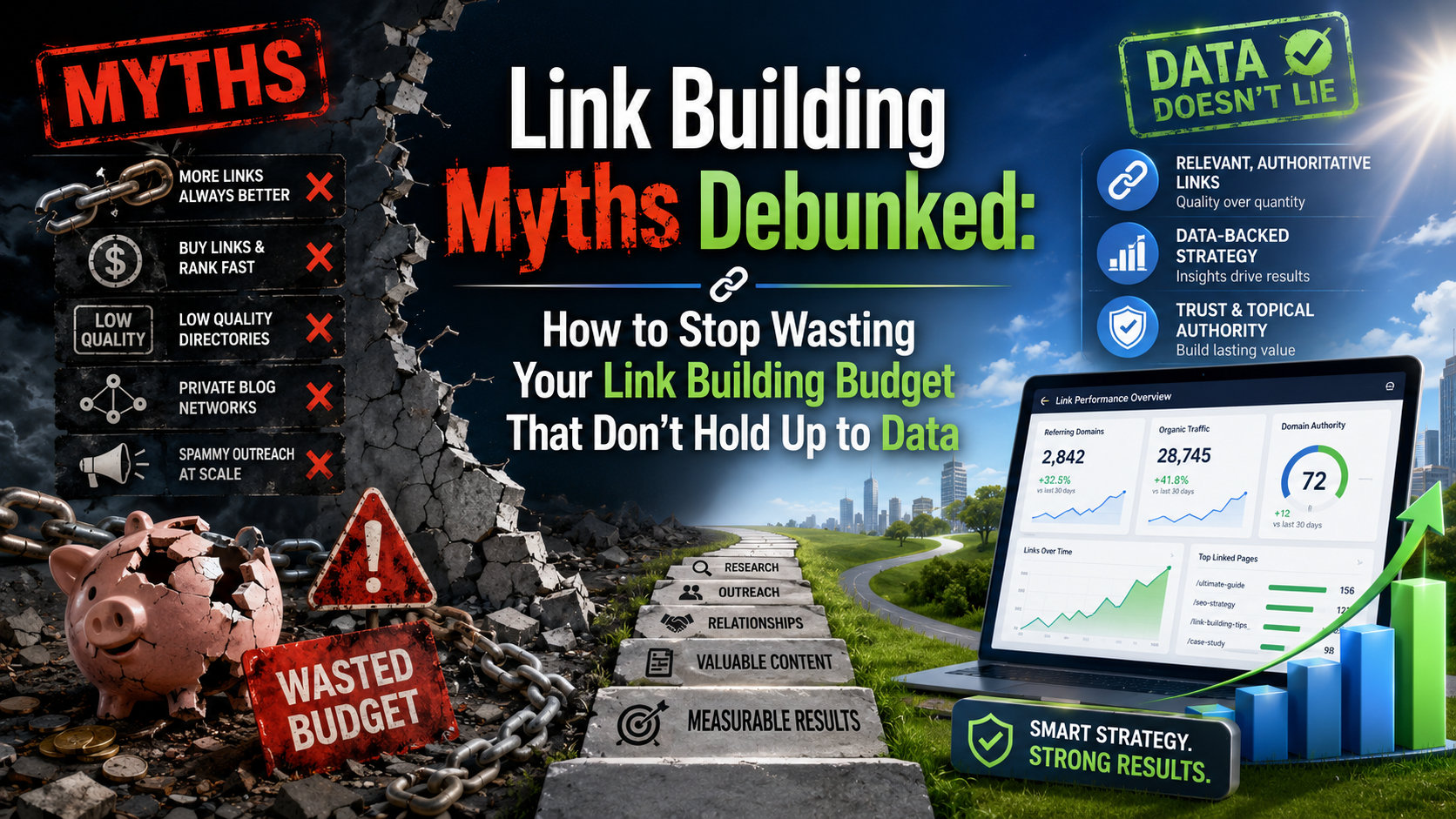
Let’s be blunt: most businesses are hemorrhaging money on link building right now. Not because they’re not trying-they are. But because they’re chasing myths instead of measurable outcomes.
Whether you’re the marketing director of a growing SaaS company or an in-house SEO managing a tight budget, the link building myths debunked in this article will likely reshape how you think about off-page SEO entirely. The internet is swimming in outdated advice that was recycled from 2012 playbooks, rephrased by AI, and published without a single data source to back it up.
This article cuts through that noise. We’re pulling from 2025 and 2026 studies by Ahrefs, BuzzStream, Editorial.Link, Authority Hacker, and PressWhizz-plus real-world examples-to give you a clear, honest picture of what works, what doesn’t, and what’s quietly draining your SEO budget with nothing to show for it.
TL;DR – Link building still works-but only when done correctly. Most commonly held beliefs about how links should be acquired, priced, and measured are wrong. Read this before you approve another link building campaign.
Why Link Building Myths Are So Persistent
The average SEO budget allocates about 28% to link building. For competitive industries, that figure climbs to over 36% of total SEO spend. We’re talking real money. Yet studies consistently show that only 30% of SEOs track advanced ROI metrics for their link acquisition efforts. That disconnect-large budgets, poor measurement-is exactly why myths survive.
When nobody’s accurately measuring outcomes, anecdotal “it worked for us once” logic fills the vacuum. And when one tactic shows a correlation with ranking improvement (even if it’s coincidental), that correlation gets promoted as gospel.
Here’s the bigger problem: Link building costs have risen 20–35% since 2022 due to AI content saturation and stricter editorial filtering. A campaign that cost your competitor $3,000 in 2022 may cost you $4,500 today-for the same results, or worse. Myths from that era are even more expensive now.
TL;DR – With link costs up 20–35% since 2022 and only 30% of SEOs tracking real ROI, outdated myths are now more financially damaging than ever.
The Biggest Link Building Myths Debunked-With the Data to Prove It
Below is a direct breakdown of the most damaging myths circulating in the SEO community today, alongside what the current research actually says.
| The Myth | The Reality (Data-Backed) |
| More backlinks = higher rankings | Link quality and relevance outrank sheer volume every time |
| High DR/DA guarantees a good link | DR can be gamed; traffic, relevance & indexation matter more |
| Guest posting is dead | Guest posting on high-relevance, editorial sites still drives strong SEO value |
| NoFollow links have zero value | NoFollow links drive referral traffic and create a natural link profile |
| Link building delivers instant results | Ranking lifts typically appear within 1–6 months post-acquisition |
| Any link is better than no link | Spammy or irrelevant links can trigger Google penalties |
| Great content earns links automatically | Even excellent content often needs active outreach to earn links |
| You only need links from your niche | Topical relevance matters, but authority links from related sectors also count |
Myth #1: More Backlinks Always Means Better Rankings
This is perhaps the most expensive myth in SEO history. The logic is intuitive-if backlinks are votes of confidence, more votes should mean more authority. But the data tells a different story.
According to a 2026 survey of 518 SEO professionals by Editorial.Link, 93.8% of link builders now say link quality is more important than sheer quantity. Meanwhile, Ahrefs data confirms that exact-match anchor text backlinks are no more effective at increasing rankings than non-exact match text-debunking another sub-myth about anchor optimization.
What actually correlates with higher rankings? A small number of editorially placed, topically relevant links from sites with genuine organic traffic. Sites with 30–35 quality backlinks average over 10,500 visits per month, according to PressWhizz 2026 data. Compare that to sites with 500+ low-quality links that struggle to crack the first three pages.
“About 66.5% of backlinks acquired in the last nine years are now dead. Quantity without strategy is money thrown into a void.” – BuzzStream Research
The takeaway? Stop counting links. Start evaluating them.
Myth #2: A High DR or DA Score Means a Quality Link
Domain Rating (DR) and Domain Authority (DA) have become the go-to shorthand for link quality. And they’re dangerously easy to game.
One SEO experiment documented by Editorial.Link showed that a site’s DR was inflated to 70 by purchasing a handful of cheap links from Fiverr-with zero real content or organic traffic on the site. A DR of 70 looks impressive on paper. In practice, that link is worth nothing and could actively harm your profile.
Here’s what you should actually evaluate when qualifying a link source:
• Organic traffic volume (verified via Ahrefs, Semrush, or SimilarWeb)
• Topical relevance to your niche or industry
• Indexation status in Google
• Anchor text diversity of existing outbound links
• Whether the site has real editorial standards and human authors
That said, DR and DA still function as useful filters. SEOs who combine metric scores with indexation and traffic data report 38% higher link ROI, according to PressWhizz. The key word is combine-not rely on metrics alone.
TL;DR – DR/DA are starting points, not endpoints. A DR 70 site with zero traffic is a liability. A DR 40 site with 25,000 monthly visitors in your niche is gold.
Myth #3: Guest Posting Is Dead
Every few years, someone publishes a think-piece declaring guest posting dead, usually citing some Google communication about link schemes. The reality is more nuanced-and more favorable.
Guest posting is not dead. Spammy, mass-produced guest posting is. There’s a significant difference.
According to Editorial.Link’s 2025 State of Link Building study, 48.6% of SEO professionals believe digital PR is the most effective tactic for 2025-but guest posting still ranks as the second-most-used strategy at 16%. It’s alive; it’s just evolved.
What’s changed is the bar. In 2025, 85.3% of guest posting sites are classified as low-quality, with weak authority and minimal traffic. The problem isn’t the tactic-it’s that the industry has flooded the market with garbage-tier placements sold as premium links.
A genuinely well-placed guest post on a relevant, high-traffic site with real editorial standards can still produce ranking lifts, referral traffic, and brand authority simultaneously. What kills budgets is buying bulk guest posts on sites that exist purely to sell links-and calling it a strategy.
Myth #4: NoFollow Links Are Worthless
The nofollow attribute was introduced to tell Google not to pass link equity-and SEOs universally took that to mean “ignore these entirely.” That interpretation has cost countless brands real opportunity.
NoFollow links still deliver measurable value. First, they generate referral traffic-traffic that doesn’t care about link attributes. Second, they signal to Google that your content is being cited and shared organically, which contributes to a natural, trustworthy link profile. A site with 100% dofollow links and zero nofollow links looks manipulated to a sophisticated algorithm.
Google itself has shifted its stance. The “hints” update to the nofollow attribute means Google may choose to treat some nofollow links as signals anyway, at its discretion. Brands appearing in major media publications-even with nofollow attributions-often see measurable domain authority growth over time.
The real-world implication? Don’t turn down a nofollow placement on a high-authority, high-traffic site because it“doesn’t pass juice.” That mindset is leaving traffic, brand awareness, and long-term SEO value on the table.
Myth #5: Link Building Shows Results Immediately
This myth has caused more premature campaign cancellations than any other. Business owners invest in link building, check their rankings two weeks later, see no movement, and conclude the strategy doesn’t work. Then they switch to the next shiny tactic.
The data is unambiguous: 89.2% of SEOs see a ranking lift within 1–6 months of link acquisition, according to PressWhizz 2026. That’s not weeks. That’s months. And that range depends heavily on your domain’s existing authority, the competitiveness of your target keywords, and the quality of the links you’re acquiring.
Google’s crawl and indexation cycle alone takes time. A link may be placed today, crawled in two weeks, re-evaluated in another four weeks, and show a measurable ranking signal six weeks after that-and that’s the optimistic timeline.
The brands that dominate organic search are the ones that committed to link building as a multi-month investment, not a one-time campaign. According to BuzzStream research, brands investing consistently in link building grow organic traffic 2x faster than those who don’t.
TL;DR – Expect 1–6 months before seeing results from link acquisition. Canceling early is one of the most common-and most expensive-link building mistakes.
Myth #6: “Any Link Is Better Than No Link”
This one has a seductive logic to it. If links are good, more links should be better, right? Wrong-and the data doesn’t equivocate here.
Google’s 2025 Spam Update specifically targeted manipulative link patterns, including link farms, private blog networks (PBNs), and mass link exchanges. Sites caught with these link profiles have seen dramatic, sometimes unrecoverable ranking drops.
Over 51.6% of link builders still use link exchanges as part of their strategy, according to industry data-a concerning figure given how closely Google’s manual review teams monitor these patterns. The cost of a Google penalty isn’t just a drop in rankings. It’s lost traffic, lost revenue, and the time and resources required for link disavow campaigns and manual reconsideration requests.
When you buy a $5 link from Fiverr, you’re not just getting a bad link. You’re potentially buying a penalty that costs you thousands in recovery costs. That’s the true price of “cheap” link building.
Myth #7: Great Content Will Naturally Earn Links
The “build it and they will come” approach to link building is one of the most romanticized-and most misunderstood-concepts in SEO. Yes, exceptional content can attract links organically. But the operative word is “can,” not “will.”
Consider this: According to industry research, 94% of online content receives zero external links. That’s not a content quality problem-that’s a distribution and visibility problem. If nobody sees your content, nobody links to it, regardless of how good it is.
There are documented success stories of content attracting links without outreach-data-driven research pieces, original studies, and unique tools can draw editorial links passively over time. But these are outliers that required significant initial content investment and often some promotional push to gain initial traction.
The most effective 2025 strategy combines content excellence with proactive outreach. Digital PR-placing your data, expertise, and brand story in front of journalists and editors-consistently ranks as the highest-ROI tactic across the industry. According to AllOutSEO, 78% of marketers say digital PR delivers higher ROI than any other off-page strategy.
Link Building Tactic Comparison: What the Data Shows
Not all link building methods are created equal. This comparison draws from real 2025–2026 industry data to show you what each tactic actually delivers-and at what cost.
| Link Building Tactic | Authority Quality | Avg. Cost/Link | ROI Potential | Results Timeline |
| Digital PR | Very High | $500–$2,000+/link | Very High | 3–6 months |
| Guest Posting (high-quality) | High | $200–$800/link | High | 2–5 months |
| Niche Edits / Link Insertions | Medium–High | $150–$500/link | Medium | 1–3 months |
| Broken Link Building | Medium | $100–$400/link | Medium–High | 2–4 months |
| HARO / Source Requests | High | Free–$300/link | High | 1–4 months |
| PBN / Link Farms | Very Low | $10–$100/link | Very Low / Penalty | Short-lived |
| Fiverr / Cheap Bulk Links | Very Low | $5–$50/link | Negative ROI risk | Short-lived |
TL;DR – Digital PR and high-quality guest posting deliver the best long-term ROI. PBNs and Fiverr-style bulk links are budget traps with penalty risk attached.
How to Allocate Your Link Building Budget Without Wasting It
Now that we’ve debunked the most persistent myths, let’s talk about what a smart budget actually looks like in 2025–2026.
The average cost per high-quality backlink now ranges from $500 to $2,000 for premium placements. Lower-quality links start around $150–$300, but as established above, cheap links carry disproportionate risk. Businesses spending under $1,000 per month in competitive niches are unlikely to move the needle in any meaningful way.
Here’s a practical budget allocation framework based on your business stage:
| Business Tier | Monthly Budget | Recommended Tactics | Expected Outcome |
| Starter / Local Business | $500–$1,500/mo | Niche edits, local citations, HARO | Brand visibility + local rankings |
| Growing SMB | $1,500–$4,000/mo | Guest posts, broken link building | Keyword ranking lift in 2–5 months |
| Competitive Mid-Market | $4,000–$8,000/mo | Digital PR + guest posts mix | Authority building + top-3 rankings |
| Enterprise / SaaS | $8,000–$20,000+/mo | Digital PR, journalist outreach | Dominance in competitive SERPs |
One important note: 56% of companies outsource their link building to agencies or freelancers. Outsourcing can be highly effective, but it also amplifies the risk of myth-driven decisions-unless your partner is transparent about their methods, their publisher network, and how they measure results.
Evaluating Link Building Services: What to Look For
If you’re considering a managed link building service-which, given the complexity and time investment, many organizations should-the key is finding a partner whose approach is grounded in transparency and data, not mythology.
When evaluating any link building service, ask these questions before signing anything:
• Can you show me the actual publisher sites where my links will be placed?
• How do you vet the sites in your network for traffic, indexation, and topical relevance?
• What metrics beyond DR/DA do you use to qualify a link?
• Do you use white-hat tactics only, and how do you document this?
• What does your reporting look like, and can I verify results independently?
• What’s your average timeline to see ranking impact?
Services that can’t answer these questions confidently are likely operating on myth-based strategies-or hiding something.
One platform worth evaluating in this space is
One platform worth evaluating in this space is OutreachZ, which operates a marketplace model paired with done-for-you managed campaign support. Unlike agencies that obscure their link sources, OutreachZ gives clients direct access to its publisher network, allowing you to see exactly where your links will live before committing budget. They report an average organic traffic increase of up to 217% for clients within five months, and their approach centers on white-hat, editorially placed links-the kind that actually hold up under algorithm updates.
That said, no single platform is right for every business. The most important thing is that whoever you work with can demonstrate a process grounded in the realities of link building today-not a playbook from five years ago.
AI Search, AI Overviews, and the Evolving Role of Links
One of the more nuanced debates of 2025 is whether link building still matters in an era of AI Overviews, Perplexity, ChatGPT, and Gemini pulling answers directly into search results.
The data suggests links still matter-significantly. According to a 2025 survey of 518 SEO professionals, 73.2% believe backlinks influence the probability of appearing in AI search results. Referring domains and backlinks are still correlated with AI Overview appearances, according to BuzzStream’s 2025 research, though branded web mentions are becoming an increasingly important signal alongside traditional link equity.
The 2026 landscape adds another layer: AI citation tools like Perplexity and ChatGPT pull from high-authority editorial sources. If your brand is cited across trusted publications-through digital PR and strategic link placement-you increase the likelihood of your content appearing in AI-generated answers.
The conclusion here is that link building isn’t just about Google anymore. It’s about building the brand authority that signals trustworthiness to every search and AI discovery system simultaneously. That’s a more compelling reason to invest in quality link acquisition than ever before.
TL;DR – 73.2% of SEOs believe backlinks influence AI search result appearances. Digital PR and brand-building through quality links now serve double duty-for Google rankings and AI citation visibility.
Red Flags That Your Link Building Strategy Is Myth-Driven
Here’s a quick diagnostic. If any of these describe your current approach, your budget is likely being wasted:
• You measure success by number of links acquired per month, not by traffic or ranking impact
• You’re buying links from the same network of sites repeatedly
• Your agency has never asked about your target keywords or buyer personas
• Your link building spend has no direct correlation to any content strategy
• You’ve never disavowed a link or audited your backlink profile
• Your average cost per link is under $100
• You can’t name the sites where your links live or verify their traffic
The good news is these issues are correctable. A clean backlink audit, a strategy reset focused on quality and relevance, and a partner who can demonstrate ROI transparency can turn a myth-driven campaign into a measurable growth engine.
What Actually Works in 2025–2026: A Data-Backed Summary
To bring it all together, here’s what the current research consistently supports:
✔ Digital PR is the highest-ROI tactic-cited by 48.6% of SEO professionals as the most effective strategy for 2025
✔ Relevance over raw authority-a DR 40 site in your niche outperforms a DR 70 generic blog every time
✔ Sustained investment beats campaigns-brands committing to 6+ months of consistent link building grow 2x faster in organic rankings
✔ Traffic verification is non-negotiable-always confirm that a prospective link source has real organic visitors
✔ Measure beyond DR/DA-use indexation, traffic, anchor diversity, and topical alignment as qualification criteria
✔ Blend tactics strategically-combine digital PR, high-quality guest posting, and niche edits for a diversified, resilient profile
✔ Track ROI properly-use Google Search Console, rank tracking tools, and referral traffic data to attribute link value accurately
Final Thoughts: Stop Budgeting for Myths
The link building myths debunked throughout this article aren’t just academic corrections. Every one of them has a real dollar cost attached. Businesses that operate on outdated assumptions spend more, earn less, and risk penalties that can undo years of SEO progress in a single algorithm update.
The encouraging reality is that link building-done right-still delivers some of the best ROI in digital marketing. Studies consistently show 78%+ of marketers report positive returns from quality link acquisition. The variable isn’t whether link building works. It’s whether you’re building links the right way.
Before approving your next link building campaign, ask the hard questions. Scrutinize your current backlink profile. Demand transparency from your agency or platform. And measure what actually matters-rankings, traffic, and revenue-not just a spreadsheet of link counts that tells you nothing about their real-world impact.
The brands winning organic search in 2026 aren’t the ones with the most links. They’re the ones who figured out the difference between links that matter and links that don’t-and stopped wasting budget on the latter.
Frequently Asked Questions
Is link building still relevant in 2025?
Yes. Despite the rise of AI search, 86% of marketers still employ link building as part of their SEO strategy and 78% report positive ROI. Backlinks remain one of Google’s core ranking signals and increasingly influence AI Overview appearances as well.
How much should I spend on link building?
Most competitive businesses benefit from a minimum of $1,500–$4,000 per month. High-competition niches like finance, legal, and SaaS often require $5,000–$20,000+ per month to move the needle meaningfully. Spending under $1,000 monthly in a competitive niche is unlikely to produce measurable results.
What is the biggest link building mistake companies make?
Prioritizing quantity over quality. Buying large volumes of cheap links from low-traffic sites not only fails to improve rankings-it can actively harm them through Google’s spam detection systems.
How long does link building take to show results?
Research shows that 89.2% of SEOs see a ranking improvement within 1–6 months of link acquisition. Consistent, sustained investment over 6–12 months typically delivers the strongest and most durable results.
What is the best link building tactic in 2025?
Digital PR is consistently ranked as the highest-ROI tactic for 2025, cited by 48.6% of SEO professionals. It combines brand building, authority acquisition, and AI citation visibility in a single strategy.