

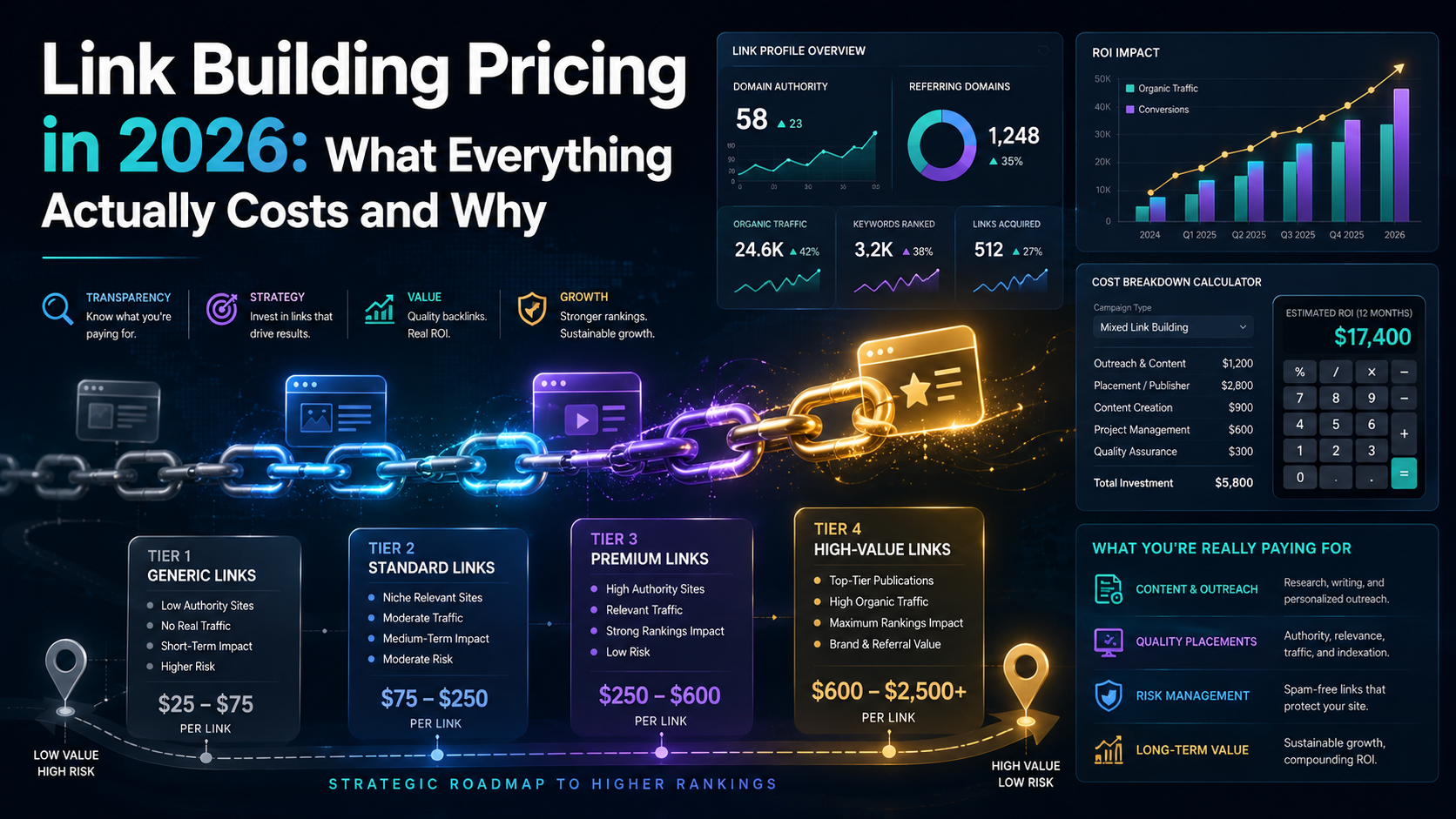
Here’s a scenario most SEOs and business owners know all too well: You open three browser tabs, request quotes from three different link building agencies, and walk away more confused than when you started. One company wants $500 a month. Another wants $5,000. A third doesn’t even list prices. And somewhere on Fiverr, someone is offering 100 backlinks for $19.
This is the reality of link building pricing in 2026 – a market so fragmented that identical-sounding services can differ in quality by a factor of 100. The confusion isn’t accidental. Plenty of providers have strong financial incentives to keep buyers in the dark.
This guide is different. Drawing on current market surveys, published agency rates, and real industry data, we’re laying out exactly what link building costs in 2026, what drives those costs up or down, and how to make sure every dollar you spend actually earns its keep in search.
Why Link Building Pricing Is All Over the Map
Before diving into specific numbers, it helps to understand a fundamental truth: link building is not a commodity. A $50 link and a $1,500 link can look identical in a spreadsheet – both are backlinks, both might carry similar Domain Rating (DR) numbers – but they produce wildly different outcomes. One could quietly improve your rankings for years. The other could trigger a Google penalty that takes 12 to 18 months to recover from.
Several forces drive this wide pricing range:
• Publisher awareness: Webmasters in 2026 know exactly how much their inventory is worth. They’ve been pitched by thousands of outreach emails and raised fees accordingly.
• Google’s algorithm maturity: SpamBrain and successive Helpful Content Updates have made it harder – and more expensive – to get links from sites with genuine editorial standards.
• AI search visibility: Links now pull double duty. They help you rank in traditional search AND influence whether AI tools like Perplexity and ChatGPT surface your brand. That added value is baked into premium pricing.
• Niche competitiveness: A guest post on a mid-tier finance blog costs two to three times more than the same placement on a lifestyle site – because demand is that much fiercer.
• Content requirements: Many publishers now require 2,000-word, expert-authored pieces. That content creation cost gets passed on to you.
TL;DR: Link building prices in 2026 range from $80 to $2,000+ per link. The variance reflects real differences in quality, editorial standards, niche competition, and AI visibility value – not just agency markup.
What You’re Actually Paying For When You Buy a Backlink
This is the question most agencies won’t answer directly. When you write a check for a $600 link, where does that money go? Breaking it down makes the pricing feel a lot less arbitrary.
• Publisher fee: The site owner’s cut for the placement. For a DR 60+ site with real organic traffic, this alone can run $200 to $800.
• Content creation: A well-researched, editor-approved guest post typically costs $150 to $500 to produce.
• Outreach labor: A skilled link building specialist might spend 5 to 10 hours prospecting, pitching, and following up for a single placement on a quality site.
• Vetting and QA: Reputable providers check organic traffic, spam scores, niche relevance, and historical link patterns before accepting a site into their network.
• Platform and tool costs: Ahrefs, SEMrush, Pitchbox, Hunter.io – the tool stack alone can run $500 to $1,000 per month for an agency.
Add it all up, and a $500 link from a legitimate agency isn’t padding margins. It’s covering real operational costs.
Link Building Pricing Breakdown by Link Type (2026)
Not every link is acquired the same way. The method matters – both for quality and for what it costs. Here’s where the market sits right now:
| Link Type | Typical Price Range | DR / Quality Ceiling | Best For |
| Guest Posts | $150 – $1,500+ | DR 20–80+ | Authority building, anchor text control |
| Niche Edits / Link Insertions | $100 – $500 | DR 30–90+ | Fast placements, budget-conscious campaigns |
| Digital PR / Editorial | $750 – $2,000+ | DR 60–95+ | Brand authority, AI search visibility |
| HARO / Expert Quotes | $0 (DIY) – $700 | DR 50–90+ | High-authority mentions, media credibility |
| Resource Page Links | $100 – $400 | DR 20–70 | Educational content, evergreen authority |
| Podcast Sponsorship Links | $300 – $800 | DR 40–70 | Niche audiences, brand awareness |
| Broken Link Building | $100 – $350 | DR 20–65 | White-hat, relationship-based outreach |
Guest Posts
Guest posting remains the backbone of most link building campaigns in 2026. According to data from BuzzStream covering more than 26,000 sites, the average guest post costs around $365, though high-quality placements on DR 60+ sites with real traffic often sit between $700 and $1,500 before any agency markup. The key variables are editorial difficulty – how selective is the site? – and content requirements. A publication that demands expert-authored, well-cited 2,500-word pieces will cost more to land than a blog that accepts most pitches with light review.
Niche Edits and Link Insertions
Niche edits – inserting a backlink into an existing, indexed page rather than publishing new content – tend to cost less because the content creation overhead is eliminated. Expect to pay $100 to $400 for a standard insertion, with pricing climbing toward $500 on high-authority domains. These are popular for quickly building a mixed link profile without the turnaround time of a full guest post campaign.
Digital PR and Editorial Placements
Digital PR is the most expensive method in 2026 – and increasingly the most valuable. A single editorial placement on a DR 80+ publication can cost $750 to $2,000, with full campaign fees ranging from $3,000 to $20,000 for 10 to 40 mentions. But the dual ROI justifies the spend: these links build traditional search authority and AI citation likelihood simultaneously. Research from 2026 shows that 73.2% of SEO professionals believe backlinks from authoritative editorial sources are a primary factor in whether a brand appears in AI search overviews – including Google’s AI Mode, Perplexity, and ChatGPT.
TL;DR: Guest posts ($150–$1,500+) are the most common tactic. Digital PR ($750–$2,000+) is the most powerful. Niche edits ($100–$500) offer the fastest and most affordable placements. The right mix depends on your goals, niche, and timeline.
Link Building Cost by Domain Rating (DR) Tier
Domain Rating is still the most-used proxy for pricing in 2026 – even as savvy buyers increasingly weight organic traffic alongside it. Here’s how per-link costs typically stack up across DR tiers:
| DR Tier | Avg. Cost Per Link | Quality Notes | Recommended Allocation |
| DR 10–29 | $80 – $150 | Low authority; limited SEO impact; high spam risk | Avoid unless part of a diversity strategy |
| DR 30–49 | $150 – $300 | Solid foundation tier; good ROI entry point | 10–20% of monthly budget |
| DR 50–69 | $300 – $600 | Sweet spot for most US businesses | 50–60% of monthly budget |
| DR 70–79 | $600 – $1,000 | Strong authority; editors more selective | 20–30% of monthly budget |
| DR 80+ | $1,000 – $2,000+ | Premium editorial; AI visibility booster | 10–15% of monthly budget (selective) |
Important caveat: DR is a proxy, not a quality certificate. A DR 75 site with 200 monthly organic visitors from bot-farm traffic is worth less than a DR 45 site with 40,000 genuine readers. Before accepting any placement, always verify organic traffic in Ahrefs or SEMrush alongside the DR score. The average price that SEO professionals in 2026 are willing to pay for a single high-quality backlink is $508.95 – a figure that reflects the DR 50–70 sweet spot for most campaigns.
Monthly Link Building Budget Benchmarks by Business Stage
Per-link pricing only tells part of the story. Most serious link building happens through ongoing campaigns, not one-off purchases. Here’s what realistic monthly investment looks like across different business stages:
| Business Stage | Monthly Budget | Links Per Month (est.) | What You Get |
| Startup / Early Stage | $1,500 – $3,000 | 5–10 links | DR 40–55 guest posts; basic outreach pipeline |
| Growth Stage | $3,500 – $7,500 | 10–20 links | DR 50–70 placements; strategic anchor text mix |
| Scale-Up / Mid-Market | $7,500 – $15,000 | 20–35 links | DR 60–80 mix; digital PR inclusions |
| Enterprise | $15,000 – $25,000+ | 35–60+ links | Full editorial strategy; DR 70–90+ placements |
| High-Competition Niches (Finance, Legal, SaaS) | $8,406+ (min) | Varies | Competitive niches require premium inventory |
According to a 2026 survey by uSERP, 46.5% of respondents spend $5,000 to $10,000 per month on link building alone. Another 18% spend more than $10,000 monthly. Businesses spending under $1,000 per month are largely chasing shortcuts that either produce no results or actively harm rankings.
TL;DR: Most growth-stage US businesses need $3,500–$10,500/month to build meaningful link velocity. The minimum viable monthly budget in high-competition niches sits around $8,400. Under $1,500/month won’t move the needle in most competitive markets.
Agency vs. Freelancer vs. In-House: Real Cost Comparison
The pricing structure you choose has as much impact as the per-link cost. Each model carries different tradeoffs that compound over time.
| Factor | Agency | Freelancer | In-House Team |
| Avg. Monthly Cost | $2,500 – $15,000 | $1,500 – $5,000 | $12,000 – $22,700+ |
| Per-Link Cost | $300 – $1,000+ | $150 – $400 | $250 – $600 (fully loaded) |
| Quality Consistency | High (SOP-driven) | Variable (vet carefully) | High (but slow to ramp) |
| Scalability | High – scales with spend | Limited by one person | Limited by headcount |
| Speed to Launch | 1–2 weeks | 1–7 days | 3–6 months |
| Risk | Low (accountability built in) | Medium (single point of failure) | Low (internal control) |
| Best For | Most businesses $3K–$15K/month | Tight budgets, specific tactics | Spend over $15K/month consistently |
The In-House Math Nobody Does
Building an in-house link building team sounds cheaper until you run the numbers. A realistic lean setup in the US requires:
• Link building manager: $65,000 – $90,000 per year
• Outreach assistant(s): $22,500 – $35,000 per year
• SEO content writer: $24,000 – $50,000 per year
• Tool subscriptions (Ahrefs, SEMrush, Pitchbox, etc.): $5,000 – $10,000 per year
That totals $116,500 to $185,000 per year for a lean setup – before management overhead, benefits, and PTO. Assuming this team produces 30 to 40 quality links per month, your loaded cost per link still runs $250 to $600. Agencies make the most sense for most businesses until you’re consistently spending $15,000 or more per month on link acquisition.
The Four Link Building Pricing Models Explained
How you pay for link building matters as much as how much you pay. In 2026, four models dominate the market – each with distinct advantages and risk profiles.
| Pricing Model | How It Works | Best For | Watch Out For |
| Pay-Per-Link | Pay per approved, delivered backlink | Budget control, new campaigns, testing | Higher per-link cost vs. retainers |
| Monthly Retainer | Fixed monthly fee for a set number of links | Predictable pipeline, consistent authority-building | Lock-in contracts, minimum spend requirements |
| Project-Based | One-time fee for a defined campaign | Product launches, content asset promotion, digital PR | No ongoing momentum; results may plateau |
| Package / Tiered | Pre-set bundles (e.g., 5 links for $1,750) | Startups with clear volume targets | Less flexibility in targeting or quality standards |
Retainers almost always deliver better per-link economics at scale. A pay-per-link model might cost you $600 per placement, while a retainer with the same provider for 10 links per month might bring that to $450 per link – because the provider can plan their outreach pipeline more efficiently. If you’re serious about link building, a 3-month minimum commitment is the standard recommendation. Most link building takes 3 to 6 months to show measurable ranking impact, and shorter tests don’t provide enough data to make meaningful decisions.
Link Building Costs by Industry: Why Your Niche Changes Everything
Your business sector doesn’t just influence which sites will link to you – it directly determines how much you’ll pay. Demand and editorial availability vary dramatically across verticals.
| Industry | Cost vs. Average | Why Prices Are Higher/Lower | Typical Per-Link Range |
| Finance / Insurance | +60–100% above avg. | High competition; strict editorial standards; YMYL scrutiny | $600 – $2,000+ |
| Legal / Law | +50–80% above avg. | Limited publisher pool; compliance concerns | $500 – $1,500 |
| Healthcare / Medical | +40–70% above avg. | YMYL sensitivity; expert authorship required | $450 – $1,200 |
| SaaS / Technology | +20–40% above avg. | High demand; competitive keyword landscape | $400 – $1,000 |
| E-commerce / Retail | Average market rate | Large publisher pool; broad topical relevance | $250 – $700 |
| Lifestyle / Travel | Average to -10% | Content-friendly niche; many accepting publishers | $200 – $600 |
| Education / Non-Profit | -10–20% below avg. | Community-driven; .edu opportunities; editorial openness | $150 – $400 |
| Gaming | -10–15% below avg. | Large content creator ecosystem | $150 – $450 |
Gambling and cryptocurrency consistently require the largest link building budgets of any sector – with 61% of SEO professionals citing these niches as the most expensive per link. In these verticals, a single mid-tier editorial link can exceed $1,500, and monthly competitive budgets routinely top $20,000.
TL;DR: Your industry can swing per-link costs by 100% or more compared to the market average. Finance, legal, and healthcare businesses should budget at the high end. Lifestyle, education, and gaming brands get more purchasing power per dollar.
Red Flags: When Link Building Pricing Is Too Good to Be True
The link building market has more bad actors than almost any corner of the marketing industry. Here’s how to spot pricing that signals a problem before it becomes your problem:
• Under $100 per link in 2026: This is a hard floor below which quality is nearly impossible to guarantee. Sub-$100 links almost universally come from Private Blog Networks (PBNs), link farms, or sites with no real organic traffic. A Google manual penalty triggered by a cheap link campaign can cost you 12 to 18 months of recovery time – far more expensive than the links ever saved.
• No transparency on placement sites: A legitimate provider should give you site metrics – DR, traffic, niche, sample URLs – before you buy. If they can’t or won’t show you where your links will land, walk away.
• Guaranteed results in 30 days: Link building results take 3 to 6 months to materialize in rankings. Anyone promising fast results is either selling you on paid link schemes or setting expectations they can’t meet.
• ‘Unlimited’ link packages: Real outreach at scale costs real money. Unlimited packages at fixed low prices are a mathematical impossibility if actual editorial standards are involved.
• No replacement guarantee: Links drop. Reputable providers offer a replacement guarantee if a placed link disappears within a set window (typically 6 to 12 months). The absence of any guarantee is a red flag.
How to Evaluate Link Building Providers Without Getting Burned
Whether you’re comparing agencies or considering a marketplace, asking the right questions separates quality vendors from ones that will waste your budget:
• Can you show me sample placements from recent campaigns – including the publisher URL, DR, and organic traffic?
• How do you vet sites before accepting them into your network? What’s your rejection rate?
• What’s your replacement policy if a placed link drops?
• Do you offer per-link pricing or only retainers, and why?
• How do you approach niche relevance? Will you match placements to my specific vertical?
• What’s your average turnaround time per link from order to live placement?
Any provider who gets defensive about process transparency or refuses to share examples is not a vendor worth trusting. The best agencies welcome this scrutiny because their results speak for themselves.
Choosing the Right Link Building Partner in 2026
With so many providers in the market, finding one that combines editorial rigor, transparent pricing, and genuine publisher relationships is the real challenge. For businesses that want a seamless bridge between their brand and high-authority publishers – without the staggering overhead of an in-house team – platforms like outreachz.com have emerged as a practical middle ground. Outreachz operates with a transparent pricing structure, vetted publisher network, and built-in quality controls that address the most common frustrations buyers have with the link building market: unclear site quality, surprise fees, and zero accountability after delivery.
What makes the difference in a link building partner isn’t just the per-link price. It’s whether they can demonstrate:
• A documented vetting process that screens for real organic traffic – not just DR
• A publisher network with genuine editorial standards, not just pay-to-play blogs
• Clear reporting that shows exactly where your links landed, with metrics to back it up
• A replacement or refund policy when placements don’t hold
• Flexibility to match your budget model – whether per-link, retainer, or package
How to Calculate Link Building ROI: A Practical Framework
The question isn’t just ‘how much does a link cost?’ – it’s ‘how much should I be willing to pay for this link to generate positive ROI?’ Here’s a straightforward calculation framework:
• Step 1: Find the top-ranking competitor in your target vertical using Ahrefs or SEMrush.
• Step 2: Pull their Traffic Value (the estimated monthly cost to buy equivalent traffic via paid search).
• Step 3: Divide that Traffic Value by their number of linking root domains to get average monthly value per link.
• Step 4: Multiply that number by 24 to get Lifetime Link Value – a reasonable two-year window for a link to pass authority.
• Step 5: Your target cost per link should be no more than 10% of that Lifetime Link Value to account for uncertainty and attribution gaps.
Example: If the top-ranking site in your niche has a monthly Traffic Value of $500,000 and 2,500 linking domains, the average link value is $200 per month. Lifetime Link Value (24 months) = $4,800. Your target cost per link for a 10:1 ratio = $480 maximum. That benchmark neatly aligns with the $508.95 average that SEO professionals say they’re willing to pay for a quality backlink in 2026 – validating the framework against real-world market behavior.
According to current research, link building delivers an average ROI of 702% for B2B companies – the highest of any marketing channel tracked in 2026. But that figure is an average across well-executed campaigns. Poorly targeted link building against the wrong keywords or in oversaturated niches delivers far less. Strategy matters as much as spend.
TL;DR: Use the Lifetime Link Value formula to set a rational cost-per-link ceiling before buying. Aim for a 10:1 lifetime value to link cost ratio. At average market rates, most quality campaigns are economically justified within 12 to 18 months.
What’s Driving Link Building Prices Higher in 2026 and Beyond
If you’re comparing today’s link building costs against what you paid in 2022 or even 2024, the increase is real and not going away. Several structural forces are pushing prices upward:
• Publisher fee inflation: Webmasters have become commercially sophisticated. They understand outreach intent and price their placements accordingly. High-quality editorial inventory is a limited resource facing rising demand.
• AI search as a new demand driver: Links now influence AI citation patterns, not just Google rankings. That expanded use case makes quality placements more valuable – and more expensive.
• Google’s quality crackdowns: Successive algorithm updates have devalued lower-quality sites. The universe of genuinely useful publisher domains has effectively shrunk, concentrating demand on fewer high-quality outlets.
• Content standard escalation: The minimum acceptable quality for a guest post placement keeps rising. What passed editorial review in 2022 doesn’t pass today. More effort means higher cost.
The bottom line: 75% of SEO professionals surveyed in 2026 expect link building costs to rise further over the next two years. Starting now locks in current relationships and market rates before another pricing step change. Businesses that invest consistently in quality editorial links are building compounding authority that becomes progressively harder and more expensive for competitors to replicate.
Link Building Pricing Summary for 2026
| Category | Price Range | Key Consideration |
| Per link (market average) | $300 – $600 | Sweet spot for DR 50–70 editorial placements |
| Guest posts | $150 – $1,500+ | Editorial difficulty and content requirements drive cost |
| Niche edits | $100 – $500 | Faster, cheaper; less editorial prestige |
| Digital PR links | $750 – $2,000+ | Highest quality; builds AI search visibility |
| HARO / expert sourcing | $0 – $700 | Best earned-media value; unpredictable volume |
| Monthly retainer (most businesses) | $3,500 – $10,500 | Growth-stage sweet spot for consistent velocity |
| Enterprise monthly spend | $15,000 – $25,000+ | Required for high-competition national rankings |
| In-house team annual cost | $116,500 – $185,000+ | Only cost-effective at $15K+/month link spend |
| Freelancer per-link | $150 – $400 | Viable with careful vetting; scalability risk |
| Agency per-link | $300 – $1,000+ | Best accountability; highest consistency |
The Bottom Line on Link Building Pricing in 2026
Understanding link building pricing in 2026 requires accepting one uncomfortable truth: the days of cheap links that work are over. The market has matured, the algorithms have gotten sharper, and the publishers with genuinely valuable inventory know exactly what they’re sitting on.
What hasn’t changed is the fundamental value proposition. A single strong editorial link from a high-authority publisher can drive ranking improvements that pay dividends for years. The businesses winning in organic search in 2026 are treating link building as an investment with compounding returns – not a one-time expense or a line item to minimize.
Whether your budget is $2,000 a month or $20,000, the approach is the same: prioritize real editorial placements on sites with genuine organic traffic, vet every provider with the same skepticism you’d apply to any major business investment, and give your campaign at least 90 days before evaluating results. Done right – with the right partner, a clear ROI framework, and a consistent publishing cadence – link building remains the highest-leverage SEO investment available in 2026.