

Introduction
For years, backlinks were the undisputed kings of SEO. Build enough of them, and rankings followed. But 2026 is telling a different story, one where niche sites with modest link profiles are outranking legacy domains that have spent years accumulating links. The topical authority vs backlinks debate has moved far beyond theory. It’s now a practical question that every site owner and SEO strategist has to answer before allocating a single dollar of their budget.
This article breaks down what’s actually driving rankings right now, what Google’s 2026 algorithm updates have confirmed, and how smart SEOs are combining both signals for rankings that hold up long-term.
TL;DR
- Topical authority is now Google’s primary trust signal for relevance and sustained rankings.
- Backlinks remain a top-3 Google ranking factor, but quality and niche relevance matter far more than volume.
- Sites with strong topical coverage (25–30+ interconnected articles) rank up to 3x faster than those chasing links alone.
- Google’s March and April 2026 core updates re-weighted topical coherence, information originality, and E-E-A-T signals directly.
- The winning strategy in 2026 is content-first, link-second: build your topical cluster, then amplify with contextually relevant backlinks.
- For AI Overviews and GEO (Generative Engine Optimization), topical depth is non-negotiable, AI systems cite comprehensive sources, not just linked pages.
What Is Topical Authority?
Topical authority is how deeply and comprehensively your website covers a specific subject area. It’s not about one well-written article on a topic, it’s about Google recognizing your domain as a trusted knowledge system for an entire niche.
Think of it this way: if two websites both publish a post on “link building strategies,” but only one of them also covers anchor text distribution, backlink audits, outreach techniques, link velocity, and toxic link removal, Google’s algorithm will consistently favor the second site. It signals expertise. It signals depth. And in 2026, that signal carries enormous weight.
Topical authority is built through:
- Pillar pages that cover a broad topic comprehensively
- Cluster content that dives deep into every subtopic
- Strategic internal linking that guides both users and crawlers through your knowledge base
- Consistent publishing within a defined niche over time
According to a 2026 analysis by ClickRank.ai, a site with lower domain authority but strong topical coverage will consistently outrank high-authority competitors that only cover a topic superficially. That’s the power of topical depth, and it’s exactly what Google’s E-E-A-T (Experience, Expertise, Authoritativeness, Trustworthiness) framework is designed to reward.
What Are Backlinks, and Why They Still Matter
Backlinks are hyperlinks from external websites pointing to your content. Google’s original PageRank algorithm was built on them, and despite more than two decades of algorithm evolution, they remain a confirmed top-3 ranking signal.
Here’s the critical stat: pages ranking #1 on Google have 3.8x more backlinks than pages ranking in positions 2–10, a finding from Backlinko’s large-scale ranking factors study. That’s not a number you can ignore. For any commercially competitive keyword in 2026, a solid backlink profile from multiple referring domains is still required to compete at the top of the SERP.
But the nature of what a “good backlink” looks like has fundamentally changed.
In 2016: 1,000 links from random directories could move the needle. In 2026: 1 contextual link from a high-authority, niche-relevant site outperforms 10,000 low-quality links.
Nearly 94% of link builders now emphasize that link quality outweighs link quantity, and 58.1% of businesses still consider link building a key factor in improving SERP rankings, according to DemandSage’s 2026 link building statistics report. Backlinks aren’t dead, but they’ve evolved from a volume game into a trust and relevance game.
For a deeper dive into what makes a backlink actually worth having, this guide on trustworthy backlinks is worth reading before you build a single link.
Topical Authority vs Backlinks: The 2026 Head-to-Head
Here’s an honest side-by-side breakdown of how these two signals compare across the metrics that matter most in 2026:
| Factor | Topical Authority | Backlinks |
| Primary function | Establishes relevance & expertise | Transfers trust & domain authority |
| Speed of impact | Slower (6–12 months to compound) | Can accelerate rankings faster initially |
| Durability | Highly durable, compounds over time | Vulnerable to link decay and algorithm devaluation |
| AI Overview eligibility | High, AI cites comprehensive sources | Moderate, links alone don’t guarantee AI citation |
| Cost to build | Content investment (time + resources) | Outreach, digital PR, or paid placements |
| Risk factor | Low, no penalty risk | Higher, spammy links can trigger penalties |
| New site advantage | Strong, builds authority without links | Weak, hard to earn links without existing authority |
| Competitive niches | Essential foundation | Still required to compete at page one |
| E-E-A-T alignment | Direct alignment | Indirect, context-dependent |
| GEO / AI search visibility | Critical factor | Supporting factor |
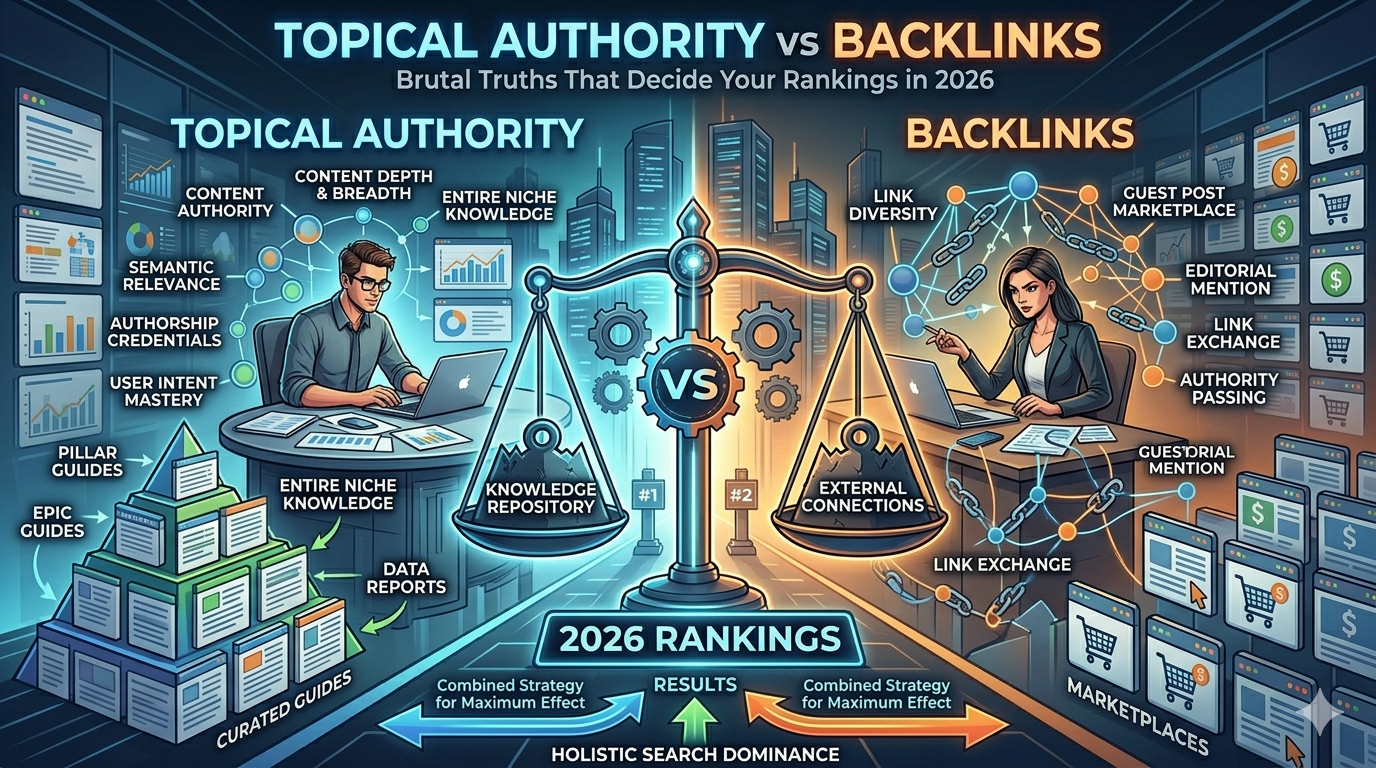
The takeaway is clear: topical authority vs backlinks isn’t a binary either/or choice. But topical authority is now the foundation, and backlinks are the amplifier.
How Google’s 2026 Algorithm Updates Changed Everything
Google’s March 2026 Core Update was a watershed moment for the topical authority vs backlinks conversation. The update re-weighted what the SEO community calls Information Gain, a ranking signal that measures how much genuinely new knowledge a piece of content adds relative to what already ranks for the same query.
According to analysis from Evertune.ai, the March 2026 update specifically targeted three overlapping signals:
- Information originality, not just whether content avoids duplication, but whether it contains insight that exists nowhere else
- Author expertise, verifiable track records confirmed across platforms through E-E-A-T signals
- Topical coherence, whether a domain has earned consistent authority within a defined subject area over time, rather than opportunistically publishing across many topics
The April 2026 update followed with stronger weighting on search intent alignment and niche expertise signals. Pages coasting on keyword density and bulk-produced content dropped fast. Sites with genuine topic depth held, and gained.
According to Quantifi Media’s January 2026 update analysis, strong internal linking, content clusters, and consistent publishing within a niche improve overall SEO performance and long-term rankings more reliably than link acquisition alone.
This explains why the topical authority vs backlinks debate now has a much clearer answer than it did even two years ago.
Where Topical Authority Wins, Clearly
1. New sites and niche domains A new site cannot earn strong backlinks in its first few months. But it can build a comprehensive content cluster. Strong topical coverage signals credibility to Google far faster than random link building for fresh domains.
2. AI Overviews and Generative Search AI-generated search responses pull from comprehensive, deeply structured sources, not just from heavily linked pages. If you want your content cited in Google’s AI Overviews or featured in tools like ChatGPT and Perplexity, topical depth is non-negotiable.
3. Long-tail and informational queries For informational searches, Google prioritizes the best answer over the most-linked page. A well-structured cluster of content that covers a topic from beginner to advanced consistently wins long-tail rankings without requiring aggressive link building.
4. Sustainable, compounding growth Sites that sustain cluster publishing for 12+ months see 40% higher organic traffic than comparable single-page strategies. Topical authority compounds. Backlinks decay.
Where Backlinks Still Win, Let’s Be Honest
1. Competitive commercial keywords For high-volume, transactional queries (“best CRM software,” “SEO agency,” “project management tools”), backlinks are still required. Data shows pages in the top 3 positions typically have 2–5x more unique referring domains than those at the bottom of page one.
2. Trust signals in YMYL niches In health, finance, and legal content, where Google’s scrutiny is highest, backlinks from authoritative domains validate your E-E-A-T in ways content alone cannot.
3. Accelerating new content discovery Links from high-authority sites help new content get indexed and ranked faster. For competitive topics, waiting for topical authority to compound without any link support is a slow strategy.
4. Brand entity building Backlinks from reputable publishers reinforce your brand’s entity across the web, something AI systems like Google’s Knowledge Graph use to assess credibility. A strong editorial link drives referral traffic, secondary mentions, and compounding brand recognition.
Knowing which backlinks actually move rankings requires more than raw DR. This breakdown of which backlinks actually help you rank cuts through the noise on what link attributes Google is actually valuing in 2026.
The Winning Strategy: Combine Both, In the Right Order
The topical authority vs backlinks question isn’t really about which one to choose. It’s about sequencing.
Here’s what SEO practitioners in 2026 have validated consistently:
Step 1: Build your topical cluster first. Map every subtopic in your niche. Create a pillar page and 8–15 supporting cluster articles that cover beginner through advanced angles. Internally link everything to signal topic relationships to Google.
Step 2: Publish consistently within the niche. Google rewards steady, focused publishing over burst-and-pause patterns. Signal to the algorithm that your site is a committed resource on the subject.
Step 3: Then acquire highly relevant backlinks. Links to a page before you’ve built any topical depth around it tend to underperform. A thin, isolated page with links doesn’t move the needle the way it used to. Build the cluster first, then use links as the amplifier.
Step 4: Focus on link quality, not volume. A handful of strong, niche-relevant backlinks from trusted referring domains will outperform a mass of generic links every time. If you’re evaluating where to get them, reviewing the best backlink services of 2026 is a smart starting point for building a shortlist of vetted providers.
How to Build Topical Authority in 2026: An Actionable Framework
| Step | Action |
| 1. Choose your niche focus | Pick one subject area, not ten |
| 2. Run a topic gap audit | Identify subtopics your site hasn’t covered yet |
| 3. Create a pillar page | Broad, comprehensive coverage of the core topic |
| 4. Build cluster content | 8–15 articles on specific subtopics, all linking back to the pillar |
| 5. Add internal links | Connect every related post to strengthen the cluster signal |
| 6. Demonstrate E-E-A-T | Author bios, credentials, original data, first-hand examples |
| 7. Publish consistently | Regular cadence within the niche, not sporadic bursts |
| 8. Measure cluster performance | Track organic traffic, rankings, and crawl depth across the cluster |
How to Build Quality Backlinks That Work in 2026
| Tactic | Why It Works in 2026 |
| Digital PR | Earns editorial links from niche-relevant publications, now used by 67.3% of marketers |
| Original research & data | Creates naturally link-worthy assets other sites want to cite |
| Expert-led guest posts | Demonstrates author authority while earning contextual links |
| Broken link building | High relevance, editorial integrity, survives algorithm scrutiny |
| Podcast guesting | Builds brand entity and earns legitimate mentions and links |
| Link reclamation | Finds and fixes lost or unlinked mentions, immediate ROI |
Avoid link farms, PBNs, and mass-directory submissions. These tactics don’t just underperform in 2026, they actively risk penalty flags as Google’s spam detection has grown more precise with each core update.
Frequently Asked Questions
Is topical authority more important than backlinks in 2026?
For most sites, especially newer ones, yes. Topical authority determines relevance and trust. Backlinks amplify it. Without topical depth, even strong backlinks deliver diminishing returns.
Can a site rank without backlinks using topical authority alone?
For low-competition, long-tail queries: yes. For commercial, high-volume keywords: unlikely without at least some referring domain support. The threshold varies by niche and competition level.
How many articles do I need for topical authority?
There’s no magic number. Research in 2026 shows that sites with 25–30+ interconnected articles on a focused subject rank up to 3x faster than those pursuing isolated link acquisition. Start with a strong pillar and 8–10 cluster articles and scale from there.
Do backlinks help AI Overviews?
Indirectly. AI systems favor sources that are comprehensive, credible, and consistently cited. Strong topical authority combined with quality backlinks, which reinforce brand credibility, improves your chances of AI citation significantly.
How long does it take topical authority to work?
Topical clusters typically compound over 6–12 months. Initial ranking movement can appear within weeks for low-competition queries, but the full authority signal builds as Google indexes more cluster pages and recognizes the internal link structure.
The Final Verdict
In the topical authority vs backlinks debate, 2026 data has handed a clear answer: topical authority is the foundation; backlinks are the fuel.
A site with deep topic clusters and minimal backlinks consistently outperforms a site with heavy link profiles and shallow content. But strip away the backlinks from a topically authoritative site in a competitive niche, and you’ll find rankings have a ceiling.
The SEOs winning in 2026 aren’t choosing between the two, they’re building content systems first, then strategically acquiring quality links to amplify what they’ve built. That sequencing is the difference between rankings that hold and rankings that evaporate after the next core update.
Build for depth. Earn for trust. Then link to amplify.