

Introduction
If you’ve spent any time in the SEO trenches, you know that building backlinks is one of the most debated, and consequential, decisions in your marketing playbook. Two strategies dominate the conversation right now: guest posting and digital PR. Both can earn you links. Both require outreach. But they work in completely different ways, carry different risks, and deliver very different results depending on your goals.
The debate around Guest Posting vs Digital PR isn’t new, but the stakes have never been higher. Google’s SpamBrain is smarter, AI-driven search is reshaping how authority is measured, and algorithm updates have dramatically shifted what “quality” looks like in a backlink profile. Choosing the wrong strategy, or leaning too hard on one, can either stall your growth or, worse, trigger a penalty that wipes months of progress overnight.
This article breaks down both strategies side by side using current data, real-world benchmarks, and a clear framework to help you decide where your budget belongs.
TL;DR
- Digital PR wins on link authority (avg. DR 61+), penalty safety, and AI search visibility.
- Guest posting wins on anchor text control, niche targeting, speed, and cost per placement.
- A 2026 survey of 500 SEO professionals shows 34% rank digital PR as the #1 link building method vs. 18% for guest posting.
- Brand mentions from digital PR correlate 3x more strongly with AI search visibility than backlinks alone.
- The smartest 2026 strategy combines both, digital PR for authority, guest posting for precision.
What Is Guest Posting?
Guest posting is the practice of writing and publishing content on another website in exchange for a backlink to your own site. You pitch an idea, write the article, and place one or more links back to a target URL, often with a chosen anchor text. It’s been a core off-page SEO tactic for over a decade.
At its best, guest posting means contributing genuine expertise to relevant industry publications, earning contextual links from sites your target audience actually reads. At its worst, it’s a scaled link scheme, mass-produced articles placed on low-quality blogs that exist purely to sell links.
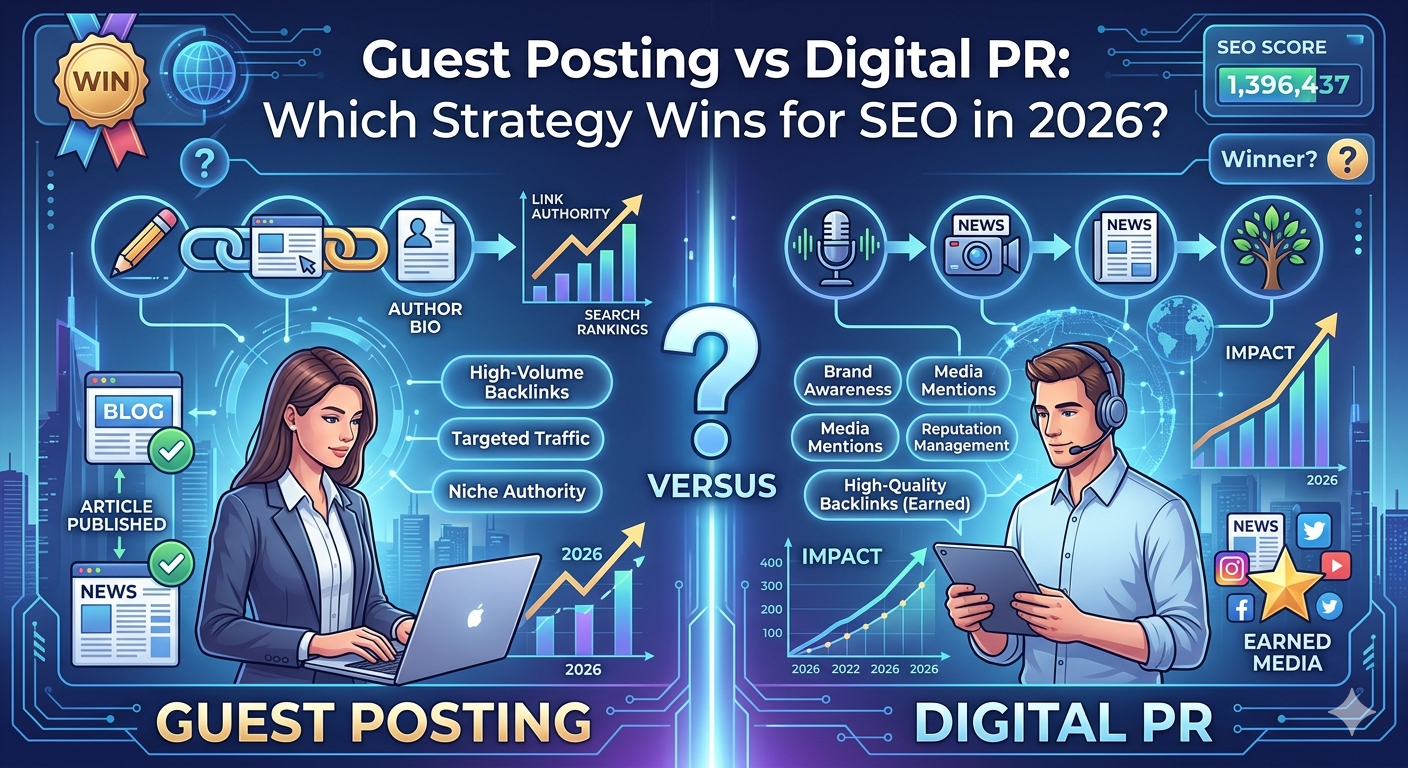
How guest posting works:
- Identify target blogs or publications in your niche
- Pitch a topic or angle relevant to their audience
- Write and submit original content (typically 1,500–2,500 words)
- Include a contextual dofollow backlink to your target page
- The host publishes the piece (sometimes with editorial revisions)
Cost typically runs $150–$500 per post, though premium placements on high-DR sites can exceed $500. Only 8.2% of available guest post sites meet the dual threshold of DR 65+ and 20K+ monthly organic traffic, a sobering reminder that quality in this market is the exception, not the rule.
What Is Digital PR?
Digital PR is a strategy that earns editorial backlinks by positioning your brand as a credible source for journalists, editors, and publishers. Instead of placing content you wrote, a journalist writes about your brand, cites your data, or includes your expert quote, and links back to your site organically.
How digital PR works:
- Create a newsworthy asset, a data study, original research, survey, or expert commentary
- Pitch it to relevant journalists and publications via platforms like Qwoted, Featured, or direct email
- When a journalist covers the story or quotes your brand, they link back to your site
- Relationships compound over time, making future placements easier
Digital PR links average a Domain Rating of 61, with over 20% coming from DR 70–79 sites and nearly 8% from DR 90+ publications. A single digital PR campaign can generate links from dozens of unique referring domains, outcomes most guest posting campaigns simply can’t match at that quality level.
Cost runs $300–$750 per link, which is higher per placement, but when measured by authority per dollar and penalty risk, the math often favors digital PR significantly.
Guest Posting vs Digital PR: Side-by-Side Comparison
| Factor | Guest Posting | Digital PR |
| Average Link DR | 30–50 | 61+ (often 70–90+) |
| Anchor Text Control | Full control | Minimal, journalist decides |
| Cost Per Link | $150–$500 | $300–$750 |
| Speed to First Link | 1–4 weeks | 4–12 weeks (campaign-dependent) |
| Penalty Risk | Moderate to High (at scale) | Very Low |
| Brand Mention Included | Rarely | Always |
| AI Search Visibility Impact | Low to Moderate | High (3x stronger per Ahrefs) |
| Topical Relevance Control | High | Medium |
| Domain Diversity Per Campaign | Low | High (dozens of domains possible) |
| Effort to Scale | Moderate | High |
| Adoption Among SEOs (2026) | 44% | 46% |
| Ranked #1 Best Performer | 18% | 34% |
| Google Alignment | Gray area at scale | Fully white-hat |
Where Guest Posting Wins
Guest posting isn’t dead, but it’s been dramatically redefined. When done strategically on high-quality, topically relevant publications with genuine editorial oversight, it still delivers real SEO value. Here’s where it has a clear edge:
1. Anchor Text Precision
You write the article, so you control the anchor text. This is critical for page-level optimization, particularly when you’re building toward a specific keyword ranking and need exact-match or partial-match anchors pointing to a specific URL.
2. Niche Specificity
Want a link from a very specific industry blog that a journalist would never cover? Guest posting lets you target micro-niche publications that digital PR campaigns can’t easily reach.
3. Speed and Predictability
Digital PR campaigns are unpredictable by nature, you pitch and wait. Guest posting delivers a clearer timeline. Pay for a placement, get a link. For businesses operating on quarterly reporting cycles or needing quick wins, that predictability matters.
4. Budget-Friendliness
For startups, small businesses, or teams with constrained budgets, guest posting offers lower per-placement costs while still generating dofollow links. When paired with smart vetting, it can deliver solid ROI.
Pro Tip: Before investing in any service, evaluate domain authority, organic traffic, and editorial standards carefully. For a curated breakdown of vetted providers, there are detailed guides available that highlight the best guest posting services, worth bookmarking before you commit budget.
Where Digital PR Wins
1. Higher-Authority Links
The average guest post lands on a DR 30–50 site. The average digital PR placement comes from a DR 61+ publication. Major editorial outlets, think national media, trade publications, industry news, simply don’t accept guest posts. They only write about things worth writing about. Digital PR puts your brand in that conversation.
2. AI Search Visibility
This is the big one for 2026 and beyond. Brand mentions, not just links, correlate 3x more strongly with AI search visibility than backlinks alone. Every digital PR placement includes a contextual brand mention. Every guest post typically doesn’t. As AI Overviews, ChatGPT Search, and Perplexity reshape how people discover information, being mentioned as a credible source has compounding value that pure link building can’t replicate.
3. Near-Zero Penalty Risk
Google has been explicit: large-scale guest posting campaigns that manipulate anchor text and rely on sites built to sell links are a link scheme. SpamBrain is increasingly effective at detecting them. Digital PR links are earned editorially, they’re exactly what Google wants to reward. The risk profile is fundamentally different.
4. Domain Diversity and Compound Authority
A single digital PR campaign can generate links from 20, 30, or more unique referring domains. Domain diversity is a critical signal in Google’s link quality assessment. One well-executed data study can build more authority than months of guest posting.
5. Real Audience Reach
When the New York Times, Forbes, or a top trade publication covers your data, real humans read it, and that drives referral traffic, newsletter signups, social shares, and future inbound links. Guest posts on low-traffic blogs rarely move these metrics.
The Risk Landscape: What Google Actually Penalizes
The Guest Posting vs Digital PR debate can’t be had honestly without addressing risk. Google has made its position increasingly clear:
| Risk Type | Guest Posting | Digital PR |
| SpamBrain Detection | High (at scale) | None |
| Manual Penalty Risk | Moderate | Near Zero |
| Link Devaluation | Common (low-quality sites) | Rare |
| Site Reputation Abuse | Possible | Not Applicable |
| Algorithm Volatility | High | Low |
In 2024, Google clarified its site reputation abuse policy, warning that publishing third-party content to exploit a host site’s authority can trigger enforcement. The August 2025 spam update continued this enforcement trend at scale. Meanwhile, SEMrush data shows that nearly 45% of SEO professionals reported a client site was impacted by a Google penalty in the past two years, many tied to manipulative link building practices.
The clearest safe anchor text distribution for guest posting sits at 40–50% branded anchors, 20–30% partial-match, 15–25% semantic/long-tail, and under 10% exact-match. Staying within these bounds reduces your exposure, but never fully eliminates risk at scale the way editorial links do.
Who Should Use Each Strategy?
Choose Guest Posting If:
- You need precise anchor text to support a specific keyword ranking
- You’re operating in a tight niche where digital PR is hard to land
- Your budget is limited and you need cost-effective link volume
- You want quick, predictable placements on a defined timeline
- You’re in early-stage growth and building topical authority in a niche vertically
Choose Digital PR If:
- You’re in a competitive space (finance, SaaS, legal, health) where authority is the moat
- You need to build domain-wide authority and brand credibility simultaneously
- You want future-proof links that survive algorithm updates
- AI search visibility is a strategic priority
- You have newsworthy data, research, or a compelling brand story worth pitching
Combine Both If (Most Businesses):
- You want both authority and precision in your backlink strategy
- You’re managing a mature SEO program with diverse link goals
- Your budget allows for a 60–70% digital PR / 30–40% guest posting split
- You’re targeting both head terms (digital PR) and long-tail rankings (guest posting)
Industry Benchmarks: By the Numbers
| Metric | Guest Posting | Digital PR |
| SEOs Who Use It (2026) | 44% | 46% |
| Ranked as #1 Best Performer | 18% | 34% |
| Average Link DR | 30–50 | 61+ |
| Sites Meeting Quality Threshold | 8.2% | N/A (editorial) |
| Cost Per Link | $150–$500 | $300–$750 |
| Brand Mention Included | No | Yes |
| AI Visibility Multiplier | 1x | 3x |
| Google Penalty Risk (at scale) | Moderate–High | Near Zero |
The Smarter Strategy: Using Both Without Diluting Either
The most effective link building programs in 2026 don’t choose between guest posting and digital PR, they architect a role for each. Think of it this way:
Digital PR is your authority engine. It builds domain-wide credibility, earns editorial citations from high-DR publications, generates brand mentions that AI systems recognize, and future-proofs your link profile against algorithm changes. Use it for competitive head terms and brand-level authority.
Guest posting is your precision tool. It targets specific pages with controlled anchor text, fills topical relevance gaps in niche verticals, and delivers faster results at lower cost. Use it to support page-level ranking pushes and round out your link profile with niche-specific placements.
The recommended budget allocation: 60–70% toward digital PR, 30–40% toward guest posting or link insertions, with the understanding that every guest placement should pass a quality filter (DR 40+, genuine organic traffic, relevant editorial standards, no patterns of paid link selling).
Frequently Asked Questions
Is guest posting still effective in 2026?
Yes, but only when done on high-quality, topically relevant sites with genuine editorial standards. Mass-produced placements on low-authority link farms are increasingly devalued by Google’s SpamBrain.
Does digital PR replace guest posting entirely?
No. Digital PR and guest posting serve different functions. Digital PR wins on authority and AI visibility; guest posting wins on anchor text control and speed. Most mature SEO programs benefit from using both strategically.
What’s the average cost difference between guest posting and digital PR?
Guest posting typically costs $150–$500 per placement. Digital PR averages $300–$750 per earned link. However, digital PR links come from higher-DR publications and carry no penalty risk, making the higher cost justifiable for many businesses.
How does digital PR affect AI search visibility?
Brand mentions from editorial placements correlate 3x more strongly with AI search visibility than backlinks alone, according to Ahrefs data cited in the 2026 BuzzStream State of Digital PR report. As AI Overviews and tools like ChatGPT Search rise, this signal is becoming increasingly important.
What’s the safest anchor text distribution for guest posting?
40–50% branded anchors, 20–30% partial-match, 15–25% semantic/long-tail, and under 10% exact-match. Never repeat the same exact anchor across multiple sites.
Final Verdict: Guest Posting vs Digital PR
Neither strategy is universally superior, but the evidence in 2026 clearly shows that digital PR delivers more authority per link, carries significantly lower risk, and aligns better with how AI-driven search engines evaluate credibility. Guest posting still has a legitimate role, particularly for anchor text precision and niche targeting, but its effectiveness depends entirely on the quality of the placements.
If you’re still relying on bulk guest post campaigns from marketplaces selling DR 20–40 links at $100 a pop, the clock is ticking. Google’s spam enforcement is accelerating, and AI search is rapidly deprioritizing link-only signals in favor of brand authority.
The brands winning in search right now are the ones treating link building as a credibility strategy, not a volume game. Digital PR builds that credibility at scale. Guest posting, done right, reinforces it with precision.
Use both. But know which one to lead with.