

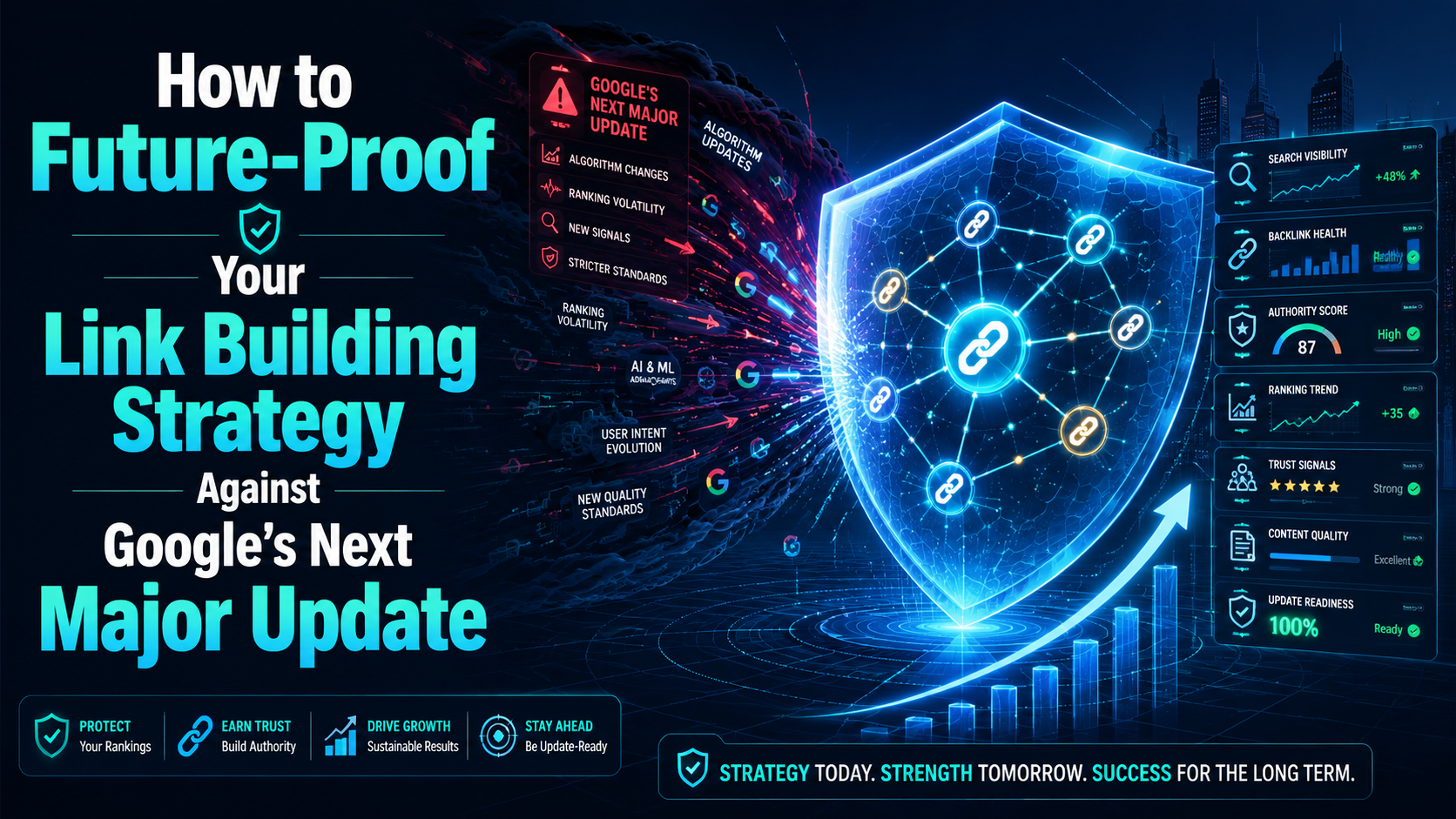
Let’s be real: if you’ve been in SEO for more than a year, you’ve probably had that sinking feeling. You built a solid backlink profile, your rankings climbed, and then – out of nowhere – a Google core update rearranged the SERP like a tornado through a filing cabinet. Traffic tanked. Panic set in. And suddenly, everything you thought you knew about link building felt fragile.
Here’s the truth: the tactics didn’t fail you – the approach did. Building a link building strategy that survives Google’s ever-evolving algorithm isn’t about gaming the system. It’s about building something genuinely difficult to penalize because it’s built on real editorial value, topical authority, and authentic relationships.
This guide breaks down exactly how to do that – backed by the latest data on what Google has rewarded, what it’s punished, and where its algorithm is clearly heading next.
| Quick Summary: Google’s algorithm increasingly rewards links earned through genuine editorial value, topical relevance, and trusted sources – while aggressively penalizing manufactured link signals. Sites that align their link building strategy with E-E-A-T principles and real audience value consistently outperform those chasing volume or shortcuts. |
Why Google Updates Keep Disrupting Link Building Strategies
| TL;DR Google has shipped more than 14 confirmed algorithm updates since early 2023. Each update compounds on the last, making reactive fixes less effective than building a fundamentally solid link profile from day one. |
To understand why so many link building strategies get wrecked by updates, you first need to understand why Google keeps changing the rules. The answer isn’t arbitrary – it’s deeply predictable once you see the pattern.
Google’s core goal has always been to surface the most helpful, trustworthy content for any given query. Every major algorithm update – from the March 2024 Core Update to the August 2025 Spam Update to the March 2026 Core Update – has been a refinement of that mission. Specifically, Google has been getting dramatically better at:
• Detecting manufactured or artificially inflated link signals
• Evaluating whether the site acquiring links actually deserves the authority being passed
• Assessing topical relevance between the linking and linked-to pages
• Identifying patterns of scaled, templated, or low-effort outreach
• Rewarding brands with consistent, multi-source expertise signals (E-E-A-T)
The March 2024 Spam Update introduced a stronger crackdown on AI-generated content and deceptive link-building practices. It also targeted three specific abuse patterns: expired domain manipulation, parasite SEO via site reputation abuse, and scaled content created purely to host links. The August 2025 Spam Update went even further, leveraging AI-based detection to catch newer forms of abuse that manual reviewers would miss.
What this means for anyone still relying on old-school volume-based link building: the window is closing fast. The sophistication of Google’s detection systems – now informed by machine learning – makes it increasingly difficult to fake editorial legitimacy at scale.
The Real State of Backlinks in 2026: What’s Changed, What Hasn’t
| TL;DR Backlinks remain the second most important ranking signal in 2026 – but the definition of a ‘good link’ has shifted dramatically toward editorial quality, topical relevance, and site trustworthiness. |
One of the most persistent myths in SEO right now is that Google has downgraded the importance of backlinks. It hasn’t. What Google has done is become far more selective about which backlinks it chooses to count.
A single editorial link from a niche-relevant publication with 5,000 engaged monthly readers now routinely outperforms hundreds of links from irrelevant, low-traffic directories or generic guest post farms. Quality has overtaken quantity so decisively that agencies still selling link volume as a metric are essentially selling last decade’s product.
According to research from LinkBuilder.com, 89.2% of link building specialists observe positive effects within 1–6 months of implementing quality links – but the emphasis is firmly on quality. Sites with rich topical authority, clear authorship, and authentic expertise are the consistent winners across every major update in the past two years.
Here’s what has meaningfully changed in how Google evaluates backlinks:
• Relevance outweighs raw Domain Authority metrics – a link from a niche industry blog often outperforms a random link from a high-DA news aggregator
• Context is everything – in-content editorial links carry far more weight than sidebar placements, footer links, or widget links
• The linking site’s audience quality matters – real traffic signals genuine editorial function
• Anchor text diversity is scrutinized – unnatural exact-match anchor patterns remain a major red flag
• Velocity matters – a sudden spike of 200 links in a week looks manipulative regardless of their individual quality
Table 1: Safe vs. Risky Link Building Tactics in 2026
Use this comparison to audit your current link building strategy and identify where you may be exposed to future algorithm penalties:
| Tactic | Risk Level | Update Resistance | Recommended? |
| Digital PR / Editorial Links | Very Low | Excellent | ✅ Strongly Recommended |
| HARO / Source Platforms | Very Low | Excellent | ✅ Strongly Recommended |
| Guest Posting (Niche-Relevant) | Low-Medium | Good | ✅ Yes, with caution |
| Broken Link Building | Low | Good | ✅ Recommended |
| Resource Page Outreach | Low | Good | ✅ Recommended |
| Unrelated Guest Posting (mass) | High | Poor | ⚠️ Avoid |
| PBN (Private Blog Networks) | Very High | Very Poor | ❌ Never |
| Paid Links (No Rel Attribute) | Very High | Very Poor | ❌ Never |
| Expired Domain Abuse | Very High | Very Poor | ❌ Never |
| Scaled AI Content Links | Very High | Very Poor | ❌ Never |
Note: Tactics marked ‘Never’ can result in manual penalties, algorithmic demotions, or complete de-indexing – recovery from which can take 6–18 months or longer.
The 7 Pillars of a Future-Proof Link Building Strategy
Let’s move past theory and into the specific structural decisions that determine whether your link building strategy holds up – or collapses – when Google’s next update arrives.
1. Build Topical Authority Before Chasing Links
| TL;DR A website with deep topical authority earns links more naturally AND retains ranking power through algorithm updates because its link profile reflects genuine expertise. |
This is where most companies get the order of operations wrong. They chase backlinks first and hope authority follows. Google’s algorithm has matured to the point where it evaluates your overall topical footprint when deciding how much weight to assign incoming links.
If your site has 12 articles on a topic and 300 relevant backlinks, those links carry more combined weight than 500 links pointing to a thin, unfocused domain. Topical authority amplifies link value – it doesn’t just add to it.
To build topical authority before embarking on aggressive link outreach:
• Map out your topic cluster and ensure comprehensive coverage of subtopics
• Publish original research, data, or unique insights – these naturally attract citations
• Keep content updated regularly; stale pages lose topical trust signals over time
• Establish named authors with verifiable credentials on all key content
2. Prioritize Digital PR as Your Primary Link Source
| TL;DR Digital PR campaigns earn editorial links from high-authority publications at scale – and these links are virtually immune to algorithm penalties because they reflect genuine media coverage. |
Digital PR has emerged as the most powerful link-building approach of this era, precisely because it’s not really link building in the traditional sense – it’s newsworthy storytelling that happens to generate links as a byproduct.
According to data published by DesignRush, strategic, news-driven PR pitches earn 40 to 60 quality backlinks per quarter – significantly outperforming generic outreach campaigns. And 95% of digital PR professionals use data-driven content to give journalists the unique angles they actively seek.
The most effective digital PR content formats that earn consistent editorial links include:
• Original research reports and industry surveys
• Expert commentary tied to trending news cycles (newsjacking)
• Proprietary data studies with fresh, citable statistics
• Bold, contrarian takes that cut through predictable industry narratives
• C-suite thought leadership positioning executives as quotable experts
Warm relationship-based outreach achieves 15–30% response rates versus 1–3% for cold email blasts. That gap is the difference between a sustainable pipeline of quality links and a burned-out strategy that collapses under algorithm pressure.
3. Embrace E-E-A-T as a Link Building Filter
| TL;DR Every link you pursue should pass a simple E-E-A-T test: Does the linking site demonstrate real Experience, Expertise, Authoritativeness, and Trustworthiness? If not, the link may actively hurt your profile. |
Google’s E-E-A-T framework (Experience, Expertise, Authoritativeness, and Trustworthiness) has become the de facto quality filter for evaluating both content and the sites that link to you. A link from a site that fails the E-E-A-T test doesn’t just fail to help – it may actively signal to Google that your backlink profile lacks editorial standards.
Apply these E-E-A-T checks before pursuing any link opportunity:
• Does the site have named authors with verifiable credentials and social presence?
• Is the site’s content clearly written for real human readers rather than search engines?
• Does the linking page have genuine organic traffic (verify via Ahrefs or Semrush)?
• Is the site editorially selective – does it reject link requests that don’t add real value?
• Is there a clear editorial or about page establishing the site’s purpose and standards?
Expert commentary platforms like Connectively (formerly HARO), Qwoted, and Featured.com have become gold-standard E-E-A-T link sources because they connect you directly with journalists actively seeking credible expert input – creating links that both Google and readers trust.
4. Conduct Quarterly Backlink Audits
| TL;DR Your link profile is only as strong as its weakest links. A single cluster of toxic backlinks can suppress your entire domain’s ranking potential during a spam update. |
Many businesses treat link building as a purely additive exercise – they focus entirely on acquiring new links without monitoring the health of their existing profile. This is a costly oversight.
Google’s spam detection runs continuously. Links that were invisible to previous algorithms may now be actively weighted against you. A quarterly audit should include:
1. Export your full backlink profile from Ahrefs, Semrush, and Google Search Console
2. Identify links from sites with no organic traffic, no real editorial content, or unrelated niches
3. Flag any link clusters with suspicious velocity patterns (dozens of links appearing simultaneously)
4. Review anchor text distribution – excessive exact-match anchors are a known penalty trigger
5. Disavow genuinely toxic links using Google’s Disavow Tool – but use it conservatively
6. Document your link velocity trends to catch sudden spikes that could look manipulative
5. Diversify Your Link Profile Intelligently
| TL;DR A natural link profile includes a mix of link types, anchor texts, and source domains. Over-reliance on any single tactic – even a legitimate one – creates detectable patterns. |
Think of link diversity the way a financial advisor thinks about portfolio diversification. No legitimate brand’s link profile consists entirely of one link type. Real brands earn links from news coverage, industry directories, partner mentions, forum discussions, educational resources, and social citations simultaneously.
A healthy, future-proof link profile includes:
• Editorial links from industry publications and news outlets
• Resource page mentions from authoritative educational and government domains
• Expert source citations (HARO, Qwoted, Featured.com placements)
• Podcast and video feature links from niche-relevant shows
• Strategic guest posts on genuinely selective, niche-relevant sites
• Brand mentions converted to links through monitoring tools
• Broken link replacements on resource-rich industry pages
Anchor text should follow a natural distribution: branded anchors (your brand name) should account for 40–60% of your profile, naked URLs 10–20%, and keyword-rich anchors no more than 10–15%. Pure exact-match anchor text concentration above 20% is consistently flagged in penalty analyses.
6. Invest in Relationship-Driven Outreach Over Template Blasting
| TL;DR Cold link requests to strangers achieve 1–3% response rates. Warm outreach to contacts you’ve already engaged with achieves 15–30%. The difference is compounding relationships versus one-time transactions. |
The era of spray-and-pray outreach is definitively over. Not because it was ever a great strategy, but because it’s now nearly impossible to execute at meaningful quality levels while maintaining the editorial standards that protect against penalties.
Modern, algorithm-resistant outreach is built on genuine value exchange:
• Engage with target editors and journalists on social platforms before pitching anything
• Cite and link to their content in your own articles – establish yourself as a reader first
• Lead with what your content or data does for their audience, not what a link does for you
• Reference specific recent pieces they’ve published and explain genuine alignment
• Follow up once, gracefully – multiple follow-ups are the fastest way to burn relationships
The most effective link builders today operate more like PR professionals than traditional SEOs – building media relationships that generate recurring link opportunities across multiple campaigns rather than one-off placements.
7. Leverage AI Overview Visibility Through Authority-Based Links
| TL;DR 92.36% of AI Overview responses link to domains that rank in the top 10 organic positions. Strategic link building that improves organic rankings directly increases your probability of AI Overview citation. |
Here’s a dimension of link building that most guides aren’t yet accounting for: the rise of AI-powered search fundamentally changes what a ‘good backlink’ means at the ecosystem level.
Google’s AI Overviews – and similar features across Bing, Perplexity, and other AI search platforms – don’t just reward rankings. They reward consistent topical authority signals across the web. When multiple high-authority sources within your niche cite you as a reference, AI systems interpret that as a meaningful trust signal.
Brands cited within AI Overviews gain three tangible advantages:
• Higher click-through rates from users who see the brand mentioned in authoritative AI-generated answers
• Enhanced credibility through association with trusted sources within the AI summary
• Preferential positioning in organic results adjacent to the AI Overview itself
This is why the future of link building isn’t just about ranking – it’s about becoming the kind of brand that AI systems and search algorithms naturally gravitate toward when assembling authoritative answers for users.
Table 2: Link Quality Evaluation Framework
Before pursuing any link opportunity, apply this six-point quality check. Links that fail multiple criteria should be deprioritized or declined entirely:
| Quality Signal | Why It Matters in 2026 | How to Evaluate |
| Topical Relevance | Google now weights relevance above raw DA metrics | Does the linking site cover your core topic? |
| E-E-A-T Signals | Authoritative sources compound trust over time | Named authors, credentials, real editorial staff |
| Organic Traffic on Linking Page | Traffic shows the site is genuine and crawled | Use Ahrefs/Semrush to verify real traffic |
| Editorial Placement | Contextual, in-content links carry more weight | Is your link in article body or sidebar/footer? |
| Anchor Text Diversity | Unnatural anchor patterns trigger spam filters | Mix branded, naked URL, and natural phrases |
| Link Velocity | Sudden spikes look manipulative to Google | Aim for steady, gradual growth month-over-month |
What Most Link Building Guides Won’t Tell You
Let’s have an honest conversation about the part of link building that doesn’t get enough airtime.
Link building is slow, expensive, and relationship-intensive. Anyone telling you otherwise is either selling shortcuts or working with a budget and timeline that most businesses don’t have. Real editorial links from high-authority publications take weeks or months to secure. A single high-quality guest post on a selective industry publication can require multiple rounds of pitching, revisions, and relationship development.
Domain Authority is not a Google metric. Ahrefs’ DR and Moz’s DA are useful proxy signals, but Google does not use them directly. A site with DA 80 that publishes content unrelated to your niche and generates zero real traffic can actively harm your profile. Stop chasing metrics Google doesn’t use.
Disavowing links is not a link building strategy. Many businesses discover toxic backlinks and assume a cleanup campaign will restore lost rankings. Disavowal removes the negative signal, but it doesn’t add positive ones. Recovery requires both removing the bad and replacing it with the good.
You’re being outranked by sites with fewer but better links. If a competitor with a smaller overall backlink profile consistently outranks you, the most likely explanation is that their links are more topically relevant, more editorially placed, or sourced from higher-trust publications within your specific niche.
Should You Build Links In-House or Use a Professional Service?
| TL;DR In-house link building offers maximum control but requires significant time, talent, and tooling investment. Professional link building services accelerate results when they use transparent, white-hat methods and provide clear reporting. |
This is a question that deserves an honest answer rather than a promotional one. The truth is: it depends on your resources, your competitive landscape, and – critically – which service or approach you choose.
Table 3: Link Building Approaches Compared
| Approach | In-House Team | Freelance Outreach | Managed Service |
| Cost | High (salary + tools) | Variable | Predictable & scalable |
| Speed to Results | Slow (ramp-up time) | Medium | Fast (existing networks) |
| Publisher Relationships | Must build from scratch | Limited | Pre-established, vetted |
| Quality Control | Depends on team skill | Inconsistent | Standardized vetting |
| Algorithm Risk | Moderate | Moderate–High | Low (white-hat focused) |
| Scalability | Limited by headcount | Limited | Highly scalable |
| Reporting & Transparency | High | Variable | High (if reputable) |
The managed service column assumes you’re working with a reputable, white-hat provider. The SEO industry has no shortage of services promising hundreds of links per month at suspiciously low price points – these almost invariably deliver the kind of profile that becomes a liability during the next spam update.
If you’re evaluating external link building services, here are the non-negotiable criteria that separate credible providers from risky ones:
7. Transparent publisher vetting – can they show you the sites before you commit?
8. Traffic verification – do they confirm real organic visitors on linking pages?
9. Editorial standards – do they have a documented quality threshold for placements?
10. Anchor text control – can you specify or review anchor text before publication?
11. No PBNs, link farms, or scaled AI content in their network
12. Clear reporting on live links, domain metrics, and campaign performance
Services like Outreachz operate on a managed outreach model that handles the relationship-building, publisher vetting, and content placement process on your behalf – freeing your team to focus on strategy while their network delivers high-quality, topically relevant placements. When evaluating any such service, always request a sample publisher list and ask about their quality control process for new placements.
Building a Link Building Strategy That Compounds Over Time
The most durable link building strategies aren’t built around any single tactic. They’re built around a compound model where each element reinforces the others:
| The Compound Model: Original research earns media coverage → media coverage builds brand authority → brand authority increases acceptance rates for outreach → improved outreach results in more editorial placements → editorial placements strengthen topical authority → stronger topical authority makes future content rank faster → faster-ranking content earns more organic links. This is the flywheel. Build it deliberately. |
The timeframe for this flywheel to begin spinning meaningfully is typically 3–6 months for initial signals and 9–18 months for compounding effects. Which means the worst time to start building it is after your next algorithm penalty – and the best time is right now.
A 90-Day Action Plan to Start Future-Proofing Today
Month 1 – Audit and Establish Foundation:
• Export and audit your complete backlink profile
• Disavow demonstrably toxic links
• Map your topical cluster and identify content gaps
• Establish named authors with verifiable credentials on all key pages
Month 2 – Build Your Digital PR Infrastructure:
• Set up source platform profiles (Connectively, Qwoted, Featured.com)
• Commission or compile an original data study in your niche
• Identify 20–30 niche-relevant publications for relationship development
• Begin engaging with target editors’ content on social platforms
Month 3 – Launch Systematic Outreach:
• Pitch your data study to journalists and industry publications
• Launch broken link building outreach on 10–15 resource-rich industry pages
• Submit 2–3 genuinely selective guest post pitches with niche-relevant angles
• Convert existing unlinked brand mentions using monitoring alerts
Frequently Asked Questions
How long does it take to recover from a Google link penalty?
Recovery from an algorithmic penalty typically takes 3–9 months after the underlying issues are addressed. Manual penalty recovery can take longer – often requiring a reconsideration request that may itself take 2–4 weeks to process. Neither timeline is guaranteed, and some sites never fully recover, particularly if they relied heavily on manipulative tactics over extended periods.
Is guest posting still a legitimate link building tactic in 2026?
Yes – but only when done correctly. Guest posting on niche-relevant sites with genuine audiences, where you’re providing real editorial value, remains a valid tactic. Mass guest posting on unrelated sites, or guest posting primarily to place keyword-rich anchors, is consistently targeted by spam updates.
How many backlinks do I need to rank for competitive keywords?
There’s no magic number. What matters more than volume is the quality, topical relevance, and editorial nature of your links relative to your competitors’. Analyze the top-ranking pages for your target keywords in tools like Ahrefs – understand the quality of their backlinks, not just the count. In many niches, 10–20 genuinely high-quality editorial links outperform 200 low-quality placements.
Should I be worried about negative SEO from competitors building bad links to my site?
Google has stated that it generally ignores links it deems to be negative SEO attacks, and it’s reasonably effective at doing so for obvious spam. However, it’s still worth monitoring your backlink profile for sudden unexplained spikes and using the Disavow Tool for clusters of clearly manipulative links that appear without any plausible organic explanation.
What’s the biggest mistake businesses make with their link building strategy?
Prioritizing link velocity over link quality – and then being surprised when the next algorithm update removes the rankings they built. The second biggest mistake is failing to audit existing backlinks while pursuing new ones, leaving a growing toxic tail in their profile that eventually becomes a liability.
Final Takeaway
The businesses winning at organic search in 2026 aren’t the ones with the most backlinks – they’re the ones whose backlink profiles most authentically reflect their real-world authority, expertise, and trustworthiness. Google’s algorithm is converging on that signal with increasing precision.
Future-proofing your link building strategy isn’t a one-time project. It’s a shift in operating philosophy – from extraction to construction, from volume to value, from transactions to relationships. Every link you earn through genuine editorial merit is a durable asset. Every shortcut you take is a liability waiting for the next update to surface it.
Build accordingly. Your future rankings depend on the decisions you make today – not in the aftermath of the next penalty.