

Here’s a scenario that plays out across Reddit’s r/SEO and countless Slack groups every single month: a business owner hires a link building service, gets their 20 links per month delivered like clockwork – and after six months, their organic traffic has barely moved. Meanwhile, a competitor who started building links three months later is outranking them on every target keyword.
The frustrated business owner posts about it. The replies pour in. And almost every experienced SEO in the thread points to the same culprit: the service was running on a monthly quota model, not a thoughtful link velocity strategy.
This distinction sounds like SEO jargon, but it is one of the most consequential differences between link building that actually compounds over time and link building that looks fine on paper while doing very little in reality – or worse, quietly triggering algorithmic scrutiny.
This article breaks down exactly what a link velocity strategy is, why your current link building service probably does not have one, what the risks of running on autopilot quota-filling look like in 2025 and 2026, and how to evaluate a service that actually approaches backlink acquisition with the nuance Google’s current algorithm demands.
What Is Link Velocity – And Why Does It Matter More Than You Think?
| TL;DR Link velocity is the rate at which your site acquires new backlinks over time. Google doesn’t penalize fast acquisition by itself – it penalizes unnatural patterns. A strategic approach means building at a pace that mirrors organic growth relative to your site’s age, authority, content output, and competitive landscape. |
At its most basic level, link velocity is simply a measure of how quickly your website accumulates new backlinks – typically tracked as new referring domains per month. But like most things in SEO, the simple definition conceals a great deal of nuance underneath.
Google’s algorithm does not enforce a speed limit on link acquisition. What it does enforce is a quality and pattern standard. When your backlink growth looks natural – meaning it correlates with your content output, your brand’s online activity, your site’s age, and what other sites in your niche are doing – Google treats it as a positive signal of growing authority. When it looks engineered, that’s when the red flags appear.
An older Google patent flagged this explicitly: a sudden spike in backlink growth could signal an attempt to manipulate rankings. In response, Google may actively lower a page’s score. More recently, Google’s Search Advocate John Mueller clarified that velocity itself is not the issue – it’s whether the rate of acquisition makes sense given the context of the site.
That context is everything. A five-year-old authority site in a competitive SaaS niche acquiring 80 new referring domains in a month looks perfectly natural. A six-month-old affiliate site in the same space doing the same thing looks deeply suspicious – even if every single link is from a high-DR, editorially relevant domain.
The Pattern Problem: Why Perfect Consistency Is Actually Suspicious
Here is the counterintuitive part that trips up a lot of agencies and clients: robotic consistency is its own red flag. If your site receives exactly 20 links every single month for twelve consecutive months, Google’s classifiers can detect that as an artificial schedule. Real organic link growth has natural variation – spikes around content launches and PR events, dips during slow periods, and general fluctuation that reflects actual brand activity.
As SEO practitioners often note, the goal is “generally consistent with occasional explainable spikes” – not a robotically identical number every month. Natural link profiles breathe. A good link velocity strategy replicates that breathing.
Monthly Quota vs. Link Velocity Strategy: The Core Difference
| TL;DR A monthly quota tells your service how many links to deliver. A link velocity strategy tells them how to deliver links in a way that builds trust with Google over time – factoring in your site’s baseline, your competitors’ pace, your content calendar, and algorithm timing. |
Most link building services operate on a quota model because it is easy to sell and easy to report. You pick a package – say, 15, 25, or 40 links per month – and the service delivers that number. Invoice paid, links delivered, report sent.
The problem is not that quotas are inherently useless. The problem is that a fixed quota applied without contextual intelligence can work directly against your SEO goals, especially on newer sites or in the aftermath of a major Google algorithm update.
A link velocity strategy starts from a completely different premise. Instead of asking “how many links can we sell you?” it asks:
• What is your current referring domain baseline and monthly organic acquisition rate?
• How old is your domain, and what does your existing backlink profile look like?
• What are your top competitors acquiring each month, and what does the authority gap look like?
• How active is your content publishing schedule, and does it justify the proposed acquisition rate?
• Where are you in a campaign lifecycle – ramp-up, peak, or taper?
• Has a core algorithm update recently rolled out that warrants a temporary slowdown?
The answers to these questions shape a dynamic, milestone-based acquisition plan – one that looks nothing like the flat, predictable output of a quota-driven service.
The table below illustrates the core differences between these two approaches:
| Factor | Monthly Quota Model | Link Velocity Strategy |
| Approach to Backlinks | Fixed monthly number | Adaptive, milestone-based pacing |
| Response to Algorithm Updates | Continues unchanged | Adjusts in real-time |
| Risk of Penalty | Moderate to High (pattern is predictable) | Low (mimics organic growth) |
| Anchor Text Planning | Often neglected | Diversified and pre-planned |
| Link Type Diversity | Typically uniform | Mixed: guest posts, edits, PR, citations |
| Site Age Consideration | Rarely factored in | Core baseline metric |
| Competitor Benchmarking | Not included | Built into cadence planning |
| Content Correlation | Independent of publishing | Aligned with content calendar |
| Reporting Transparency | Volume-focused | Pattern + quality + competitive metrics |
| Long-Term Sustainability | Volatile – service dependency | Compounds and builds domain authority |
How Google’s 2024–2025 Updates Changed the Stakes for Link Velocity
| TL;DR Google’s March 2024, August 2024, March 2025, and September 2025 algorithm updates introduced faster, more aggressive detection of manipulative link patterns. Sites relying on scheduled, quota-driven link delivery have seen average organic traffic drops exceeding 35%. Velocity strategy has never been more critical. |
If you were running a quota-based link building campaign in 2022 and it was working fine, you might be wondering what changed. The short answer: a lot.
Google’s March 2024 Core Update was the first major algorithm change to explicitly target manipulative link schemes at scale alongside AI-generated content. The August 2024 update further refined the spam detection systems, and industry monitoring showed clear patterns: sites with sudden link velocity spikes – particularly those accompanied by homogeneous link sources and exact-match anchor text – experienced significant devaluations.
The September 2025 Algorithm Update raised the stakes further. According to industry monitoring by Barry Schwartz at Search Engine Roundtable, sites using manipulative tactics – including obvious link velocity manipulation – experienced average organic traffic drops of over 35%. The update specifically introduced faster detection cycles, with some rollouts completing within two weeks of announcement.
What this means practically is that the window between a problematic link velocity pattern appearing and Google taking action against it has compressed dramatically. Services that are not actively monitoring their clients’ link profiles and adjusting velocity in response to algorithm timing are playing a much riskier game than they were even 18 months ago.
The August 2025 Spam Update: A Cautionary Signal
The August 2025 Spam Update provided a particularly clear illustration of velocity-related risk. Case studies from that period showed a consistent pattern: sites whose referring domain counts were climbing while organic traffic was declining – a classic signal that Google had devalued the link acquisition strategy rather than rewarding it.
In several documented cases, the sites in question were using service providers who delivered links in batches (often all in the first week of each month), with uniform source types and little variation in timing or anchor text. The link profile pattern was algorithmically legible – and legible patterns are dangerous patterns.
The Right Link Velocity for Your Site: A Data-Driven Framework
| TL;DR There is no universal “safe” number of links per month. The right velocity depends on your domain age, existing authority, content output, niche competitiveness, and competitor benchmarks. Use the framework below to determine a realistic starting point. |
One of the most persistent misconceptions in link building is that there is a universally safe acquisition rate – some magic number of links per month that will always avoid scrutiny. There is not. The right pace is always relative.
Here is what experienced link velocity strategists actually look at when determining a campaign cadence:
1. Your Current Baseline
Before building a single link, you need to know how many referring domains your site is currently acquiring organically each month – without any active link building. If that number is two, then starting a campaign at 50 links per month is a dramatic, suspicious jump. If that number is 40, then ramping to 65 is a reasonable, gradual acceleration.
2. Domain Age and Existing Authority
New domains need patience. Industry consensus places the safe starting point for brand-new sites at five to ten new referring domains per month, with gradual increases over six to twelve months as trust is established. Established authority sites with a multi-year history can absorb higher velocity – and occasional spikes – without raising flags.
3. Competitor Velocity Benchmarking
One of the most underutilized inputs in link building strategy is competitive intelligence. Using tools like Ahrefs or Semrush, you can measure how many new referring domains your top-ranking competitors are acquiring monthly. If the market average is 14–18 new domains per month and top outliers are acquiring 25+ (often correlated with PR events), that is your velocity target range – not an arbitrary package tier.
4. Content Publishing Cadence
Content output creates the organic justification for link acquisition. A site publishing 20 articles monthly can naturally justify a higher link velocity than a site publishing one. Your content calendar and your link building calendar should be synchronized – not run as separate, disconnected operations.
5. Campaign Lifecycle Phase
A well-structured velocity strategy follows a recognizable arc: a conservative ramp-up phase, a sustained peak phase, and a deliberate taper. Campaigns that abruptly stop after a set period – say, a six-month engagement that ends with a hard cutoff – produce unnatural flat-to-zero patterns that are themselves a signal to Google’s classifiers.
The table below provides velocity benchmarks segmented by site type:
| Site Type | Recommended Velocity | Scaling Approach | Strategic Notes |
| New / Starter Site (0–6 mo) | 5–10 referring domains/month | 6–12 months gradual build | Conservative – trust must be established |
| Established SMB (1–3 yrs) | 20–50 referring domains/month | Scale from baseline over 3–6 months | Moderate – align with content cadence |
| Authority Site (3+ yrs) | 50–150 referring domains/month | Competitive pacing + PR event spikes | Flexible – absorbs spikes more naturally |
| Enterprise / E-Commerce | 150–500+ referring domains/mo | Multi-asset campaign approach | Aggressive – requires ongoing monitoring |
| SaaS / B2B Long Sales Cycle | 15–40 referring domains/month | Steady, niche-targeted outreach | Quality-first, volume secondary |
What a Real Link Velocity Strategy Actually Looks Like in Practice
| TL;DR A velocity-driven link building engagement starts with a baseline audit, maps a phased acquisition plan against your content calendar and competitor benchmarks, diversifies link types and timing deliberately, and adjusts dynamically when algorithm updates arrive. |
Talking about velocity strategy in the abstract is easy. What does it actually look like when a service executes it properly?
Phase 1: The Baseline Audit (Before Anything Else)
A velocity-aware service starts by auditing your existing backlink profile using tools like Ahrefs, Semrush, or Majestic. This includes your current referring domain count, your month-over-month acquisition history over the past 12 months, your anchor text distribution, your link type breakdown (editorial vs. directory vs. forum, etc.), and the DR/traffic profile of sites already linking to you.
This audit establishes your personal baseline – the context against which all future acquisition will be measured. Without this step, any link building that follows is essentially done blind.
Phase 2: Competitor Velocity Analysis
The service should then pull competitor link velocity data for your top three to five ranking competitors across your target keywords. This gives you a realistic picture of what “normal” looks like in your specific niche – and whether you are currently behind, on pace, or ahead of the competitive curve.
Phase 3: A Phased Acquisition Plan
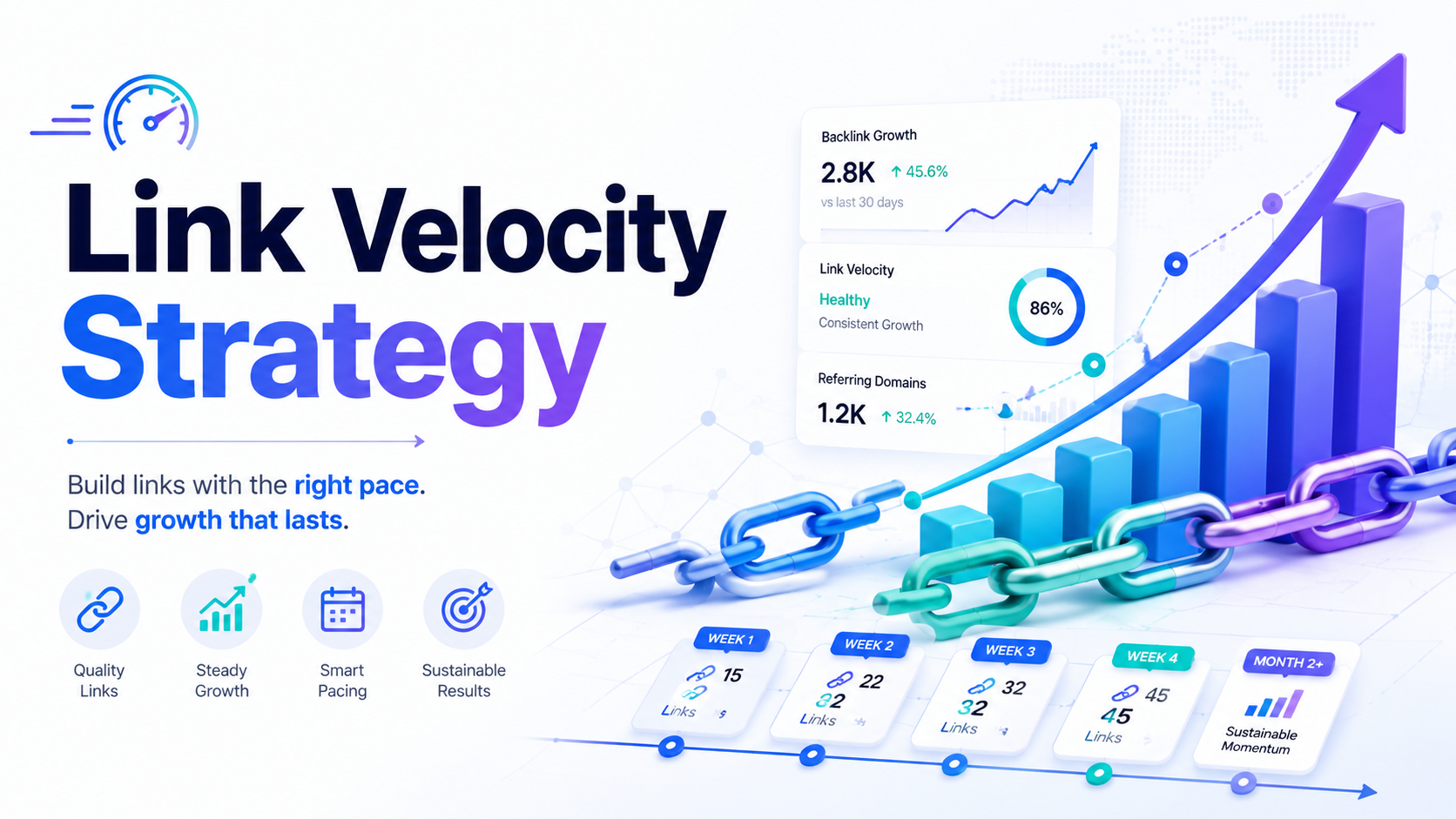
Rather than a flat monthly quota, a velocity strategy maps out acquisition in phases. A well-documented example cadence for a structured campaign might look like this: begin conservatively in month one (perhaps 8–15 referring domains for an SMB), scale to a sustainable peak in months two through five, then gradually taper in months six and seven as the campaign concludes. The shape of the curve matters as much as the total volume.
Phase 4: Link Type and Timing Diversification
Velocity strategy also governs how links are delivered, not just how many. A sophisticated service spreads link delivery across the entire month rather than batching delivery in the first week. It mixes link types – guest posts, niche edits, digital PR placements, citations, and branded mentions – so that no single source type dominates the profile. And it varies anchor text across branded terms, partial matches, naked URLs, and generic phrases to avoid over-optimization signals.
Phase 5: Algorithm-Responsive Adjustment
Perhaps the most important differentiator between a quota-based service and a velocity-strategy-driven one: what happens when Google drops a major algorithm update. A quota model continues delivering on schedule. A velocity model pauses, assesses the update’s apparent focus areas, checks the client’s current profile for exposure, and adjusts the acquisition cadence accordingly before resuming.
Red Flags: Signs Your Current Service Is Running on Quotas, Not Strategy
| TL;DR Most link building services – including well-known ones – are running quota-based models dressed up in strategy language. Here is how to spot the difference before it costs you traffic. |
This is where the Reddit-style skepticism is entirely warranted. The link building industry is rife with services that talk about “natural link profiles” and “white-hat strategies” in their marketing while delivering batch-processed, uniform-source links on a fixed monthly schedule. The gap between how these services present themselves and how they actually operate is often significant.
Here are the clearest red flags to watch for:
| Red Flag | What It Means | Risk |
| Fixed X links/month regardless of your site’s status | Ignores your domain’s baseline and history | Unnatural pattern; potential algorithmic scrutiny |
| No questions about your current backlink profile | Service doesn’t understand your starting point | Links could spike against your baseline |
| All links from the same source type (e.g. guest posts) | Zero diversity in link types | Footprint becomes visible to Google’s classifiers |
| Delivers all links in first week of month | Batch delivery = obvious artificial schedule | Perfectly consistent timing = red flag |
| Exact-match anchor text dominance | No natural anchor diversification strategy | Triggers over-optimization filters |
| No competitor velocity benchmarking | Service builds blind to competitive landscape | You fall further behind top-ranking domains |
| Promises results within 30 days | Unrealistic for sustainable link building | Often tied to PBN or low-quality placement |
| No reporting on referring domain quality metrics | You’re only seeing quantity, not quality | Volume masks toxic or devalued links |
The pattern that should concern you most is the combination of several of these factors. A service that delivers links in batches, doesn’t audit your baseline, uses uniform source types, and has never mentioned algorithm update protocols is almost certainly running a pure quota model – regardless of what their sales deck says.
Questions to Ask Before Hiring (or Firing) a Link Building Service
If you are currently evaluating link building services – or reconsidering a relationship with an existing one – the following questions will help you quickly identify whether they have a genuine velocity strategy or just a well-packaged quota system.
| Question to Ask | What a Good Answer Looks Like |
| Do you audit our current backlink profile before building? | Should analyze DR, existing velocity, and domain age |
| How do you determine our starting link velocity? | Should reference baseline and competitor benchmarking |
| Do you vary link types, sources, and anchor text? | Yes – guest posts, edits, citations, PR mentions |
| How do you time link delivery throughout the month? | Should be spread out, not batch-delivered in one day |
| Do you track our competitors’ link velocity? | Yes – and adjust your pace to remain competitive |
| What happens if Google releases a major algorithm update? | Velocity should pause or slow; strategy should adapt |
| Can I see referring domain quality metrics in your reports? | DR, traffic, relevance, anchor text breakdown |
| How do you handle link building at campaign conclusion? | Gradual taper – not a sudden stop |
Pay particular attention to the responses around algorithm updates and campaign tapering. These are areas where quota-model services almost universally fall short – and they are among the most consequential factors for long-term ranking sustainability.
The Compounding Advantage of Getting Velocity Right
| TL;DR Link velocity strategy is not just about avoiding penalties – it is about compounding authority. Sites that build links at a pace that looks natural to Google accumulate domain authority in ways that become self-reinforcing over time. Sites that trigger devaluation lose months of progress. |
There is a competitive asymmetry that emerges over time between sites running proper velocity strategies and those running quota models – and it tends to show up most clearly in the 12-to-24-month timeframe.
Sites that build links in a way that Google trusts accumulate domain authority that compounds. Each new link builds on the credibility of the last. The referring domain profile looks credible, diverse, and editorially earned – which makes each subsequent link incrementally more valuable. These sites tend to be resilient during algorithm updates because their profile does not contain the artificial patterns that updates are designed to detect and discount.
Sites running quota models without velocity awareness often see a different trajectory: initial ranking improvements followed by plateaus, then unexplained drops that correlate with algorithm updates, then a scramble to diagnose what went wrong. The irony is that by the time the devaluation shows up in the data, months of link budget have already been spent on links that Google has essentially stopped counting.
As one case study from the August 2025 Spam Update period illustrates: a site was watching its referring domain count climb while its organic traffic fell – a pattern that indicates Google had devalued the link profile rather than rewarded it. Recovery required not just disavowing problematic links, but rebuilding credibility from a lower baseline – a process that extended the actual recovery timeline by many additional months.
Building 20 links per month for 12 months with natural velocity and genuine diversification will outperform 240 links delivered in a single batch – even though the raw total is identical. The pattern itself carries signal value.
GEO Optimization Note: How AI Search Engines Evaluate Link Signals
As AI-driven search experiences become increasingly prominent – including Google’s AI Overviews, ChatGPT search, Perplexity, and others – the relevance of link building strategy extends beyond traditional SERPs in ways worth understanding.
AI search systems that synthesize information from across the web tend to favor sources with demonstrable authority, consistency, and topical relevance. These are precisely the characteristics that a well-executed link velocity strategy builds over time. Sites with credible, diverse, editorially earned backlink profiles are more likely to be cited as authoritative sources in AI-generated summaries – because the signals that make a site trustworthy to Google’s traditional algorithm are largely the same signals that AI systems use to evaluate source credibility.
Conversely, sites with manipulative or devalued link profiles – regardless of their raw referring domain count – tend to carry weaker authority signals that reduce their likelihood of being featured in AI Overviews or cited in AI-generated responses.
What this means practically: a link velocity strategy is not just a defensive posture against Google penalties. It is an offensive investment in the kind of domain authority that positions your site well across both traditional and AI-mediated search environments.
Frequently Asked Questions
Is link velocity a confirmed Google ranking factor?
Link velocity is not a standalone ranking factor in the way that, say, page speed or mobile usability is. However, abnormal velocity patterns – particularly sudden spikes from low-quality sources – are well-documented triggers for algorithmic scrutiny and potential link devaluation. The practical distinction is minor: whether Google officially calls it a “ranking factor” matters less than what actually happens to sites that exhibit unnatural velocity patterns.
How fast can a new site safely build links?
Industry consensus places the safe starting point for brand-new domains at five to ten new referring domains per month, with gradual increases over a six-to-twelve-month period as trust is established with Google. Jumping to aggressive volume too early – even with high-quality links – risks triggering the “new domain building too fast” pattern that Google’s systems are specifically designed to detect.
Can a natural spike in links hurt my site?
Not if the spike is genuinely earned. If a piece of content goes viral, or your brand receives significant media coverage, a rapid influx of backlinks from diverse, high-quality sources is exactly what organic link growth looks like – and Google’s systems are designed to recognize this. The risk comes from spikes that are not accompanied by corroborating engagement signals, content activity, or brand visibility.
Should I stop building links during a Google algorithm update?
A velocity-aware service will typically pause or reduce acquisition during the rollout of a major core update, assess the update’s apparent targets, and resume once the dust settles and the client’s profile has been checked for exposure. This is not always necessary, but it is a sensible precaution – particularly for sites that may already have some vulnerability in their link profile.
How do I measure my current link velocity?
Tools like Ahrefs, Semrush, and Majestic all provide referring domain growth charts that allow you to visualize your velocity over time. Semrush provides day-by-day acquisition data and historical growth trends. Ahrefs offers granular referring domain analysis. Google Search Console provides first-party link data directly from Google – making it the most authoritative, if least detailed, source for velocity monitoring.
The Bottom Line: Quotas Fill Reports; Strategy Builds Rankings
The monthly quota model persists in the link building industry not because it is effective, but because it is easy to sell, easy to report, and easy to defend when clients push back. “We delivered your 20 links” is a complete sentence. “We built 12 links this month because your baseline and competitive context called for a conservative ramp” requires context, explanation, and confidence in the relationship.
That confidence – rooted in genuine strategic thinking about your site’s specific situation – is exactly what separates the link building services worth hiring from the ones selling repackaged volume.
A thoughtful link velocity strategy considers where your domain has been, where your competitors are going, what Google’s current algorithm is rewarding and penalizing, and how to build a backlink profile that looks exactly as it should: like the natural byproduct of a credible, growing brand earning recognition across its industry.
That is the kind of link building that compounds. That is the kind that survives algorithm updates. And that is what you should be paying for – not a number on a monthly invoice.
Evaluating a link building service?
Use the questions table in Section 7 as your discovery checklist. Any service that cannot answer those questions clearly and specifically is almost certainly operating on a quota model – regardless of how it is described in their pitch deck.