

Introduction
You’ve done everything right. Your Google Business Profile looks polished, your website is fast, and your reviews are solid. But your local rankings are still stuck, and you can’t figure out why.
Nine times out of ten, the culprit is something deceptively simple: your NAP data is a mess.
NAP SEO, the practice of keeping your business Name, Address, and Phone number consistent across every corner of the web, is one of the most foundational, and most overlooked, factors in local search. One wrong digit in a phone number, one old address still sitting on a forgotten directory, one extra keyword slipped into your business name on Yelp, and Google starts to doubt whether your business is even real. In local SEO, doubt equals invisibility.
This guide breaks down exactly what NAP in SEO means in 2026, why it matters more than ever in an AI-driven search landscape, and how to get it right the first time.
TL;DR
- NAP stands for Name, Address, and Phone Number, the three core data points Google uses to verify and rank local businesses.
- Inconsistent NAP data across directories, social profiles, and your website directly suppresses local map pack rankings.
- Over 60% of local businesses have at least one NAP inconsistency online, most don’t know it’s happening.
- Google cross-references your NAP from dozens of sources; even small variations (like “St.” vs. “Street”) create trust issues.
- Fixing NAP inconsistencies alone can improve local visibility by 10–25% within 60–90 days.
- In 2026, NAP consistency is equally critical for AI search engines, LLMs and voice assistants rely on consistent entity data to surface your business.
- NAP must match exactly across your website, Google Business Profile, schema markup, and all third-party directories.
- NAP is a gatekeeper signal, not a direct ranking lever, it removes obstacles that prevent your other signals from working.
What Is NAP in SEO?
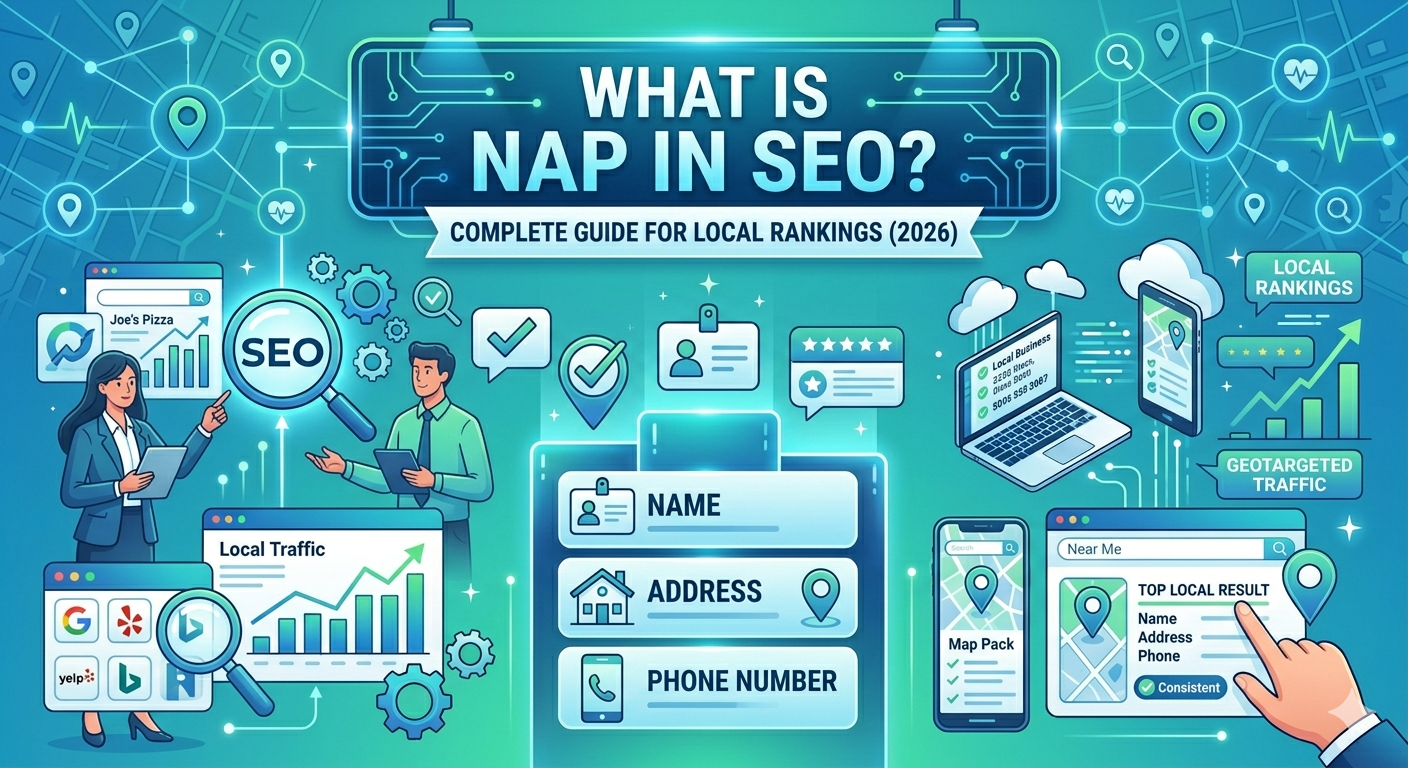
NAP stands for Name, Address, and Phone Number. In local SEO, it refers to the standardized set of business information that search engines use to verify, identify, and rank a physical business across the web.
Here’s the simple version: Google doesn’t just look at your website when it decides where to rank you locally. It pulls data from dozens of sources, business directories, social platforms, data aggregators, news sites, and more, and compares all of it against each other. When your NAP information is consistent across all those sources, Google gains confidence that your business is legitimate and accurately located. That confidence translates into higher rankings in the Local Pack, Google Maps, and local organic results.
When your data is scattered or contradictory? Google’s confidence drops. And lower confidence directly suppresses your local rankings, not because of a penalty, but because of uncertainty.
NAP SEO is the discipline of building and maintaining that consistent, verified online identity across the entire web ecosystem.
Why NAP Consistency Is the Backbone of Local Rankings
Google’s Entity Verification Model
Google doesn’t just rank websites anymore. It ranks real-world entities, verified businesses with confirmed locations and contact details. NAP data is one of the primary signals Google uses to confirm that your business is a legitimate, trustworthy entity rather than an unverifiable online listing.
When Google cross-references your business across multiple sources and finds consistent data, it increases what local SEO practitioners call your “confidence score.” When it finds discrepancies, even minor ones like “Suite 200” vs. “#200”, it creates what researchers describe as data quality flags that can actively suppress your map pack visibility.
The Numbers Don’t Lie
The scale of NAP inconsistency problems is striking:
- 60%+ of local businesses have inconsistent NAP information across the web, often without knowing it.
- Businesses with clean, consistent NAP data receive 23% more website clicks from Google than those with inconsistencies.
- According to BrightLocal research, 68% of consumers would stop using a local business if they found incorrect information in online directories.
- Listings with inconsistent NAP data receive 40–50% fewer direction requests than those with clean data.
- One case study showed that after standardizing NAP across 47 platforms and implementing consistent schema markup, a business saw local AI search visibility increase by 340% and voice search traffic grow by 520%.
How Small Variations Cause Big Problems
Most business owners assume that “close enough” is fine. It isn’t. Search engine algorithms process NAP like entity resolution systems, they look for exact string matches. To a machine:
| Variation | Perceived As |
| Smith & Sons Plumbing | Different entity than “Smith and Sons Plumbing” |
| 123 Main St | Different from “123 Main Street” |
| (555) 555-5555 | Different from “555-555-5555” |
| Suite 300 | Different from “Ste. 300” or “#300” |
| 1-800-555-1234 | Different from “800-555-1234” |
Every one of these mismatches is a weak signal. Weak signals accumulate. And accumulated weak signals erode your local authority over time.
NAP SEO and Google’s Local Ranking Algorithm
Google’s local search algorithm operates on three primary factors: Relevance, Distance, and Prominence. NAP consistency plays a role in all three.
| Ranking Factor | How NAP Affects It |
| Relevance | Consistent business category + NAP data reinforces what your business does and where |
| Distance | Accurate address data ensures Google places your pin in the correct location |
| Prominence | Clean NAP across authoritative directories builds citation authority |
The three pillars of local SEO that work together are a fully optimized Google Business Profile, consistent NAP citations across the web, and a strong review strategy. When all three are working in sync with geo-targeted website content and proper schema markup, businesses regularly appear in the top three of the local map pack within 30 to 90 days of launching a focused campaign.
Common NAP Inconsistency Issues (And Why They Happen)
Understanding the root causes of NAP problems is the first step toward fixing them.
Business relocation is one of the most common culprits. When a business moves, old addresses persist across dozens of directories for months or years. One counselor who relocated her office lost all her local rankings almost immediately after updating her Google Business Profile, because her citations still pointed to the old address, creating a mismatch that crushed Google’s confidence in her data.
Phone number changes create similar havoc. Even formatting differences, adding a country code prefix, using dashes versus dots, can cause algorithmic confusion.
Rebranding is another frequent trigger. Even a slight business name change, adding “LLC,” dropping a word, swapping an ampersand for “and”, creates a split identity across the web.
Multi-location formatting inconsistencies are a particular pain point for growing businesses. If each location formats its suite number, state abbreviation, or phone number differently, directories may treat them as unrelated businesses rather than branches of the same brand.
Third-party data scrapers compound every issue above. Many directories don’t gather data directly from businesses, they scrape it from other directories that may already have outdated information, spreading the error across the web automatically.
How to Conduct a NAP Audit in 2026
A proper NAP audit follows a structured process. Here’s how to run one:
Step 1: Establish Your Master NAP
Before auditing anything, define the canonical version of your business information. Choose one format for every element and document it:
- Business Name: Exactly as it appears on your legal registration or storefront. No keyword stuffing.
- Address: Use the USPS standardized format. Pick one format for suite/unit numbers and never deviate.
- Phone Number: Choose one format (recommend: (XXX) XXX-XXXX) and use it everywhere.
Step 2: Audit Your Core Platforms First
| Priority Tier | Platforms to Check |
| Tier 1 (Critical) | Google Business Profile, website footer/contact page, schema markup |
| Tier 2 (High) | Yelp, Bing Places, Apple Maps, Facebook, Yellow Pages |
| Tier 3 (Important) | Industry-specific directories, local chambers of commerce, data aggregators (Neustar Localeze, Data Axle, Foursquare) |
| Tier 4 (Supporting) | Niche directories, community websites, local news sites |
Step 3: Use Auditing Tools
Several tools can automate the discovery of inconsistent citations:
- Semrush Listing Management: scans key directories and pushes consistent NAP data from a single dashboard
- BrightLocal: citation finder and audit tool with tracking
- Moz Local: monitors citations across major aggregators
- Whitespark: deep citation audit and building tool
Step 4: Fix, Request, or Document
For listings you control, update them directly to match your master NAP. For directories that require manual changes, reach out to operators with documented proof of your correct information. For listings that cannot be corrected, abandoned directories, locked entries, document them and move on. As you build more consistent high-authority citations, lower-quality inconsistent ones carry progressively less weight.
NAP SEO and Schema Markup: The Technical Layer
In 2026, consistent NAP data doesn’t live only in directories and profiles, it lives in your website’s code. LocalBusiness schema markup is the structured data layer that communicates your NAP directly to search engines and AI systems in a machine-readable format.
Every local business website should implement LocalBusiness schema (or a more specific subtype like Plumber, Restaurant, or LegalService) on the homepage, contact page, and every location-specific landing page. The schema should include:
{
“@context”: “https://schema.org”,
“@type”: “LocalBusiness”,
“name”: “Your Exact Business Name”,
“address”: {
“@type”: “PostalAddress”,
“streetAddress”: “123 Main Street, Suite 100”,
“addressLocality”: “Chicago”,
“addressRegion”: “IL”,
“postalCode”: “60601”,
“addressCountry”: “US”
},
“telephone”: “(555) 555-5555”,
“geo”: {
“@type”: “GeoCoordinates”,
“latitude”: 41.8781,
“longitude”: -87.6298
},
“sameAs”: [
“https://www.google.com/maps/…”,
“https://www.yelp.com/biz/…”,
“https://www.facebook.com/…”
]
}
Critical rule: The NAP data in your schema markup must be byte-for-byte identical to the NAP in your Google Business Profile and every directory citation. Any mismatch between your schema and your GBP is treated by Google as conflicting data, it doesn’t average things out. It becomes unconfident. And unconfidence in local SEO means suppressed rankings.
After the February 2026 Core Update, Google accelerated its prioritization of “verified entities.” Schema markup has effectively become your digital ID card, proof that you are who you claim to be. Businesses with accurate, specific, and validated LocalBusiness schema consistently outperform those relying on content signals alone.
NAP Consistency in the Age of AI Search
Here’s something most local businesses aren’t thinking about yet: NAP SEO is now critical for AI search engines, not just traditional Google results.
Large language models, the technology powering Google’s AI Overviews, Perplexity, ChatGPT, and voice assistants, rely on data consistency to surface businesses in response to local queries. When someone asks their phone “Who’s the best HVAC company near me?” or tells their smart speaker to “call a plumber in downtown Denver,” the AI system is running entity resolution algorithms behind the scenes, cross-referencing your business name, address, and phone number across multiple data points to identify a trustworthy, definitive answer.
LLMs and AI search systems demonstrably favor businesses with what researchers call “boring consistency”, the exact same name format, identical address structure, and matching phone numbers across every platform. Businesses that are clean entities in AI knowledge graphs get cited. Businesses with fragmented data get skipped.
The voice search dimension makes this even more urgent. Voice search queries for local businesses have grown substantially in 2026, and these queries route directly through AI systems that depend entirely on structured, consistent entity data to return accurate results.
Building strong local link equity is another powerful way to reinforce your NAP authority and overall entity strength. The 10 best link building services for local SEO in 2026 can help you identify vetted partners who specialize in citation-adjacent authority building, combining consistent NAP signals with high-quality backlinks for compounding local visibility gains.
NAP SEO for Multi-Location Businesses
Managing NAP for a business with multiple locations requires a systematic architecture rather than a case-by-case approach.
| Challenge | Solution |
| Each location using different formatting | Create a master NAP template for each location, enforced company-wide |
| Google treating locations as the same entity | Ensure each location has unique address, phone number, and GBP |
| Schema markup conflicts | Use “hub and spoke” model: Organization schema on homepage + unique LocalBusiness schema per location page |
| Duplicate listings across directories | Report and merge duplicates using each platform’s official procedure |
| Branch-level review attribution | Link each location’s GBP to its dedicated location page |
The hub-and-spoke schema model is particularly important: your homepage carries the Organization schema as the parent entity, while each individual location page has its own LocalBusiness block with location-specific PostalAddress and GeoCoordinates. This prevents what SEO practitioners call “entity cannibalization,” where your own locations compete against each other in the same local search.
NAP vs. NAPW: The Evolution of the Standard
The traditional NAP triad has evolved. Many local SEO practitioners now refer to NAPW — Name, Address, Phone, and Website — as the complete citation standard for 2026.
| Element | Why It Matters |
| Name | Establishes entity identity; must match legal/GBP name exactly |
| Address | Confirms physical location; drives proximity ranking signals |
| Phone | Enables customer contact verification; confirms business operates |
| Website | Links citation authority back to your domain; critical for entity association |
The sameAs property in your LocalBusiness schema essentially formalizes the NAPW connection in machine-readable form, linking your business entity to its website, social profiles, GBP listing, and other authoritative platforms simultaneously.
NAP SEO vs. Other Local Ranking Factors
NAP consistency is foundational but not sufficient on its own. Here’s how it stacks up against other key local ranking signals:
| Ranking Signal | Impact Level | Works Without NAP? |
| Google Business Profile completeness | Very High | No, GBP NAP must match citations |
| NAP consistency across citations | High | N/A, this is the baseline |
| Review quantity and recency | High | Partially, but NAP errors suppress attribution |
| LocalBusiness schema markup | High | No, schema NAP must match GBP |
| Backlinks from local/relevant sites | High | Yes, but NAP strengthens link attribution |
| Website on-page local optimization | Medium-High | Yes, but NAP on contact page is essential |
| Behavioral signals (clicks, calls) | Medium | Yes, but inconsistent data confuses attribution |
| Social proof and engagement | Medium | Yes |
The key insight: NAP is a gatekeeper. It doesn’t win you rankings on its own, but inconsistent NAP actively blocks your other signals from working at full strength. Reviews earned under an incorrect business name may not be attributed properly. Backlinks built to an entity Google can’t confidently identify contribute less authority. Fix the NAP first, everything else compounds on top of it.
Ongoing NAP Maintenance: It Never Fully Stops
NAP management isn’t a one-time fix. It’s an ongoing operational discipline for any local business that cares about search visibility.
Set up a recurring audit schedule, quarterly at minimum, monthly if your business information changes frequently or you operate in a competitive local market. Any business event that touches your NAP, a relocation, a new phone number, a rebrand, adding locations, should trigger an immediate full NAP audit across all platforms.
Use citation management tools to monitor for new inconsistencies introduced by data scrapers and third-party aggregators. Even businesses that have cleaned their NAP completely can find fresh inconsistencies appearing within months as scrapers pull old data from other scrapers in a chain reaction.
Frequently Asked Questions About NAP SEO
Does NAP consistency still matter in 2026 with AI search?
More than ever. AI systems and LLMs use entity resolution to identify and surface local businesses. Consistent NAP across all platforms is how your business becomes a reliable entity in AI knowledge graphs, which directly determines whether you appear in AI Overviews, voice search responses, and generative local answers.
How long does it take to see results after fixing NAP inconsistencies?
Typically 60 to 90 days for meaningful improvements in local visibility. Cleaning NAP data alone, without additional content or link building, can drive a 10 to 25% increase in local search visibility in that window.
What’s the single most important place to have accurate NAP?
Your Google Business Profile. Google’s own systems prioritize GBP data and cross-reference all other citations against it. If your GBP NAP doesn’t match your citations, no amount of directory consistency will fully compensate.
Can I include keywords in my business name for better NAP SEO?
No. Your business name in NAP must reflect your actual legal or operating business name. Keyword-stuffed business names violate Google’s guidelines and can result in GBP suspension, a far worse outcome than a ranking dip.
What’s the difference between a citation and a backlink?
A citation is a mention of your NAP on another website, it may or may not include a link. A backlink is a hyperlink pointing to your website. For NAP SEO purposes, citations carry authority even without a link, though a citation plus a backlink is always the stronger signal.
Conclusion
NAP SEO isn’t glamorous. There are no viral content hacks or algorithmic shortcuts hidden inside it. It’s pure operational discipline, the kind that most businesses skip because it feels boring.
But that’s exactly why it’s such a reliable competitive advantage. While your competitors are chasing trending tactics, a clean NAP across every platform quietly tells Google, AI search engines, and every data aggregator on the web exactly who you are, where you are, and how to reach you. That clarity is the bedrock on which all your other local SEO work compounds.
In 2026, with AI systems increasingly acting as the gateway between local businesses and local customers, NAP consistency has shifted from a best practice to a business-critical infrastructure investment. Get it right, maintain it consistently, and watch how much easier every other local SEO effort becomes.