

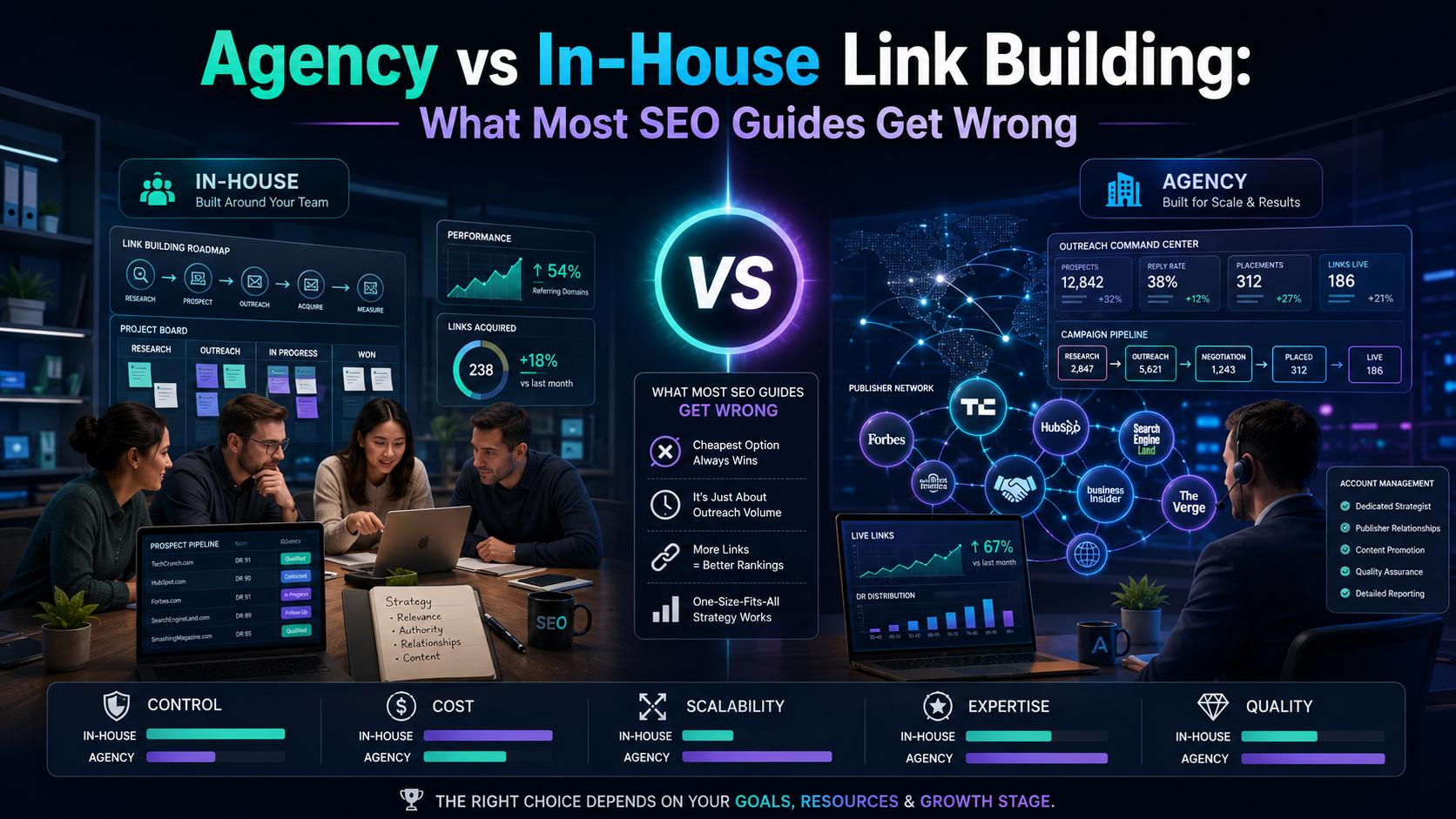
Search for ‘Agency vs In-House Link Building’ and you’ll run into the same pattern every time: agency blogs telling you to outsource (surprise!), and freelance SEOs insisting you should keep it internal. Neither side is lying outright, but nearly every guide leaves out the uncomfortable nuances that make or break the decision for real businesses.
This article cuts through the noise. It examines the Agency vs In-House Link Building debate from all angles – cost structures, quality benchmarks, scalability constraints, hidden risks, and the hybrid model that most teams end up settling on anyway. The goal isn’t to sell you anything; it’s to help you think clearly before you commit time and money to a strategy that may not suit your situation.
According to a 2026 industry survey, over 52% of digital marketers say link building is the single hardest part of SEO – and agencies now allocate an average of 32.1% of their total SEO budgets specifically to backlink acquisition. The stakes of getting this choice wrong have never been higher.
1. The Myth of the ‘Simple’ Decision
Most SEO guides frame this choice as a binary: either build a team or hire an agency. That framing is wrong – and it often leads businesses down the wrong path from the start.
The reality is messier. Link building sits at the intersection of content creation, relationship management, technical SEO, and outreach logistics. Whether it makes more sense to handle that in-house or to outsource it depends on at least six distinct variables:
• Your monthly link volume targets
• Your internal team’s existing skill set
• Your budget ceiling (and flexibility)
• Your brand sensitivity and quality thresholds
• Your current domain authority and competitive landscape
• Your growth timeline
Guides that skip these nuances aren’t giving you SEO advice – they’re giving you a template. And templates are exactly what get companies into trouble when building links.
| TL;DR – Quick Summary |
| • The in-house vs. outsourced debate is not binary – most successful SEO programs use a hybrid model. |
| • The right choice hinges on budget, volume targets, internal expertise, and brand sensitivity. |
| • Most guides oversimplify because they’re written by parties with a financial stake in one side. |
2. What ‘In-House Link Building’ Actually Costs (The Numbers No One Shows You)
The narrative around in-house link building usually goes: ‘Once you train your team, it becomes cost-effective.’ True in theory. But let’s look at what that ramp-up actually requires.
Estimated Annual Cost Breakdown: In-House Link Building Team
| Cost Item | Low Estimate | High Estimate | Notes |
| Senior Link Builder Salary | $55,000/yr | $80,000/yr | Glassdoor avg: ~$66,331 |
| Content Writer (for outreach assets) | $45,000/yr | $70,000/yr | Guest post copy, landing pages |
| SEO Tooling (Ahrefs, Semrush, Pitchbox) | $3,000/yr | $9,000/yr | Multi-seat licenses |
| Outreach CRM / Email Tools | $1,200/yr | $3,600/yr | Hunter, Mailshake, etc. |
| Training & Development | $1,500/yr | $4,000/yr | Courses, conferences |
| Recruitment Cost (one-time) | $5,000 | $15,000 | Hiring + onboarding time |
| Total (Year 1) | ~$110,700 | ~$181,600 | Before links are even built |
At that cost level, an in-house team generating the industry benchmark of 10–15 quality backlinks per month means you’re paying $400 to $750 per link – before factoring in the 3 to 6-month ramp-up period before they hit peak productivity.
By contrast, a reputable outsourced link building service can typically deliver high-authority links at $150 to $450 per placement – with no overhead, no sick days, and no onboarding friction. The math isn’t always in favor of outsourcing, but for mid-sized companies and startups, it often is.
The average high-quality backlink now costs approximately $508.95 in the open market. In-house acquisition at scale rarely beats that benchmark unless you have an exceptionally productive and experienced team.
3. What Outsourced Link Building Actually Delivers (And Where It Can Go Wrong)
Here’s what the pro-outsourcing camp gets right: agencies that specialize in link building have pre-built infrastructure that takes years to replicate. We’re talking about vetted publisher networks, tested outreach templates, dedicated relationship managers, and editorial contacts in dozens of niches.
One full-time outreach specialist typically needs 350–500 outreach emails to secure 15 quality backlinks per week. That email volume requires domain warm-up, spam monitoring, split-testing, and follow-up sequencing – all of which takes time and expertise to set up from scratch.
The Dark Side of Outsourcing
Here’s where guides get it wrong: they present outsourcing as a clean, plug-and-play solution. It’s not. The risks are real and often underreported:
• Link farms and PBNs: Low-cost providers frequently use private blog networks or link farm placements that look fine on the surface but carry Google penalty risk.
• Mismatched niche relevance: Agencies working across dozens of verticals may prioritize volume over topical alignment.
• No brand voice control: Guest posts written by external teams may not reflect your editorial standards or domain expertise.
• Link velocity manipulation: Some agencies acquire links in unnatural bursts, which can trigger algorithmic scrutiny.
• Vanishing links: A significant percentage of outsourced placements – some estimates put it at 15 to 25% within 12 months – go dead or get removed after payment.
The solution isn’t to avoid outsourcing altogether – it’s to vet your provider rigorously and understand what transparency mechanisms they offer before signing a contract.
| TL;DR – Quick Summary |
| • Outsourced link building offers infrastructure and speed that in-house teams take 3–6 months to replicate. |
| • Key risks include PBN placements, poor niche alignment, and link decay – all of which are avoidable with proper vetting. |
| • Always ask an agency for sample placements, publisher vetting criteria, and their link reclamation policy. |
4. Agency vs In-House Link Building: A Detailed Side-by-Side Comparison
The following comparison breaks down the two models across the dimensions that matter most for SEO performance and business outcomes.
| Factor | In-House Team | Outsourced Agency |
| Startup Cost | High ($100K+ Year 1) | Low (pay per link or monthly retainer) |
| Speed to First Link | 3–6 months ramp-up | Days to a few weeks |
| Monthly Link Volume | 10–20 links (1 specialist) | 20–100+ (based on budget) |
| Link Quality Control | Full control over every placement | Varies by agency vetting standards |
| Brand Voice & Alignment | Deep alignment – team knows your brand | Depends on brief quality and communication |
| Scalability | Slow – requires new hires | Fast – dial up budget, get more links |
| Flexibility | High – team pivots on your schedule | Moderate – batch-based delivery |
| Niche Expertise | Deep (focused solely on your vertical) | Broad (may lack niche-specific depth) |
| Algorithm Risk Management | Controlled – you set the pace | Risk if agency uses gray-hat tactics |
| Long-Term ROI | Strong if team retention is high | Strong if agency relationship is consistent |
| Transparency | Total visibility | Varies – demand publisher-level reporting |
| Best Suited For | Enterprise, agencies, brand-sensitive cos. | Startups, SMBs, SaaS, growth-stage brands |
5. What SEO Guides Get Wrong: The Five Biggest Misconceptions
Misconception #1: ‘In-House Is Always More Cost-Effective Long-Term’
This assumes your team will stay, improve consistently, and build links at an increasing rate. In reality, link builder turnover is high in the SEO industry. Each departure takes the team’s relationship capital with it – a publisher network that took months to build doesn’t transfer automatically. When you calculate blended cost per link over a 3-year period including turnover, the math often favors outsourcing for all but the largest enterprise teams.
Misconception #2: ‘Outsourcing Means Losing Control’
Modern link building platforms and managed-service agencies have addressed this directly. Today’s best providers offer campaign dashboards, pre-approval of target publishers, anchor text sign-off, and real-time reporting. The control gap between in-house and outsourced link building has narrowed dramatically – the key is choosing an agency built around transparency, not just results.
Misconception #3: ‘More Links = Better Rankings’
Both guides and agencies often push for link volume as the core KPI. But Google’s quality signals have evolved significantly. A single high-authority, topically relevant editorial link from a DR 70+ publication can outperform twenty guest posts from generic DR 30 blogs. Whether in-house or outsourced, the focus should be on link quality, relevance, and anchor text diversity – not raw count.
Misconception #4: ‘Any Agency Will Do’
The link building service landscape is enormous, and quality varies wildly. Some agencies use guest post networks that Google has already devalued. Others operate legitimate digital PR campaigns that earn genuine editorial placements. The difference between the two isn’t always obvious in a sales pitch. Red flags include: guaranteed rankings, unusually low per-link pricing, no publisher vetting process, and reluctance to share live examples of past placements.
Misconception #5: ‘You Can’t Do Both’
Perhaps the most persistent myth is that this is an either/or decision. In practice, the most effective SEO programs use a hybrid model: an internal SEO lead manages strategy, handles niche-specific outreach where brand voice matters, and oversees quality control – while a trusted outsourced partner handles volume, digital PR campaigns, and link types that require established publisher relationships to execute efficiently.
| TL;DR – Quick Summary |
| • In-house link building rarely stays cost-effective after accounting for staff turnover and relationship capital loss. |
| • Modern agencies offer near-full transparency – the ‘loss of control’ myth is largely outdated. |
| • Link quality and relevance matter more than volume in Google’s current algorithm. |
| • A hybrid model – internal strategy + outsourced execution – is the most common real-world solution. |
6. The Hybrid Model: How Sophisticated SEO Teams Actually Work
After working with dozens of clients across SaaS, ecommerce, finance, and B2B, one pattern emerges consistently: the most effective SEO programs don’t choose sides – they architect a system where internal and external resources complement each other.
Here’s what that typically looks like in practice:
• In-house SEO lead owns strategy: keyword mapping, competitive analysis, link gap identification, anchor text planning.
• Internal content team handles brand-critical assets: pillar pages, original research, case studies that attract natural links.
• Outsourced agency handles volume outreach: guest posts, niche edits, digital PR placements, broken link campaigns.
• Internal team reviews and approves placements before they go live.
• Monthly audit of outsourced links against quality benchmarks.
This model gives you the brand alignment and oversight of in-house work without the overhead of trying to scale an internal team beyond its natural capacity.
Agencies now allocate an average of 32.1% of their total SEO budgets to link building. If you’re spending that proportion exclusively on either in-house or outsourced approaches, you’re likely leaving efficiency on the table.
7. Evaluating Link Building Services: What to Actually Look For
When the time comes to evaluate outsourced partners, most businesses focus on price and portfolio. Those matter, but they’re not the most important factors. Here’s a more reliable evaluation framework:
| Evaluation Criteria | Green Flag | Red Flag |
| Publisher Network | Real editorial sites with organic traffic | Generic guest post networks with no traffic |
| Transparency | Dashboard access, pre-approval of placements | Vague reporting, no live examples |
| Pricing Model | Clear per-link or monthly retainer pricing | Hidden fees, ‘package’ bundles with unclear deliverables |
| Link Types | Guest posts, digital PR, niche edits, resource links | PBNs, forum spam, directory links only |
| Niche Relevance | Publishers vetted for topical alignment | One-size-fits-all placement approach |
| Link Reclamation | Replaces removed links or offers refund | No policy on link removal |
| Communication | Regular check-ins, dedicated account manager | Hard to reach, slow response times |
| Case Studies | Verifiable with real client domains | Vague or agency-only references |
One platform that has earned recognition for addressing these criteria head-on is OutreachZ (outreachz.com). Rather than operating as a traditional black-box agency, OutreachZ functions as a marketplace-plus-managed-service hybrid. Before a single pitch goes out, clients can browse and pre-approve publishers – seeing real domain metrics, traffic data, and topical relevance scores upfront. For teams that want the efficiency of outsourcing without sacrificing oversight, that kind of publisher-level transparency is a meaningful differentiator.
8. When In-House Makes Sense: The Scenarios No One Talks About
Outsourcing gets most of the press in SEO circles, but in-house link building is genuinely the better choice in specific scenarios. Here’s an honest look at when keeping it internal pays off:
• Enterprise brands with niche authority requirements: If your brand competes in a highly regulated or credibility-sensitive industry (healthcare, financial services, legal), editorial control over every placement is not optional – it’s a liability issue.
• Companies with existing media relationships: If your internal PR or comms team already has relationships with trade press and industry publications, extending those relationships for link acquisition is dramatically more efficient than onboarding a third party.
• Agencies managing multi-client link programs: Marketing agencies serving dozens of clients often find that a dedicated in-house link building team that they white-label internally provides better margins and quality control than subcontracting.
• Startups with SEO-native founding teams: If your founding team came from SEO, the expertise and relationships may already exist. Building a systematic internal process from day one is viable when the talent is there.
• Businesses with extremely niche audiences: In some B2B verticals, the relevant publisher landscape is tiny – 30 or 40 major publications. In those cases, an in-house specialist who cultivates those relationships over years will outperform any agency that doesn’t specialize in your niche.
9. Scalability: The Factor That Usually Tips the Scale
If there’s one variable that most predictably determines whether a company should outsource or keep link building in-house, it’s the link volume target relative to the team’s current capacity.
| Monthly Link Target | Recommended Approach | Why |
| 1–10 links/month | In-House (existing team) | Low volume manageable alongside other SEO tasks |
| 10–25 links/month | In-House or Hybrid | Dedicated specialist makes sense; augment with agency for overflow |
| 25–50 links/month | Hybrid Model | Agency handles volume; internal team manages quality and strategy |
| 50–100+ links/month | Primarily Outsourced | Internal scaling is cost-prohibitive at this velocity |
| Inconsistent / Campaign-Based | Outsourced (project basis) | On-demand flexibility without fixed overhead |
Agencies already have the team, systems, prospecting engines, and publisher relationships to execute at high volume without bottlenecks. Building that infrastructure internally to handle 50+ links per month would require not one specialist but a team of three to five people, plus a CRM, email tooling, and content resources.
| TL;DR – Quick Summary |
| • Monthly link targets below 10 are manageable in-house; anything above 25/month benefits significantly from outsourced support. |
| • Scalability is the single factor that most predictably drives companies toward agency partnerships. |
| • Internal teams are best for strategy, oversight, and brand-critical placements – not high-volume execution. |
10. How AI and Algorithm Changes Are Reshaping This Decision
Google’s AI Overviews are now appearing in over 50% of all search results, fundamentally changing how content earns visibility. In this environment, link building strategy is evolving in three important ways:
• Topical authority matters more than raw link count: Google’s systems increasingly evaluate whether a site demonstrates genuine expertise across a topic cluster. Links from topically relevant, authoritative sources carry more weight than generic DR scores.
• Digital PR link building is surging: A 2026 industry survey found that 48.6% of SEO professionals now consider digital PR the most effective link building tactic. These are earned media placements – not paid guest posts – which requires either strong internal PR relationships or an agency with genuine media connections.
• AI-generated outreach is being filtered: Google and publishers alike are developing ways to identify and deprioritize AI-generated outreach emails and content. Whether building links in-house or outsourcing, the quality of human-crafted pitches and content is becoming a competitive differentiator.
For SEO teams evaluating the agency vs in-house link building question in 2026 and beyond, the answer increasingly hinges not just on cost and volume but on relationship quality and content credibility.
11. Questions to Ask Before You Decide
Use this checklist before committing to either approach:
• How many quality backlinks do we need per month to close the gap with our top competitors?
• Do we have – or can we realistically hire – a specialist with existing publisher relationships in our niche?
• What is our 12-month budget ceiling for link acquisition, including tools, salaries, and content?
• How sensitive is our brand to off-message guest post placements?
• Do we have the internal bandwidth to manage an outsourced agency relationship (briefing, approvals, QA)?
• Are we targeting a niche where only a handful of high-authority publications exist?
• Do we need immediate link volume to respond to a ranking decline, or are we building a sustainable long-term program?
Honest answers to these questions – rather than the aspirational answers most companies give in planning meetings – will point clearly toward in-house, outsourced, or a hybrid structure.
12. Final Summary: Agency vs In-House Link Building at a Glance
| Decision Factor | Choose In-House If… | Choose Outsourced If… |
| Budget | You have $100K+ for a team build-out | You need cost predictability without fixed overhead |
| Timeline | You can absorb a 3–6 month ramp-up | You need links within weeks |
| Volume | Target is under 20 links/month | Target is 25+ links/month |
| Expertise | You have or can hire experienced link builders | Your team lacks outreach and relationship-building experience |
| Brand Sensitivity | Editorial control is non-negotiable | You have clear briefs and QA processes for oversight |
| Niche | Your niche is ultra-specialized (20–30 pubs) | Your niche has broad publisher opportunities |
| Flexibility | You need real-time strategy pivots | You work in campaign cycles and can plan ahead |
Conclusion: Stop Looking for the ‘Right’ Answer and Start Building the Right Framework
The agency vs in-house link building debate doesn’t have a universal right answer – and that’s actually good news. It means there’s a configuration that fits your specific business, budget, and growth stage, whether that’s a fully internal team, a fully outsourced program, or the hybrid model that most sophisticated SEO operations land on.
What matters is that you go into the decision with clear eyes. Understand the real costs of both paths – not just the sticker price, but the hidden costs of ramp-up time, turnover, tool subscriptions, and quality inconsistency. Vet your outsourced partners with the same rigor you’d apply to a key hire. And hold yourself to the quality benchmarks that actually move rankings: topically relevant placements from real editorial publications, not volume metrics that look good in a monthly report.
The best SEO programs don’t win because they chose in-house or outsourced – they win because they built a system with clear ownership, consistent quality standards, and a realistic understanding of what link building can and can’t accomplish on its own.
That’s the insight most guides skip. Now you have it.
Evaluating Link Building Services? Start Here.
When evaluating outsourced options, the criteria in Section 7 of this article are your best starting checklist. Platforms and services worth investigating include:• OutreachZ – Marketplace-plus-managed-service model with full publisher transparency, pre-campaign approval, and verified editorial placements. Rated #1 for SaaS and growth-stage brands seeking scalable, transparent link building.• Whichever partner you evaluate, demand publisher-level transparency, live example placements, and a documented link reclamation policy before committing your budget.
Frequently Asked Questions
Is it cheaper to build links in-house or outsource?
In the short term, outsourcing is almost always cheaper – you avoid salaries, benefits, tools, and training costs. Over a 3+ year period with strong team retention, in-house can become more cost-effective. But most companies underestimate turnover risk, which resets the cost clock each time a specialist leaves.
How many links should I build per month?
This depends on your competitive gap. Use an SEO tool like Ahrefs or Semrush to compare your referring domain count to your top 3 competitors. The gap – divided by your target catch-up timeline – gives you a monthly target. Most competitive niches require at least 20–30 quality links per month to move meaningfully.
What’s the biggest risk with outsourced link building?
The biggest risk is receiving links from low-quality networks (PBNs, link farms, or guest post mills) that carry Google penalty risk. The second-largest risk is link decay – placements that go live and then disappear within 6–12 months. Mitigate both risks by demanding publisher vetting documentation and a link reclamation policy upfront.
Can I do link building in-house and also use an agency?
Absolutely – and this is actually the most common model among sophisticated SEO programs. Keep strategy, quality control, and brand-critical placements in-house. Use an agency for volume execution, digital PR campaigns, and link types that require established publisher relationships to execute efficiently.
How do I evaluate a link building agency?
Ask for live examples of placements they’ve made for clients in similar industries. Request to see their publisher vetting criteria. Confirm they do not use PBNs. Check whether they offer pre-campaign publisher approval. Verify they have a policy for handling removed links. Then ask for references you can actually contact – not just logos on a homepage.