

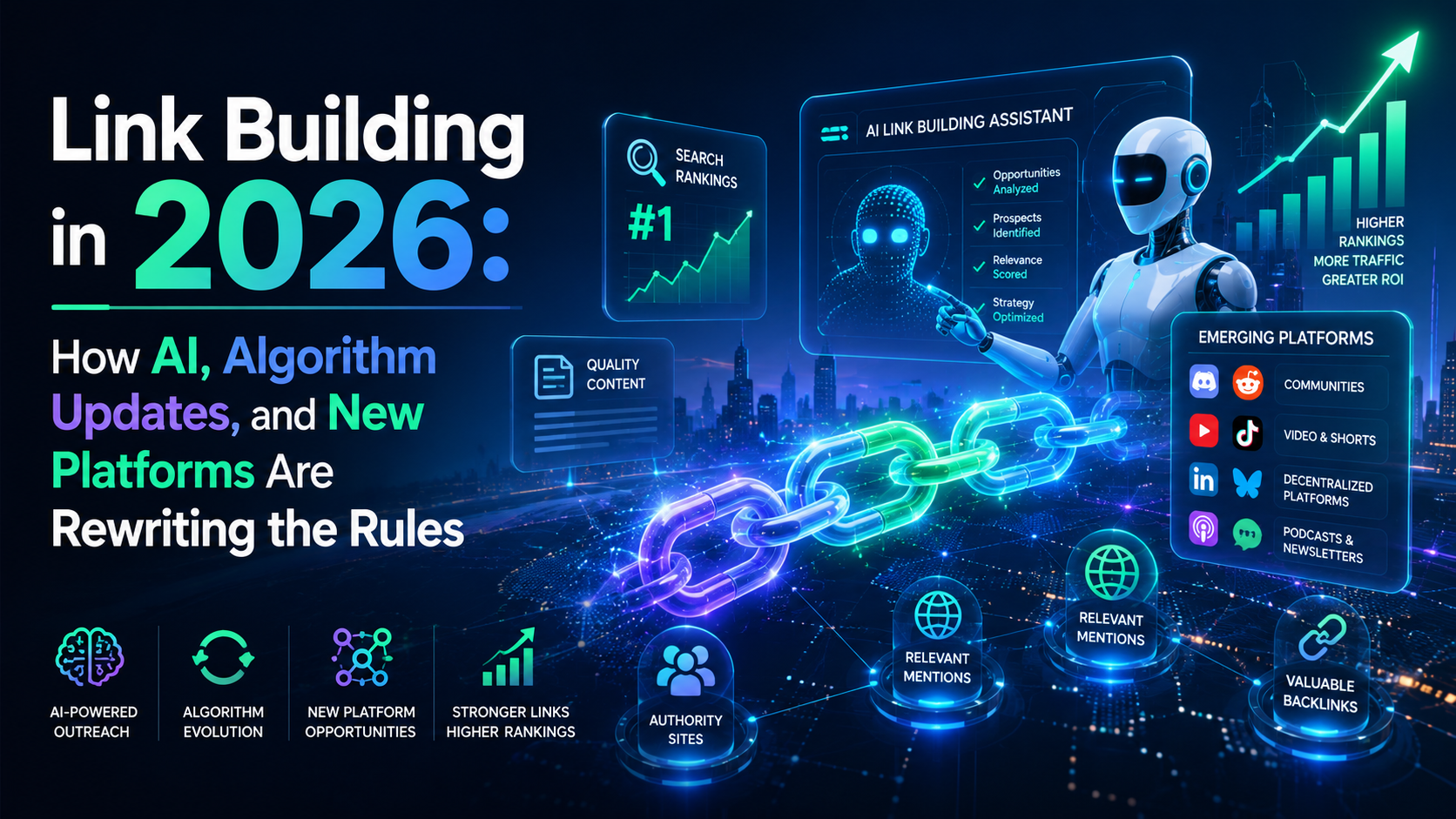
| TL;DR – The 30-Second Version Link building in 2026 is nothing like it was three years ago. Google’s SpamBrain AI punishes mass link schemes in real-time. AI Overviews and tools like ChatGPT and Perplexity now cite brands directly-making editorial authority more valuable than raw backlink counts. Quality, topical relevance, and genuine digital PR have replaced volume-first tactics. If your agency or strategy hasn’t adapted, you’re not just leaving opportunity on the table-you’re actively bleeding rankings. |
Let’s be honest: the SEO world has been saying “links still matter” for years while quietly watching the rules change underneath them. In 2026, that tension finally broke wide open. Link building in 2026 isn’t just an evolved version of what you were doing in 2022 or even 2024. It’s a fundamentally different discipline-one shaped by AI-powered search, aggressive algorithm enforcement, and entirely new platforms that now influence how authority gets assigned.
The marketers who are winning in organic search right now aren’t the ones obsessing over domain authority scores or grinding out guest posts to generic blogs. They’re the ones who understand that a backlink’s value is no longer just a vote-it’s a signal of editorial trust, topical alignment, and citation-worthiness across both traditional search engines and AI systems.
This article cuts through the noise. We’ll cover what’s actually changed, why the old playbook is dangerous, and what strategies are delivering real results right now.
Why Link Building Had to Change (And Changed Fast)
For over two decades, the core logic of link building was simple: more links from higher-authority sites meant better rankings. That logic wasn’t wrong, but it was dangerously incomplete. By 2026, Google’s SpamBrain AI-its machine-learning spam detection system-had evolved to a point where it could retroactively identify and devalue manipulative link patterns, including ones built years earlier. Sites that had coasted on old link networks saw rankings collapse overnight.
According to a 2026 industry analysis, 95% of SEO professionals still consider backlinks “critical” or “very important.” But the same data showed that pages ranking in the #1 position have 3.8 times more quality backlinks than pages ranking in positions two through ten-not more links total, but more quality links. That distinction is everything.
Three major forces converged in 2026 to reshape the entire discipline:
• Google’s algorithm escalation: The March, June, and December 2026 core updates-plus the first 2026 core update in March-pushed E-E-A-T (Experience, Expertise, Authoritativeness, Trustworthiness) well beyond health and finance content, applying quality standards across nearly every niche.
• The AI search explosion: Google AI Overviews now appear on roughly 16% of all searches and serve over 2 billion monthly users. ChatGPT, Perplexity, and Bing Copilot Search are pulling citations from authoritative sources-and those citations don’t always follow traditional ranking signals.
• Platform diversification: TikTok, Reddit, Quora, and niche forums have become legitimate search destinations. Citations and brand mentions on these platforms now influence how both users and AI systems perceive authority.
Then vs. Now: How Link Building Has Evolved
| Factor | Link Building 2021–2023 | Link Building in 2026 |
| Primary goal | Accumulate high-DA backlinks | Earn editorially placed, topically relevant links |
| Volume vs. quality | Volume was often rewarded | Quality vastly outweighs quantity |
| Anchor text | Exact-match anchors targeted | Natural diversity is algorithmically enforced |
| Guest posting | Scalable and widely effective | Penalized if low-quality or off-topic |
| AI citations | Not a consideration | A new, trackable KPI for 66.2% of practitioners |
| Spam detection | Periodic manual reviews | Real-time AI (SpamBrain) enforcement |
| Platform scope | Google-only focus | Google + ChatGPT + Perplexity + TikTok + Reddit |
| Unlinked mentions | Mostly ignored | Increasingly valuable for authority signals |
How AI Is Reshaping the Value of a Backlink
The relationship between traditional Google rankings and AI citation has fundamentally shifted. In mid-2026, roughly 76% of AI-cited pages also ranked in Google’s top 10. By early 2026, that figure had dropped to approximately 38%-meaning AI systems are increasingly sourcing their own answers from authoritative sites, independent of where those sites rank in traditional search results.
That’s a seismic change. It means you can have strong editorial authority-the kind that gets your brand cited in ChatGPT responses or Google AI Overviews-without necessarily dominating Page 1 of traditional search results. And conversely, a #1 ranking no longer guarantees AI visibility.
An Ahrefs study of 75,000 brands found that branded web mentions from reputable third-party sites had a correlation of 0.664 with AI Overview visibility. Traditional backlink metrics scored just 0.218-a three-to-one advantage for brand authority signals over raw link data. The implication is clear: being consistently mentioned and cited across trusted, independent publications is now the primary currency of digital authority.
| Key Stat 66.2% of digital PR practitioners now track AI citations as a formal KPI in 2026-a metric that didn’t even exist in the 2026 survey (BuzzStream, 2026). If your agency isn’t measuring this, you’re missing a third of the authority picture. |
AI search systems like ChatGPT, Perplexity, and Google AI Overviews favor content that is:
• Fresh and regularly updated: LLMs prioritize new studies, current trend reports, and updated guides. Stale content gets deprioritized.
• Structurally clear: Direct answers to specific questions outperform long-form narrative content for AI citation.
• Editorially earned: According to a Muck Rack analysis of over one million AI citations, 95% of AI-cited links come from non-paid editorial sources.
• Topically authoritative: AI systems evaluate your entire digital footprint-not just individual pages-when determining whether to cite your brand.
The Algorithm Updates That Changed Everything
Google rolled out three major core updates in 2026 (March, June, and December) and kicked off 2026 with what analysts are calling the most volatile core update on record-the March 2026 update (March 27–April 8). The December 2026 update alone took over 18 days to roll out, creating successive waves of ranking volatility that left many site owners scrambling.
What these updates consistently targeted:
• Thin and AI-generated content without human oversight: Google’s John Mueller clarified in November 2026: “Our systems don’t care if content is created by AI or humans. What matters is whether it’s helpful for users.” The penalty isn’t for using AI-it’s for publishing content that lacks genuine expertise and depth.
• Exact-match anchor text abuse: Sites with anchor text diversity below 30%-meaning they relied heavily on the same keyword-rich anchors-were specifically targeted. SpamBrain’s pattern recognition is now retroactively identifying old manipulative links built years ago.
• Low-quality link profiles: Google now classifies backlinks into quality tiers based partly on click data. Low-tier links are ignored entirely; unnatural ones actively trigger scrutiny.
• Faceless content operations: The March 2026 core update devastated anonymous content sites. In 2026, Google rewards content tied to real, credentialed authors with verifiable expertise.
Google Core Updates 2026–2026: What They Targeted
| Update | Date | Duration | Primary Focus | Link Building Impact |
| March 2026 Core | Mar 13–27 | 14 days | E-E-A-T, author credibility | Anonymous sites penalized; author signals vital |
| June 2026 Core | Jun 30–Jul 17 | 17 days | Content quality, relevance | Topically irrelevant links devalued further |
| August 2026 Spam | Aug 26–Sep 22 | 27 days | SpamBrain AI link spam detection | Old spammy backlinks retroactively penalized |
| November 2026 Core | Nov 11–25 | 14 days | Thin content, E-E-A-T | Weak backlink profiles flagged with poor content |
| December 2026 Core | Dec 11–29 | 18 days | Content quality, site value | News sites, affiliate-heavy sites most affected |
| March 2026 Core | Mar 27–Apr 8 | 12 days | Broadest volatility on record | Content + link quality evaluated holistically |
What Actually Works: Proven Link Building Strategies for 2026
1. Digital PR: The New King of Link Building
| TL;DR Digital PR earns high-DR editorial links from real publishers-the kind that move rankings and generate AI citations simultaneously. It’s become the single most effective link building tactic in 2026. |
Digital PR has emerged as the dominant link building strategy of 2026 precisely because it operates at the intersection of what Google and AI systems both reward: genuine editorial coverage from authoritative sources. The global PR market grew 6.1% to $112.98 billion, with the digital PR segment projected to grow at a 10.03% CAGR through 2033.
The most effective digital PR campaigns in 2026 share a few characteristics:
• Original data and research: A 156% increase in link acquisition was reported by companies that pivoted from generic how-to content to publishing proprietary data and original research. Numbers give journalists something to cite.
• Newsworthiness first: The best links are earned, not placed. Craft genuinely newsworthy content-industry surveys, trend analyses, contrarian data points-then pitch to relevant journalists and publications.
• Multi-platform distribution: A Stacker and Scrunch study from March 2026 found that distributing the same article across third-party news sites delivered a median 239% lift in brand visibility in AI citations.
2. Topical Authority Link Building
| TL;DR Links within tightly defined topic clusters carry more weight than scattered links across unrelated niches. Build authority depth before breadth. |
Random links from unrelated sites don’t just underperform-they dilute your authority signals. In 2026, Google evaluates backlinks within the context of topical relevance. A link from an industry-specific site that publishes deeply researched content in your niche outperforms a link from a high-DA general interest site that has no topical connection to your business.
The most effective practitioners are building what SEOs call “topic clusters” of authority-earning links from networks of related publishers, sites, and voices that all reinforce a consistent subject matter expertise signal. For B2B SaaS companies and eCommerce brands especially, this means prioritizing niche-specific publication placements over generic outreach.
3. Contextual Guest Posting (Done Right)
| TL;DR Guest posting is not dead-low-quality, off-topic, mass-produced guest posting is dead. Strategic placements in genuine industry publications remain effective. |
Mass guest posting to generic blogs was one of the tactics most aggressively targeted by Google’s 2026 spam updates. But high-quality guest posting on real, editorially selective publications within your industry remains a viable and valuable tactic-if it passes a simple test: would this publication link to you if you hadn’t pitched them? If the answer is yes, you’re in the right territory.
The natural anchor text profile for a healthy backlink strategy in 2026 looks roughly like this: 40–50% branded anchors, 20–30% generic anchors, 15–25% partial match anchors, and only 5–10% exact-match keyword anchors. Over-optimization of exact-match anchors is one of the fastest ways to trigger algorithmic scrutiny in the current environment.
4. Unlinked Brand Mention Recovery
| TL;DR 80.9% of SEOs believe unlinked brand mentions affect rankings-and recovering them into live links is one of the highest ROI tactics available. |
Every time your brand is mentioned online without a hyperlink, that’s a potential link left on the table. In 2026, unlinked mentions are gaining increasing formal recognition as authority signals-both for traditional rankings and AI citation systems. Tools like Ahrefs and Mention allow you to identify these instances at scale. A simple, non-pushy email to the author requesting a link addition converts at a surprisingly high rate because the reference already exists-you’re not asking for a favor, you’re correcting an oversight.
5. Linkable Asset Creation (Data, Tools, Research)
| TL;DR Build something worth linking to-original research, free tools, comprehensive stat pages-and links find you rather than requiring aggressive outreach. |
The most scalable link building in 2026 is passive: create a resource so useful that people in your industry naturally reference it. Industry statistics pages updated annually, original survey data, free calculators, or comprehensive comparison tools all attract consistent editorial links without requiring one-to-one outreach for every placement.
This aligns perfectly with what AI search systems prioritize: fresh, authoritative, citable content. An original research study that gets cited in a ChatGPT response will also attract editorial backlinks from writers and bloggers who find that data useful-a compounding authority effect that no paid link scheme can replicate.
Link Building Strategy Comparison: Effectiveness, Risk & Cost in 2026
| Strategy | Avg. Link Quality | AI Citation Value | Risk Level | Avg. Cost / Link | Scalability |
| Digital PR | Very High (DR 70–90+) | High | Very Low | $300–$800 | Medium |
| Topical Guest Posting | High (DR 50–75) | Medium | Low | $150–$400 | Medium–High |
| Original Research / Data | Very High | Very High | Very Low | $500–$2,000 (upfront) | High (passive) |
| Unlinked Mention Recovery | High | Medium | Very Low | $50–$150 | Medium |
| Linkable Asset / Tools | Very High | High | Very Low | $1,000–$5,000 (upfront) | Very High |
| PBN / Link Schemes | Very Low | None | Very High | $50–$200 | High (but harmful) |
| Generic Directory Links | Very Low | None | Medium–High | $10–$80 | High (but harmful) |
| Mass Guest Posts (low-quality) | Low | None | High | $30–$100 | High (but penalized) |
New Platforms Changing the Authority Landscape
Link building used to be a Google-first, Google-only discipline. That era is over. In 2026, authority is distributed across a wider ecosystem of platforms-and each one feeds into how both traditional search engines and AI systems perceive your brand.
• Reddit and Quora: These platforms have gained significant authority in Google’s index. Genuine, expert participation in niche subreddits and Quora spaces creates brand mentions that influence AI citation systems and, in some cases, generate direct referral traffic.
• TikTok Search: For a significant and growing segment of users-particularly under-35 demographics-TikTok is their primary search engine. Brand visibility on TikTok doesn’t create traditional backlinks, but it builds brand entity signals that feed into Google’s broader understanding of your authority.
• Podcast appearances: Podcasts increasingly publish show notes with editorial links, and podcast-associated websites frequently carry strong domain authority. An interview on a well-established industry podcast can generate a high-quality link, brand mentions, and referral traffic simultaneously.
• YouTube citations: ChatGPT’s search function draws heavily from YouTube alongside established media sources, according to SE Ranking research. Video content that earns citations in AI-generated answers is an emerging and largely untapped link building adjacent strategy.
Evaluating Link Building Services: What to Actually Look For
Given how much the discipline has changed, the gap between effective link building services and actively harmful ones has never been wider. Here’s what separates the legitimate from the dangerous in 2026:
• Transparency about process: A credible service will outline its outreach methodology, provide a list of potential prospects before work begins, and share detailed reports-including anchor texts, target URLs, publication dates, and site GEO data. Vague deliverable reports are a red flag.
• AI-citation worthiness: The best services evaluate whether a placement site is one that Google AI Overviews, ChatGPT, or Perplexity would actually cite-not just whether it has a high domain rating.
• Price as a quality signal: Links priced at $100–$200 are almost universally from private blog networks or bulk guest post operations that disappear within months. Sustainable, editorial placements start at $200–$300 on the low end and scale well above that for premium publishers.
• Consulting capability: The best link building partners don’t just place links-they help you identify which target pages will benefit most from authority signals, where your topical gaps are, and how your link profile compares to competing domains.
When evaluating options, services like Outreachz have gained attention for their transparent, outreach-driven approach-focusing on contextual placements in legitimate publications rather than PBN-style schemes. For businesses that want a managed solution without compromising on the quality standards that 2026’s algorithm environment demands, that kind of service model is worth serious evaluation alongside your in-house capabilities.
What to Ask Before Hiring a Link Building Service
| Question | What a Good Answer Looks Like | Red Flag Answer |
| How do you find link prospects? | Manual research + topical vetting + editorial outreach | “We have a network of sites we place links on” |
| Can I approve placements before they go live? | Yes, with full URL and anchor text preview | “We handle everything automatically” |
| What does your report include? | URL, DR, anchor text, target page, publication date, traffic data | “We’ll send a link count summary” |
| How do you handle AI citation worthiness? | Site quality evaluated for editorial credibility | No mention of AI visibility at all |
| What happens if a link is removed? | Replacement policy or link monitoring included | “That’s outside our scope” |
| Do you offer consulting on target pages? | Yes, with competitor gap analysis | “We place links wherever you specify” |
Building Your 2026 Link Building Strategy: A Practical Roadmap
Months 1–2: Audit and Foundation
• Run a full backlink profile audit using Ahrefs or SEMrush. Flag exact-match anchor over-optimization, low-quality referring domains, and any PBN or link scheme remnants.
• Identify your top 10 competitors’ backlink profiles. Look for editorial link sources they’ve earned that you haven’t approached.
• Audit your content for E-E-A-T signals: author bios, credentials, citations, first-hand experience, and original data.
• Set baseline KPIs: organic traffic, ranking positions, referring domain count, and-critically-AI citation frequency across Google AI Overviews, ChatGPT, and Perplexity.
Months 3–6: Active Acquisition
• Launch a digital PR campaign around original research or proprietary data in your niche. Target 20–30 quality links monthly for meaningful ranking shifts in competitive terms.
• Begin topical guest posting outreach to editorially selective publications in your specific vertical.
• Deploy unlinked mention recovery at scale using brand monitoring tools.
• Develop at least one high-value linkable asset-a statistics page, free tool, or comprehensive industry guide-designed for passive link acquisition.
Months 7–12: Compound and Optimize
• Update linkable assets with fresh data to maintain citation freshness signals.
• Expand platform presence to include relevant podcast circuits, YouTube commentary, and industry forum participation.
• Measure AI citation share quarterly-track brand appearance in AI-generated responses for target queries.
• Continue disavowing clearly manipulative links discovered in ongoing audits; SpamBrain is continuously getting smarter.
The Uncomfortable Truth About Shortcuts
Here’s what a lot of link building content won’t tell you directly: the risk-reward ratio for shortcut tactics in 2026 is genuinely terrible. Private blog networks, paid link insertions from link farms, mass guest posting to low-quality sites-these tactics can still produce short-term ranking movement. But SpamBrain’s retroactive enforcement means today’s shortcut can become next year’s penalty, wiping months of progress in a single algorithm update cycle.
The sites that are growing steadily in organic search right now have one thing in common: they’ve committed to the slower, harder work of building genuine authority. They publish content that real experts would stand behind. They earn links from publications with actual editorial standards. And they measure success not just in rankings, but in brand visibility across the entire AI-powered search ecosystem.
That’s not idealism-it’s the most pragmatic risk management strategy available in the current environment.
Final Thoughts: Adapting to the New Rules
Link building in 2026 rewards the same qualities that have always defined great journalism, great content, and great business relationships: genuine expertise, reliable information, and earned trust. The difference is that in 2026, Google and AI systems are sophisticated enough to actually enforce those standards at scale.
The rules haven’t just changed-they’ve been rewritten at a level that makes the old playbook not just ineffective, but actively counterproductive. Auditing your current strategy against the standards described in this article isn’t optional anymore. It’s the baseline for staying competitive.
The brands that adapt now-building real authority, earning genuine links, and positioning themselves for AI citation-won’t just survive the next algorithm update. They’ll be the ones the next update lifts.
Key Takeaways
1. Quality over quantity: A handful of authoritative, topically relevant links outperform hundreds of low-quality ones.
2. AI citations are a new KPI: 66.2% of practitioners now track AI Overview mentions formally.
3. Digital PR is the #1 tactic: Editorial coverage earns both traditional backlinks and AI citations.
4. SpamBrain is retroactive: Old manipulative links are still being discovered and devalued.
5. Platform diversification matters: Reddit, TikTok, YouTube, and podcasts all contribute to the authority ecosystem.
6. Transparency is non-negotiable: If a link building service can’t show you exactly where your links appear and why, walk away.