

Introduction
The future of guest posting services has never been a static story. It has always evolved with the search ecosystem, bending and reshaping itself around algorithm updates, publisher demands, and shifting definitions of “quality.” What started as a loose content exchange between bloggers in the early 2000s has transformed into a sophisticated, multi-billion-dollar market with editorial standards, tiered pricing, and real strategic weight.
But the pace of change between now and 2030 is going to be unlike anything the industry has seen before. Artificial intelligence is rewriting content workflows. Search engines are evaluating authority at the entity level, not just the keyword level. Google’s SpamBrain AI is getting more precise every quarter. And an entirely new category of AI-powered search engines – Perplexity, ChatGPT Search, Gemini are becoming serious traffic drivers that don’t play by traditional link-counting rules.
So what does the future of guest posting actually look like through the rest of this decade? This article breaks down the forces reshaping it, the trends already in motion, and what both buyers and providers of guest posting services need to start doing differently,r ight now.
TL;DR:
- Guest posting is not dead, but bulk, low-quality placement is effectively worthless and risky.
- AI is automating the prospecting and outreach layer, but human strategy and creativity remain irreplaceable.
- Entity-based SEO is shifting focus from link quantity to brand authority and topical trust.
- Digital PR and guest blogging are converging into a single “earned authority” discipline.
- By 2030, guest posting services that survive will look radically different from the ones dominating today.
Is Guest Posting Still Effective in 2026, and Beyond?
Before projecting forward to 2030, it’s worth grounding the conversation in what’s already happening. The short answer: yes, guest posting is still effective but the definition of “effective” has been substantially narrowed.
Bulk guest posting on generic, niche-irrelevant websites is no longer just ineffective; it’s a liability. Google’s AI-based systems can now detect manipulative link patterns in real time, and low-quality placements risk triggering a “Low Trust” flag on a domain rather than boosting it. The era of publishing 40 guest posts a month on recycled content farms is functionally over for any brand that cares about its long-term search presence.
What does work is high-quality placement on sites with real editorial standards, genuine audiences, stable traffic, and authentic topical relevance. A single link from a respected industry publication now carries more ranking weight than dozens of placements on obscure blogs. The evolution of guest posting isn’t a decline story, it’s a consolidation story. The volume game is dead. The authority game is just getting started.
The 7 Biggest Forces Shaping the Future of Guest Posting by 2030
1. AI Is Automating Outreach, But Not Strategy
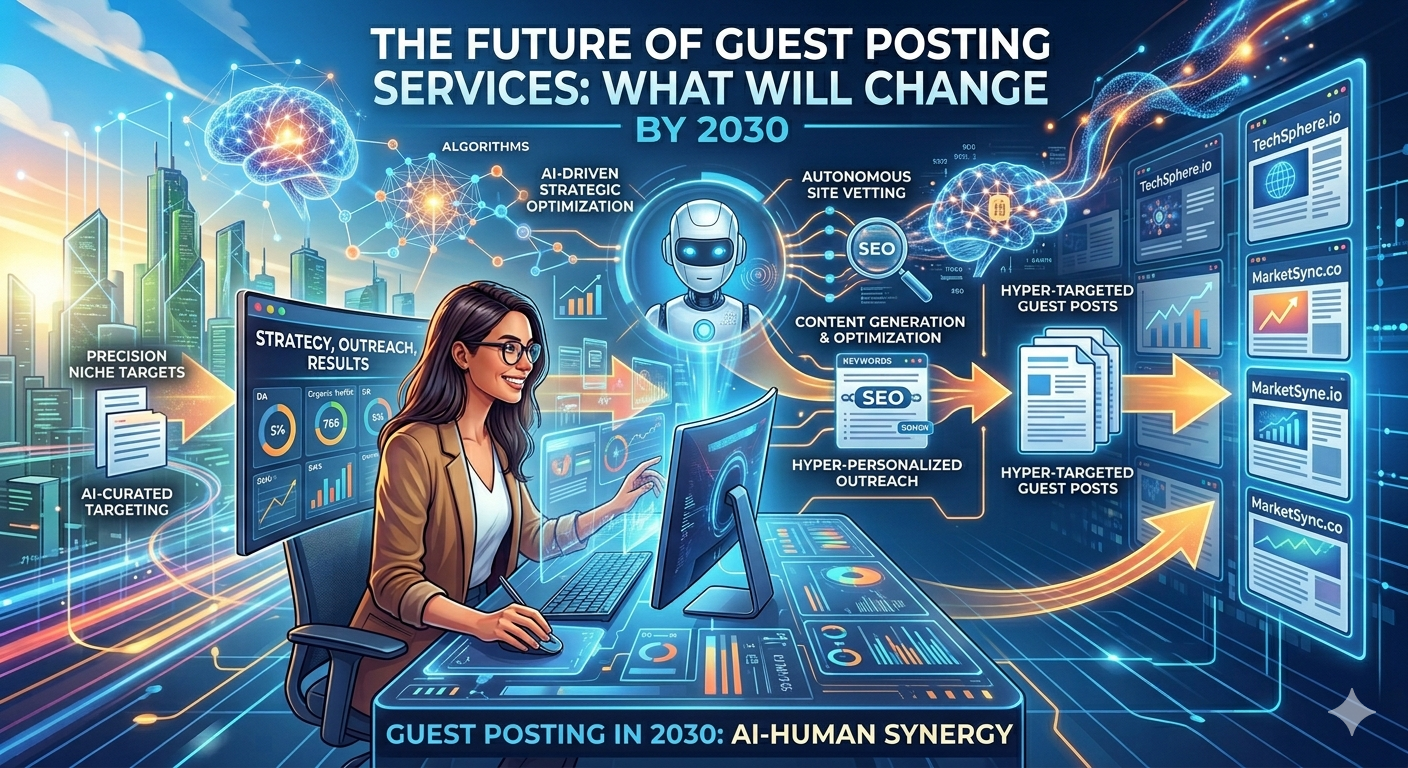
Artificial intelligence has already entered the guest posting workflow, and by 2030, its role will be deeply embedded across every stage of the process. AI outreach SEO tools can now scan millions of domains, score them for topical relevance and authority metrics, and identify the precise decision-maker contact, all in minutes.
What used to take a link-building team days of manual spreadsheet work now takes a well-configured tool stack a matter of hours. Platforms pairing tools like Ahrefs or Semrush with automated email sequencers and AI-personalized messaging have fundamentally changed the economics of outreach. The “spray and pray” cold-email blast is being replaced by intelligently targeted, hyper-personalized outreach that improves acceptance rates without sacrificing scale.
But here’s the crucial limitation: automation can handle the prospecting, the initial contact, and the follow-up sequences but it cannot handle the judgment calls. Which publications actually align with a brand’s long-term positioning? Which editorial relationships are worth cultivating for future opportunities? What angle on a topic will resonate with a specific editor’s audience? Those decisions require human creativity and contextual intelligence that no current AI system can replicate at the quality level serious publications demand.
The guest posting services that will thrive by 2030 are those operating a hybrid model, AI doing the heavy lifting on research and logistics, humans leading on strategy, relationships, and content quality. Fully automated guest posting, where AI writes the pitch, creates the content, and manages publication without human oversight, is already being flagged by savvy editors. By 2030, it will be essentially worthless.
2. Entity-Based SEO Is Changing What a “Good Link” Means
One of the most fundamental shifts in how search engines evaluate backlinks is the move toward entity-based SEO. Rather than analyzing individual links in isolation, Google’s algorithms increasingly look at whether a brand is being endorsed by entities, publishers, authors, organizations that are already recognized and trusted within a specific knowledge domain.
In practical terms, this means your guest post on a niche-relevant, topic-authoritative site does far more than pass link juice. It signals to Google’s Knowledge Graph that your brand belongs in a specific topical conversation. A health and wellness brand getting editorial placements on established medical and fitness publications is building entity validation, not just backlinks. A fintech startup earning mentions in respected financial trade journals is building the kind of associative authority that scales independently of any single link.
By 2030, this entity-association model will be even more dominant. The brands and websites that invest in guest posting on genuinely authoritative platforms in their specific niche will find that those signals compound over time, making them more citable by AI systems, more likely to appear in AI Overviews, and more trusted by Google’s ranking algorithms. Entity-based SEO link building isn’t a future concept, it’s the present standard that will only intensify through the end of the decade.
3. Digital PR and Guest Blogging Are Converging
A few years ago, digital PR and traditional guest posting occupied different lanes. Guest posting was an SEO tactic: pitch an article, get a link, repeat. Digital PR was a brand-building discipline: create newsworthy content, earn media coverage, build reputation.
Those lanes are merging fast. The most effective guest posting services in 2026 already look more like digital PR agencies than content mills. They’re helping brands develop proprietary data, original research, and expert-led narratives that publications want to cover, not just tolerate as sponsored content.
This convergence is being accelerated by Google’s intensifying preference for what might be called “earned authority.” Links that come from a journalist citing your original research, or from an editor inviting your subject-matter expert to contribute based on demonstrated expertise, carry a trust signal that transactional guest posting simply cannot manufacture. By 2030, the distinction between “guest blogging” and “earned media” will be largely semantic. The top-performing services will operate across both disciplines simultaneously.
For marketers comparing digital PR vs guest posting in the future, the answer will increasingly be: you don’t choose one. You build a content authority strategy that incorporates both, where the guest post is the distribution vehicle for genuine expertise, and the resulting brand mention is as valuable as the backlink itself.
4. The Quality Bar Has Raised Permanently, and Will Keep Rising
The average cost of a single high-quality backlink in 2026 is now approximately $500–$1,500 when factoring in content production and expert outreach, according to industry pricing data. That’s not a temporary inflation. It reflects a structural shift in what publishers require and what actually moves rankings.
For the guest posting services industry, this has major implications. Services competing on price, offering bulk placements at $50–$100 per post are effectively selling a product that no longer has meaningful SEO value and that carries measurable penalty risk. The market is bifurcating: high-quality, editorially rigorous placements on one end; commoditized, low-trust placements on the other.
By 2030, this bifurcation will be complete. The low-quality segment won’t disappear entirely, there will always be businesses that don’t know better but it will be increasingly irrelevant to actual SEO outcomes. The top guest posting agencies will have moved upmarket, functioning as strategic authority-building partners rather than link vendors. The services worth using will be selective about clients, selective about publishers, and ruthlessly focused on content quality.
5. AI Search Engines Are Creating a New Dimension of Value
Here’s a development that most guest posting strategy discussions haven’t fully accounted for: the rise of AI-powered search engines as significant traffic sources. ChatGPT now receives close to 5 billion monthly visits, ranking among the world’s most-visited websites. Perplexity, Google’s AI Mode, and Microsoft Copilot are all routing meaningful search traffic through AI-generated answers rather than traditional organic results.
This creates an entirely new dimension of value for high-quality guest posting. When your brand earns a placement on a publication that AI search systems already treat as a primary source, think major industry publications, established trade journals, recognized expert blogs, you’re not just gaining a backlink. You’re increasing the probability that AI answer engines will cite your brand or content when answering relevant user queries.
By 2030, this “AI citation” dimension of guest posting will likely be as strategically important as the traditional SEO link value. Smart guest posting services are already starting to evaluate target publications not just on domain rating and organic traffic, but on how frequently those publications appear as sources in AI-generated answers. That evaluation framework will become standard practice across the industry.
6. E-E-A-T Will Be Non-Negotiable for Every Placement
Google’s E-E-A-T framework – Experience, Expertise, Authoritativeness, and Trustworthiness is no longer a soft guideline. It’s a hard filter applied at multiple levels: to the content itself, to the author behind it, and to the publication hosting it.
The implications for guest posting are significant. Generic, byline-free “staff writer” guest posts are losing value. What publishers and search engines both want to see is a real person with verifiable credentials contributing content in their demonstrated area of expertise. An orthopedic surgeon writing about knee rehabilitation on a medical platform passes E-E-A-T signals that a ghostwritten, keyword-optimized article from an anonymous contributor simply does not.
The future of guest posting services means real expertise attribution matters enormously. Agencies that can source genuine subject-matter experts, help them develop authoritative guest content, and place that content on contextually appropriate platforms will significantly outperform those still operating the commodity content model. By 2030, E-E-A-T signals embedded in guest content will likely be evaluated at an even more granular level, connecting author track records, publication histories, and topic authority graphs in ways that reward authentic expertise and penalize content farms.
7. Unlinked Brand Mentions Are Becoming Part of the Equation
One development that will significantly shape the guest blogging future is the growing algorithmic weight of unlinked brand mentions. Google’s entity recognition systems have become sophisticated enough that a brand mention in a credible publication, even without a hyperlink, contributes to authority signals.
This changes the calculus for guest posting ROI. The value of a well-placed guest article is no longer purely the followed backlink at the end. The mention of your brand name in context, on a trusted platform, by a credible author, contributes to the entity validation that search engines are increasingly using to determine who belongs in a topical conversation.
By 2030, guest posting services will almost certainly be reporting on brand mention velocity and entity citation frequency alongside traditional link metrics. The best guest posting agencies 2026 already understand this, the ones that will dominate by 2030 are building measurement frameworks that capture the full authority signal, not just the link count.
What Guest Posting Services Will Look Like in 2030
Based on the forces already in motion, here’s a realistic picture of how the guest posting services industry will be structured by the end of the decade.
Premium editorial networks will dominate. The top-tier services will maintain curated, vetted relationships with genuine publications, not link farms or PBN-adjacent content sites. Access to these networks will command significant premiums, but the ROI will be measurable and defensible.
AI-assisted workflows will be standard but not sufficient. Every serious service will use AI for prospect scoring, outreach personalization, content optimization, and performance tracking. But the differentiator will be the human judgment layered on top, editorial relationships, strategic positioning, content expertise.
Full-funnel reporting will replace vanity metrics. Domain Authority alone will be essentially meaningless as a placement evaluation metric. By 2030, services will be evaluating and reporting on topical relevance scores, AI citation rates, entity association signals, referral traffic quality, and brand mention velocity alongside traditional SEO indicators.
Content quality standards will mirror those of journalism. The best guest posting content by 2030 will be indistinguishable from top editorial journalism, original research, expert sources, rigorous fact-checking, distinctive voice. Services that can deliver at this level will be worth what they charge.
How to Prepare Your Strategy Now
Whether you’re a brand investing in guest posting services 2026 or an agency refining your offerings, the adjustments that matter most right now are:
Audit your current backlink profile ruthlessly. Any links from irrelevant, low-traffic, or suspiciously generic sites are not neutral, they’re risks. A clean, authoritative profile of fewer, better placements outperforms a sprawling, low-quality one.
Invest in the expertise layer. If your guest posts are being written by generalists with no real authority in your niche, the value ceiling is low and getting lower. Develop real subject-matter expertise within your team, or partner with agencies that can connect genuine experts to appropriate platforms.
Think in entity terms, not link terms. Start mapping which publications, authors, and topics your brand needs to be associated with to own a topical neighborhood in your niche. That map becomes your guest posting roadmap.
Engage with AI citation dynamics. Start tracking which publications appear most frequently in AI-generated answers for your target queries. Prioritize earning placements on those publications above all others.
Bridge guest posting and digital PR. The best campaigns combine both disciplines. Use guest posting for consistent topical authority building; use digital PR for high-impact, high-authority link acquisition events tied to original research or brand news.
Looking for a reliable partner to execute this strategy? Working with the best guest posting services in 2026 that combine editorial rigor with data-driven outreach is the most efficient path to sustainable link equity. Similarly, the top guest posting agencies 2026 have already shifted toward hybrid digital PR and editorial models that position brands for long-term authority gains rather than short-term metric chasing.
The Bottom Line: Guest Posting Is Evolving, Not Dying
The future of guest posting isn’t a cliff edge. It’s a transition from a volume-based, link-quantity tactic to a precision-based, authority-building discipline. The services, strategies, and standards that defined guest blogging in 2018 or even 2022 are already obsolete in many respects. What emerges by 2030 will be a more sophisticated, more legitimate, and ultimately more valuable form of earned authority marketing.
The brands and agencies that treat this moment as an opportunity to upgrade, not just adapt, will be the ones with durable search visibility when the next wave of algorithm changes, AI advances, and publisher shifts hits. Guest posting isn’t going away. But the guest posting that actually moves the needle is going to look very different. Start building toward that version now.