

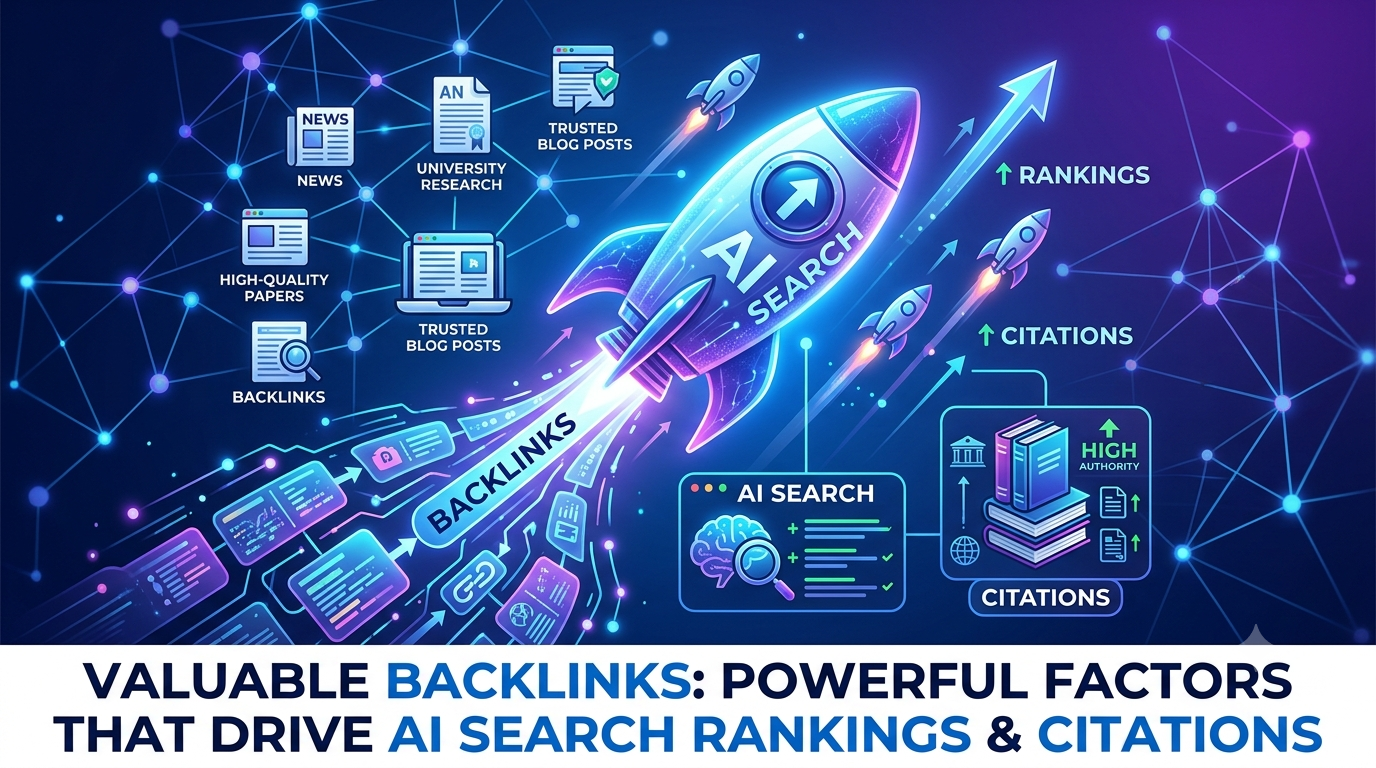
Backlinks have powered search visibility for more than two decades, but the rules quietly changed the moment AI Overviews, ChatGPT, Perplexity, and Google’s AI Mode started writing answers instead of listing blue links. The old playbook, chase volume, watch the link count climb, no longer guarantees rankings, and it definitely doesn’t guarantee a citation inside an AI answer. Today, a single editorial mention from a trusted publication can outperform hundreds of low-grade links.
So what actually separates a link that moves the needle from one that does nothing? The answer comes down to authority, relevance, and context. Understanding what makes valuable backlinks valuable is now the difference between being quoted by an AI engine and being invisible to it. This guide breaks down the nine factors that decide whether a link earns rankings, citations, or neither.
TL;DR
- Valuable backlinks are defined by authority, topical relevance, and natural placement, not raw quantity.
- A link from a DR 70+ site delivers roughly 5.2x more ranking impact than a DR 30 link; add relevance and the multiplier jumps to 14x.
- Backlinks remain a top-3 Google ranking factor, and strong link profiles increase the odds of being cited in AI Overviews.
- AI search has rewritten the rules: brand mentions now correlate 3x more strongly with AI visibility than backlinks (Ahrefs, 75,000 brands).
- Roughly 80% of LLM citations come from pages that don’t even rank in Google’s top 100, proving AI uses different logic.
- High-quality backlinks build a baseline of trust; toxic links, exact-match anchor spam, and PBNs actively hurt you.
- Winning in AI search means combining valuable backlinks with brand mentions, fresh content, structured data, and clear, citable writing.
What Are Valuable Backlinks in the Age of AI Search?
A backlink is simply a link from one website to another, a vote of confidence that signals trust. But not every vote carries the same weight. Valuable backlinks are links from authoritative, topically relevant pages that pass real trust, drive qualified traffic, and sit naturally inside genuine editorial content.
The shift to AI search hasn’t made links irrelevant. If anything, the baseline still matters: a site with zero backlinks is highly unlikely to earn enough trust to be cited by an AI engine in the first place. Backlinks provide the credibility that gets your content considered. What’s changed is that the quality bar is higher, and links now work alongside brand mentions, freshness, and content clarity rather than carrying the load alone.
If you’re evaluating where to invest, it helps to understand the landscape of providers first, this overview of the best backlink services is a useful starting point for separating credible options from link farms before you spend a dollar.
How AI Search Rewired the Value of a Link
The data makes the shift impossible to ignore. AI search visits grew 42.8% year over year, climbing from 15.6 billion in Q1 2025 to 27.4 billion in Q1 2026, while traditional Google search grew just 2.4%. As more queries end without a click, the citation, not the ranking, becomes the visible surface.
Here’s the catch that surprises most marketers: the systems behind these citations don’t behave like Google. According to Ahrefs research, 80% of LLM citations don’t rank in Google’s top 100 for the original query, and 28.3% of ChatGPT’s most-cited pages have zero organic search visibility. A page can hold thousands of backlinks and earn no AI citations, or have a modest link profile and get quoted constantly.
That said, the two systems overlap. Writesonic’s analysis of one million AI Overviews found that 40.58% of AI citations come from Google’s top 10 results, meaning traditional link authority partially transfers to AI visibility. Strong link profiles improve rankings, and stronger rankings raise the odds of an AI citation. The relationship is a feedback loop, not a replacement.
The 9 Factors That Make a Backlink Valuable
Below are the factors that determine whether a link earns rankings, citations, or both. Together they explain why valuable backlinks behave so differently from ordinary ones.
1. Domain & Link Authority
Authority is the foundation. A link from a DR 70+ domain delivers about 5.2x more ranking impact than a link from a DR 30 site. Metrics like Ahrefs’ Domain Rating, Moz’s Domain Authority, and Majestic’s Trust Flow estimate this strength based on the quality and quantity of a site’s own backlinks. Higher-authority sources pass more equity, which is exactly why a handful of links from DA 70+ sites can outperform a hundred links from DA 20 pages.
2. Topical Relevance
Relevance multiplies authority. Backlinks from sites in the same niche are worth roughly 2.7x more than links from unrelated domains. A link from a high-authority marketing publication to your marketing services page scores on every dimension; a link from an unrelated forum, no matter how powerful, lacks the relevance that makes a backlink truly valuable. AI engines amplify this, they assess links alongside semantic context, not just numbers.
3. Referring Domain Diversity
One hundred links from a single site signal far less than links from a hundred different sites. Top-ranking pages earn backlinks from an average of 66.5 referring domains, and Google rewards broad recognition across many unique sources over repeated links from the same one. Prioritize new referring domains over additional links from sites already pointing to you.
4. Editorial Placement & Context
Where a link lives matters as much as where it comes from. Editorial links placed naturally within relevant content carry weight; sitewide footer links, low-value directories, and PBNs do not. Analysis of large Ahrefs and Semrush datasets confirms that editorial and expert-source backlinks correlate strongly with AI search visibility, while directory submissions and PBN links fail in generative search entirely.
5. Traffic & Indexation
A link from a page with real organic traffic is worth more than one from a dead page nobody visits. The linking page also has to be indexed by Google, an unindexed page passes no SEO benefit at all. Traffic-bearing links are also more likely to be re-crawled and trusted.
6. Freshness
AI engines have a strong appetite for recency. An Ahrefs study of 17 million citations across seven AI platforms found AI-cited content is 25.7% fresher than Google’s organic results, averaging 1,064 days old versus 1,432 days for organic listings. Links and mentions on recently updated, frequently maintained pages are far more likely to be surfaced and cited.
7. Anchor Text Diversity
Varied, natural anchor text signals organic growth; over-optimized exact-match anchors signal manipulation and can trigger penalties. A healthy profile mixes branded, naked-URL, partial-match, and generic anchors. Interestingly, branded anchors are also the second-strongest correlate with AI Overview presence.
8. Follow vs. Nofollow Balance
Dofollow links pass ranking equity, but nofollow links still matter more than many assume. Roughly 10.6% of backlinks to the top 110,000 sites are nofollow, so a profile with zero nofollow links can look unnatural. Mentions on Wikipedia, Reddit, and YouTube are often nofollow yet still build trust, traffic, and the brand signals AI engines weigh.
9. Source Trust & Reputation
The most underrated factor: who’s talking about you. AI systems favor earned media from publications they were trained to trust. Muck Rack’s analysis of over one million AI citations found 82% came from earned media and 94% from non-paid sources, editorial coverage from credible third parties, not self-published content.
Backlink Quality Factors: Traditional SEO vs. AI Search
The same link can be evaluated very differently depending on the system reading it. This comparison shows where priorities diverge.
| Quality Factor | Traditional SEO (Google Rankings) | AI Search (Citations & Overviews) |
| Domain authority | Critica, passes PageRank | Moderate,correlates ~0.33 with AI mentions |
| Topical relevance | High, boosts equity 2.7x | Very high, semantic context drives citations |
| Brand mentions | Indirect signal | Strongest predictor (0.664 correlation) |
| Content freshness | Helpful | Major, AI favors recent sources |
| Editorial vs. PBN | Editorial preferred | Editorial required; PBNs ignored |
| Anchor text | Diversity rewarded | Branded anchors highly correlated |
| Earned media | Valuable | Dominant, 82% of AI citations |
Why Brand Mentions Now Rival Backlinks for AI Citations
This is the single biggest shift in off-page strategy. Ahrefs studied 75,000 brands and found that branded web mentions correlate with AI Overview visibility at 0.664, more than three times stronger than backlinks at 0.218. The top three correlating factors were all off-site: brand web mentions (0.664), branded anchors (0.527), and branded search volume (0.392). Domain Rating landed in the middle of the pack at 0.326.
The distribution effect is brutal: brands in the top 25% for web mentions earned up to 10x more AI Overview mentions than the next quartile, while the bottom half were essentially absent from AI answers. A separate Stacker and Scrunch study across five LLMs found that distributing content through third-party outlets produced a 239% median lift in AI visibility, reaching 325% in some cases.
The takeaway isn’t to abandon links, it’s to recognize that valuable backlinks and unlinked brand mentions now work together. Both come from the same source: earning genuine coverage from publications AI engines already trust.
How AI Engines Actually Choose Their Citations
Modern AI search runs on Retrieval-Augmented Generation (RAG): the system retrieves relevant documents, then generates an answer grounded in those sources. Citations exist to verify accuracy, not to reward popularity, which is why ranking #1 on Google doesn’t guarantee a citation.
Research points to several controllable, page-level signals that improve citation odds:
- Structured data: Valid JSON-LD (Article, FAQPage, HowTo) helps engines interpret content.
- Semantic HTML: Clean heading hierarchy and logical structure make content extractable.
- Citation quality: Inline references to authoritative sources (.gov, .edu, standards bodies) build credibility.
- Answer-first formatting: Concise 40–60 word definitions near the top earn featured-snippet and citation treatment.
- Data and quotes: A Princeton-led GEO study found adding statistics can lift AI visibility by 22%, and adding quotations by 37%.
Concentration is extreme, across major LLM systems, fewer than ten distinct URLs appear in 80% of responses, and the top 20% of cited domains capture 80% of all references. Earning one of those slots requires being clear, fresh, credible, and widely mentioned.
High-Quality Backlinks vs. Toxic Backlinks
Not every link helps. Some actively damage rankings and erode the trust AI engines look for. Knowing the difference protects everything you’ve built. If you want a deeper diagnostic framework, this guide to identifying and removing toxic backlinks walks through the warning signs and cleanup steps in detail.
| Attribute | High-Quality Backlinks | Toxic Backlinks |
| Source | Authoritative, relevant editorial sites | Spammy, irrelevant, or hacked sites |
| Anchor text | Natural and varied | Exact-match, keyword-stuffed |
| Placement | Within genuine content | Footers, sidebars, comment spam |
| Link networks | Independent publishers | PBNs and link farms |
| Acquisition | Earned or organic | Bought in bulk, manipulative |
| Impact | Boosts authority and citations | Risks penalties and ranking drops |
A useful habit: audit your profile monthly, watch your referring-domain diversity and nofollow ratio, disavow clearly toxic links quickly, and never chase volume at the expense of quality. Notably, 93.8% of link builders now prioritize quality over quantity, a clear signal of where the industry has landed.
How to Build Valuable Backlinks for AI Search
Strategy in 2026 means building links and mentions in the same motion. Digital PR has emerged as the most effective tactic, used by 67.3% of marketers, because earning editorial coverage produces exactly what AI engines reward: third-party validation from trusted publications. Pair that with original data, expert commentary, and genuinely linkable assets, and you create content other sites want to reference.
Practical priorities for earning valuable backlinks that also win AI citations:
- Publish original research and statistics worth quoting.
- Pursue editorial coverage and bylined guest articles on relevant, high-authority publications.
- Participate authentically on Reddit, Quora, and LinkedIn, heavily cited AI sources.
- Keep cornerstone pages fresh and updated.
- Maintain a diverse, natural anchor and referring-domain mix.
Earning these links is resource-intensive, which is why many brands work with specialists. If you’re evaluating partners, this breakdown of the 11 best link building agencies can help you shortlist vendors that build white-hat, editorial links rather than risky bulk placements. Individual high-quality links typically cost $700–$2,000 each, so vetting matters.
Frequently Asked Questions
Do backlinks still matter for AI search? Yes. Backlinks remain a top-3 Google ranking factor and provide the baseline trust AI engines need before considering your content. They simply work alongside brand mentions and freshness now rather than in isolation.
What’s more important: backlinks or brand mentions? For traditional rankings, backlinks lead. For AI citations, brand mentions correlate more strongly. The smartest strategy earns both at once through digital PR and editorial coverage.
How many valuable backlinks do I need? Quality outweighs quantity. Five to ten links from authoritative, relevant sites often outperform hundreds of low-quality ones. Top-ranking pages average backlinks from roughly 66.5 referring domains.
Can a site with few backlinks still get cited by AI? Yes, because 80% of LLM citations come from pages outside Google’s top 100. Clear, fresh, well-structured content with strong brand mentions can be cited even with a modest link profile.
Conclusion
The era of counting links is over. What makes valuable backlinks valuable in AI search is the same thing that makes them valuable everywhere: authority, relevance, and genuine editorial trust. The difference now is that those signals don’t just lift your rankings, they decide whether ChatGPT, Perplexity, and Google’s AI Overviews quote you at all.
Build links from sites that matter, earn mentions from publications AI engines already trust, keep your content fresh and citable, and treat brand visibility and link authority as two halves of one strategy. Do that, and you won’t just rank, you’ll be the source the answer is built on.