

Introduction
Search has fundamentally changed. In March 2026, 48% of all Google searches displayed an AI-generated answer at the top of the page, up from 34.5% just three months prior. ChatGPT now reaches over 700 million monthly active users. Perplexity is averaging 21.87 citations per response. And according to BrightEdge research, AI referral traffic surged 527% year-over-year in 2025.
Here’s the uncomfortable truth most SEO guides haven’t caught up to: ranking on Google no longer guarantees visibility in AI answers. A landmark study of 150 B2B companies found that 44% of Google top-ten brands receive zero ChatGPT citations for the same keywords. The reverse is equally alarming, 81% of ChatGPT-recommended brands are not even in Google’s top ten.
That gap is where guest posting for AI SEO becomes a game-changing strategy. When done right, guest posting is no longer just a backlink play, it is a dual-purpose authority engine that earns you citations in AI Overviews, ChatGPT responses, and Perplexity answers while simultaneously moving traditional rankings.
This article unpacks exactly what makes a guest post valuable to AI engines in 2026, which signals matter most, and how to build a strategy that earns your brand a permanent seat in AI-generated answers.
TL;DR
- AI Overviews now appear in 48% of Google searches, guest posts on authoritative domains directly improve your citation probability.
- 81% of ChatGPT-cited brands are NOT in Google’s top 10, traditional SEO alone is no longer sufficient.
- Brand mentions correlate 3x more strongly with AI visibility than backlinks, guest posts on niche-relevant publications build both.
- Pages with FAQ schema earn ~40% more citation weight in ChatGPT’s retrieval system.
- Distributing content across multiple publications increases AI citations by up to 325% compared to publishing on your own site alone.
- AI referral traffic grew 527% YoY in 2025, this channel is no longer optional.
- Guest posting for AI SEO requires editorial quality, topical alignment, and structured content, not volume.
What AI Engines Actually Look for When Citing Sources
Before diving into tactics, it helps to understand the mechanics. Both Google AI Overviews and ChatGPT use Retrieval-Augmented Generation (RAG), they pull content from indexed pages and synthesize answers. But unlike traditional search, which ranks pages, AI systems either cite your page or they don’t. There is no page two.
According to research from Growth Memo (February 2026), 44.2% of all LLM citations come from the first 30% of a piece of text, meaning the introduction and opening sections carry disproportionate citation weight. If your answer isn’t surfaced within the opening paragraphs, it’s likely being ignored entirely.
According to comprehensive AI SEO statistics compiled by Position Digital, the top five metrics that consistently drive LLM citations are:
- Domain authority of the publishing site
- High-quality backlinks (specifically from DA 60+ domains)
- Mentions in “best-of” and listicle-style content
- Total number of referring domains
- Unique referrer diversity across niches
Every one of these signals is directly influenced by a strategic guest posting program.
Why Guest Posting Is a Dual-Purpose AI SEO Signal
Traditional guest posting built backlinks. In 2026, it builds something more valuable: distributed brand authority across the open web.
When your content appears on respected industry publications, two compounding things happen simultaneously. You earn a traditional SEO backlink that feeds Google’s ranking algorithm. And you gain a citation signal a verifiable brand mention on a trusted domain that AI language models use to assess credibility when deciding what to surface in generated answers.
According to data from Stacker (December 2025), distributing content to a wide range of publications can increase AI citations by up to 325% compared to only publishing on your own site. That is not a marginal improvement. That is a strategic multiplier.
As you explore your options, checking out the best guest posting services can help you identify placement opportunities on publications that carry real editorial authority the kind AI models are trained to trust.
The key distinction worth understanding: unlinked brand mentions also carry citation weight. AI models are trained on raw text, not just link graphs. When a trusted publication references your brand name in context, even without a hyperlink the model registers that co-occurrence and builds confidence in your topical relevance. Guest posts, by definition, create both the link and the mention simultaneously.
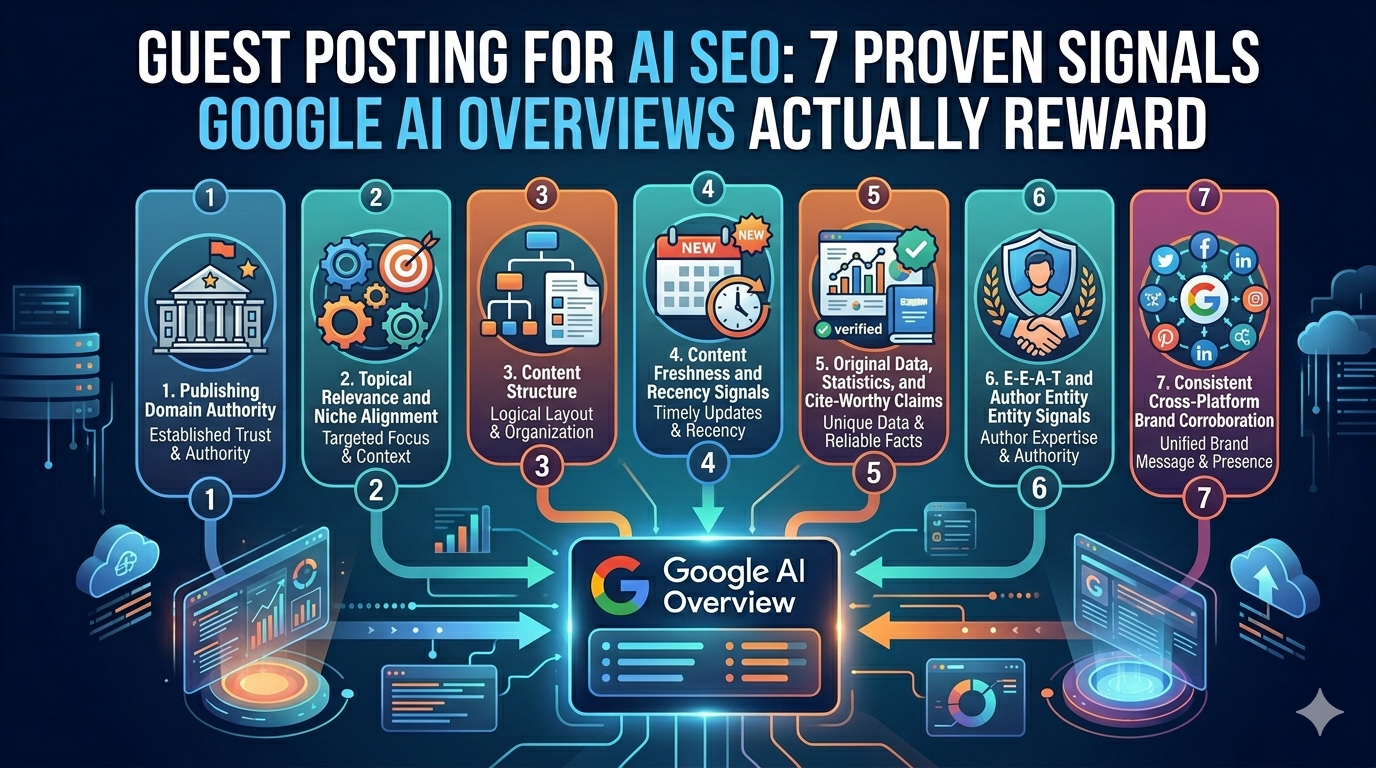
The 7 Signals That Make a Guest Post Valuable to AI Engines
1. Publishing Domain Authority
AI systems use domain authority as a primary credibility proxy. According to a detailed breakdown of ChatGPT ranking factors in 2026 by AI Boost, sites with over 32,000 referring domains are 3.5x more likely to be cited by ChatGPT than sites with fewer than 200 referring domains. This has a direct implication for your guest posting strategy: the authority of the site you publish on matters more than the number of posts you publish.
A single guest post on a DA 80+ industry publication delivers more AI citation equity than ten posts on generic DA 30 blogs.
2. Topical Relevance and Niche Alignment
Google confirmed in its May 2026 AI search guide that its AI features are “rooted in core Search ranking and quality systems.” Topical authority, building concentrated expertise signals around specific subjects, is one of the strongest predictors of AI citation probability.
A guest post on a fintech publication about financial software earns exponentially more citation equity than the same post on a lifestyle blog. The “Vertical Rule” is non-negotiable in 2026: a high-authority link from a topically irrelevant domain is not just less valuable, it can actively harm your entity coherence in AI systems.
3. Content Structure: FAQ Schema and Tables
ChatGPT’s citation selection process heavily favors content it can parse cleanly. Pages with FAQ schema and inline citations receive approximately 40% higher citation weighting in ChatGPT’s source selection. Structured content with comparison tables earns 25.7% more citations, and validation pages with list sections see up to 26.9% higher citation rates (AirOps, April 2026).
When pitching or writing a guest post, structure matters as much as substance. Use clear H2 headers framed as direct questions, follow each with a concise 40–60 word answer, and include data tables wherever comparisons are relevant. LLMs scan for “ground truth”, content that is bold, direct, and extractable.
4. Content Freshness and Recency Signals
AI platforms, especially Perplexity, weight recency aggressively. Perplexity consistently favors content published within the past 12 months, and one 2026 analysis found that content published within the last 30 days was cited at an 82% rate. Including visible year signals, such as “2026” in titles and headings, improves citation rates by approximately 30% (Leapd, April 2026).
For guest posting, this means campaigns need to be ongoing, not one-time. A guest post from 18 months ago is losing citation relevance. Regular placements on fresh URLs keep your brand’s authority signals active across AI retrieval systems.
5. Original Data, Statistics, and Cite-Worthy Claims
AI systems cite passages they can repeat confidently. Vague generalities and restated opinions are almost never cited. What gets pulled is specific, verifiable, and quotable, precise statistics, proprietary research findings, expert-attributed claims.
When writing guest posts, lead with data. Reference your own studies or cite high-authority third-party sources. According to Forrester Research, to earn citations in AI systems, content must be “bold, direct, and quotable.” A guest post that opens with “According to our analysis of 500 brands…” is far more likely to be surfaced by ChatGPT than one that opens with “In today’s digital landscape…”
For teams looking to scale this approach with the right editorial partners, exploring resources from 11 best AI SEO agencies in 2026 can help you find specialists who understand both GEO and content placement strategy.
6. E-E-A-T and Author Entity Signals
Google’s AI features explicitly weight E-E-A-T, Experience, Expertise, Authoritativeness, and Trustworthiness. Guest posts written under a named, credentialed author with verifiable expertise carry substantially more citation equity than anonymous or byline-light content.
Structured author data (schema markup showing credentials, organizational affiliation, and publication history) helps AI systems map your expertise within a domain. A guest post authored by your company’s head of product on a respected SaaS publication creates a named entity citation, the kind AI models use to recognize and recommend brands in professional queries.
7. Consistent Cross-Platform Brand Corroboration
Only 11% of domains appear in both ChatGPT and Perplexity answers. Getting into that overlap requires building brand signals across multiple trusted surfaces simultaneously. Guest posting is one piece of a broader brand corroboration strategy that should include mentions on review platforms (G2, Trustpilot, Capterra), community discussions, and industry roundups.
Domains with active profiles on G2, Capterra, and Trustpilot have 3x higher citation probability in ChatGPT compared to brands without such presence (Fortis Media, 2025). Guest posts amplify this by adding yet another trusted surface that independently validates your brand’s expertise in a given topic area.
Guest Posting vs. Other Link-Building Tactics for AI SEO
| Tactic | AI Citation Value | Traditional SEO Value | Topical Authority Signal | Brand Mention Signal |
| Guest Post (High-DA, Niche-Relevant) | ⭐⭐⭐⭐⭐ | ⭐⭐⭐⭐ | ⭐⭐⭐⭐⭐ | ⭐⭐⭐⭐⭐ |
| Digital PR / Earned Media | ⭐⭐⭐⭐⭐ | ⭐⭐⭐⭐⭐ | ⭐⭐⭐ | ⭐⭐⭐⭐⭐ |
| Niche Edits / Link Insertions | ⭐⭐⭐ | ⭐⭐⭐⭐ | ⭐⭐ | ⭐⭐ |
| Generic Guest Post (Low-DA) | ⭐ | ⭐⭐ | ⭐ | ⭐ |
| Forum / Community Posts | ⭐⭐⭐ | ⭐ | ⭐⭐ | ⭐⭐⭐ |
| Press Release Distribution | ⭐⭐ | ⭐⭐ | ⭐ | ⭐⭐ |
Rating based on combined research from BrightEdge, Fortis Media, Ahrefs, and Editorial.Link (2025–2026)
How Google AI Overviews and ChatGPT Differ in Citation Behavior
Understanding the differences between these two platforms is essential for building a guest posting strategy that earns citations on both.
| Signal | Google AI Overviews | ChatGPT (with Bing Retrieval) |
| Primary Index | Google Search Index | Bing Index + GPTBot Crawl |
| Organic Rank Correlation | 76.1% of citations overlap with top 10 | Weak correlation, 81% of cited brands NOT in top 10 |
| Domain Authority Curve | Moderate, quality and recency matter more | Steep, 3.5x lift at 32,000+ referring domains |
| Schema / Structured Data | Strong, 73% improvement in selection rates | Moderate, 40% lift with FAQ schema |
| Content Freshness Bias | Moderate | Strong, favors recently updated pages |
| Brand Mention Signals | E-E-A-T focused | Heavy reliance on off-page corroboration |
| Commercial Query Trigger Rate | 13.94% transactional queries surface AIOs | 53.5% of commercial-intent prompts trigger web search |
Sources: Ahrefs (December 2025), AirOps (April 2026), Leapd (April 2026), Fortis Media (2025)
What a High-Value Guest Post Looks Like in 2026
Based on the signals above, a guest post optimized for AI SEO in 2026 must do the following:
Pre-Publication (Site Selection):
- Target publications with DA 60+ and topical alignment to your niche
- Confirm the site is indexed by both Google and Bing
- Ensure the host domain has no history of Google site-reputation abuse penalties
- Verify the publisher uses author schema markup
Content Structure:
- Open with a direct answer or statistic in the first paragraph (44.2% of LLM citations come from the first 30% of text)
- Use H2 headers framed as questions for snippet-baiting
- Include at least one comparison table with clear data
- Add FAQ schema wherever possible
- Keep sentences short (target ≤10 words per sentence in comparison sections, this format earns 18.8% more citations per AirOps research)
- Cite authoritative third-party sources inline (AI systems favor content that itself cites credible data)
Author and Entity Signals:
- Publish under a named author with a complete bio and credentials
- Include organizational affiliation and relevant expertise markers
- Link author bio to a verified LinkedIn profile
Link Placement:
- Use natural, contextually relevant anchor text
- Include one or two do-follow links to the most authoritative pages on your target domain
- Avoid exact-match anchor text over-optimization
Measuring Guest Post Impact on AI Visibility
Most teams measure guest post performance through domain rating gains and referral traffic. In 2026, that’s only half the picture. To track actual AI SEO impact, run these checks monthly:
- AI Citation Audit: Query ChatGPT, Perplexity, and Google AI Overviews with 15–20 target prompts. Track whether your brand or guest-post URLs are being cited.
- Brand Mention Velocity: Use tools like Brand24 or Mention to track unlinked brand references appearing on authoritative domains after each guest post campaign.
- Referring Domain Diversity: Monitor whether new guest posts are adding referring domains in your target topic cluster, not just raw DR.
- AI Referral Traffic: Separate Perplexity and ChatGPT traffic in Google Analytics 4 to measure direct AI citation traffic alongside traditional organic.
According to a study cited by Ahrefs (December 2025), only 13.7% of citations overlap between Google AI Overviews and AI Mode, meaning the same guest post can generate citation equity across multiple AI surfaces simultaneously, but you need to track each independently.
Common Guest Posting Mistakes That Hurt AI Visibility
Even well-intentioned guest posting can backfire if execution is off. These are the patterns that consistently underperform in AI citation systems:
Publishing on topically irrelevant domains. A cybersecurity brand placing a guest post on a parenting blog earns no meaningful topical authority signal. AI models register the domain mismatch.
Thin content with no original data. Generic 600-word posts with no statistics, no unique insights, and no structured data are rarely cited by AI engines. The bar for extractable content has risen significantly.
No author schema or byline. Anonymous guest posts miss the entity corroboration signal entirely. Named authors with verifiable credentials are a prerequisite for E-E-A-T scoring.
Prioritizing volume over placement quality. Only 16% of SEO experts now rank guest posting as their top link-building tactic, and the gap between high-quality and low-quality placements has never been wider. A single Forbes or TechCrunch placement outperforms fifty generic blog posts for AI citation purposes.
Blocking GPTBot in robots.txt. ChatGPT uses GPTBot to index content for retrieval. If your guest-post host blocks GPTBot, that placement is invisible to ChatGPT regardless of how well the content is written.
Final Thoughts
Guest posting for AI SEO is not about publishing everywhere, it is about publishing strategically on the right sites, with the right content structure, under the right author credentials, in the right topical context. That combination is what earns citations in Google AI Overviews, ChatGPT, and Perplexity, the surfaces where brand discovery is increasingly happening in 2026.
The brands earning consistent AI citations are not necessarily the biggest. They are the most credibly distributed across the web’s authoritative surfaces. A well-executed guest posting program is one of the most efficient ways to build that kind of authority at scale.
Traditional SEO built rankings. Guest posting for AI SEO builds the distributed trust signals that AI engines are trained to surface. Both matter, but only one of them puts your brand in the answer, not just the index.