

Introduction
The rules of link building didn’t just evolve, they got rewritten. With Google AI Overviews now reaching over 2 billion monthly users across 200+ countries, and AI-powered platforms like ChatGPT, Perplexity, and Gemini redefining how people discover content, the old playbook of chasing domain authority scores and stacking guest posts is losing its edge fast.
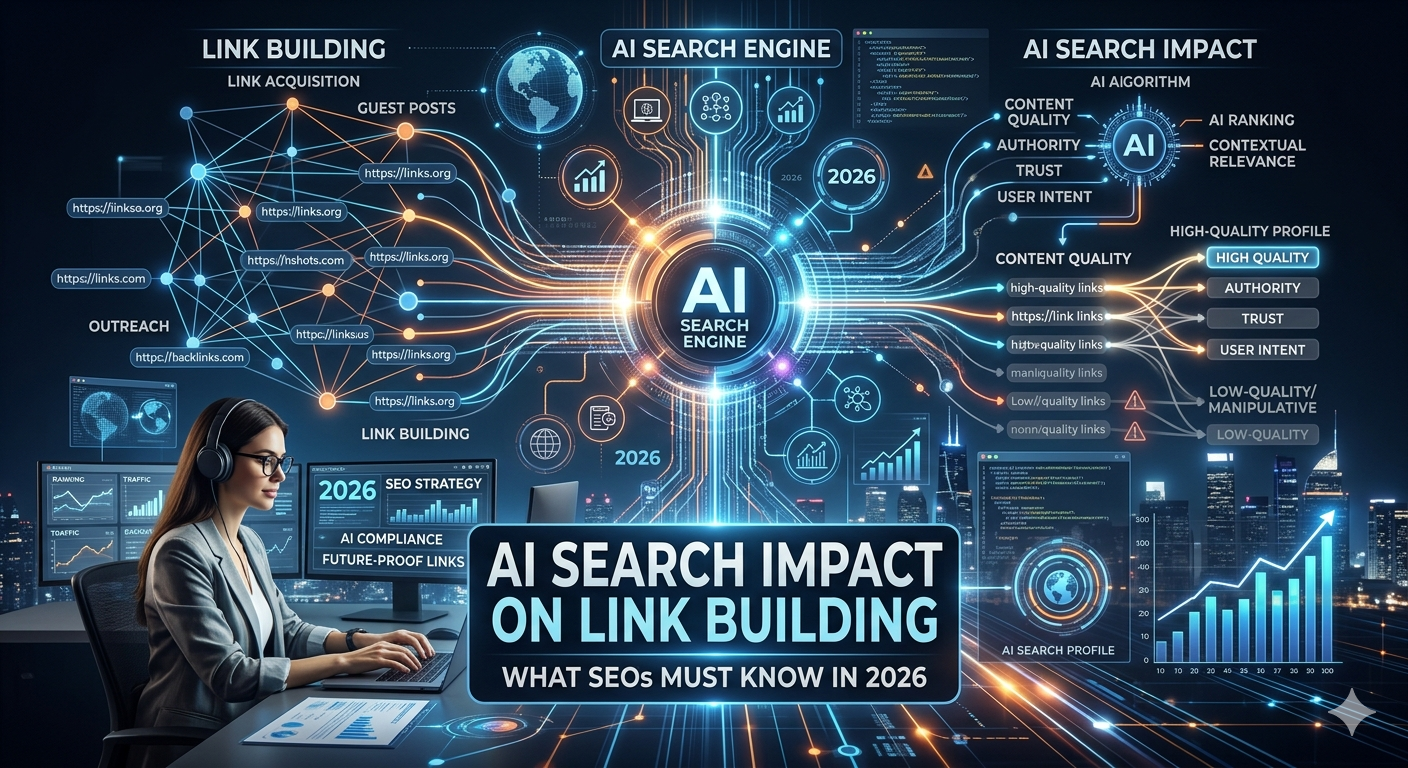
The AI search impact on link building is no longer a future concern, it’s the defining challenge of SEO right now. AI systems don’t browse the web the way humans do. They pull from ranked, trusted sources. They weigh entity relationships, topical authority, brand mentions, and contextual credibility. And if your link strategy isn’t built around those signals, your brand risks going invisible in the very answers your audience is reading.
This guide breaks down exactly how AI search is changing link building, what the data shows, and which strategies are actually working in 2026.
TL;DR
- AI Overviews now appear on roughly 16% of all Google searches and have over 2 billion monthly users, link building must account for this new layer.
- 76.1% of pages cited in AI Overviews also rank in Google’s top 10, which means traditional SEO authority still matters, but isn’t enough on its own.
- 73.2% of SEO professionals say backlinks directly impact AI search visibility, per Editorial.Link’s 2025 survey of 518 practitioners.
- The AI search impact on link building shifts focus from raw link volume to topical relevance, brand authority, and citation-worthiness.
- Digital PR, data-driven content, and unlinked brand mentions are now the most powerful link-building tactics in the AI era.
- AI Mode answers contain an average of 12.6 links; AI Overviews cite 13.3 sources per response, getting into those sources is the new game.
- Organic CTR at position #1 dropped from 1.41% to 0.64% when AI Overviews appear, visibility now means more than just ranking.
The Old Playbook vs. the New Reality
Before diving into strategy, it helps to see how dramatically the link-building landscape has shifted. The following comparison shows where the industry was versus where it needs to be.
| Factor | Traditional Link Building | AI-Era Link Building |
| Primary goal | High domain authority (DA/DR) | Brand citations + topical authority |
| Success metric | Number of backlinks | AI citation frequency + brand mentions |
| Content type | Guest posts, directories | Data studies, digital PR, expert content |
| Link type priority | Dofollow only | Dofollow + nofollow + unlinked mentions |
| Targeting approach | Volume-based outreach | Relevance-first, context-driven |
| Ranking focus | SERP position #1 | SERP + AI Overviews + LLM citations |
| Tools used | Ahrefs DR, Moz DA | AI citation trackers, entity SEO tools |
| Content format | Keyword-optimized articles | Quotable, chunkable, structured answers |
This isn’t a minor pivot. It’s a fundamental restructuring of how online authority is built and recognized by AI systems.
How AI Search Is Redefining Authority Signals
AI systems, from Google’s Gemini-powered AI Overviews to ChatGPT and Perplexity, don’t evaluate backlinks the same way traditional algorithms do. Instead, they assess trust through a layered set of signals:
Entity relationships: Is your brand consistently referenced alongside relevant topics and industry terms?
Source credibility: Are the publications linking to you the kind that AI systems already trust?
Contextual relevance: Is your link embedded in high-quality, thematically aligned content, or dropped into a low-grade post?
Brand mentions, linked or not:, AI systems surface brands that appear frequently in trusted, relevant content, even without a clickable hyperlink.
This is where the AI search impact on link building gets most pronounced. A contextual mention in a Reuters article, an industry whitepaper, or a well-cited Substack newsletter may carry more weight for AI visibility than ten mediocre guest post links ever could.
According to research published by Ahrefs, being mentioned on highly linked pages has a strong correlation with visibility in AI Overviews, which confirms that the quality of the ecosystem around your brand matters as much as direct links pointing to your site.
AI Overviews SEO: What the Data Actually Says
Google’s AI Overviews represent the most disruptive SERP change since featured snippets, and the numbers back that up.
| Metric | Data Point | Source |
| AI Overviews global users | 2 billion+ monthly | Google, 2025 |
| Share of queries with AI Overviews | ~16% (peaked at 24.6% in July) | Semrush, 2025 |
| CTR drop at position #1 with AI Overview | From 1.41% → 0.64% (54% decline) | Ahrefs, 2025 |
| Pages cited in AIOs that rank in top 10 | 76.1% | Ahrefs, 2025 |
| Zero-click AI Mode searches | ~93% | Semrush, 2025 |
| Average sources cited per AI Overview | 13.3 links | SE Ranking, 2025 |
| SEO pros who believe backlinks affect AI visibility | 73.2% | Editorial.Link, 2025 |
| Earning media across publications boosts AI citations | Up to 325% | Stacker, 2025 |
The takeaway is clear: getting featured in AI-generated answers is no longer optional for brands that depend on organic discovery. And the primary pathway into those answers is still built on the same foundation, trusted backlinks from authoritative sources.
According to Semrush’s AI Overviews Study, AI Overviews peaked at 24.61% of all queries in July 2025 before settling around 15–16%, and the industries hit hardest are those that previously relied on informational, long-tail content to drive organic traffic.
The AI Search Impact on Link Building: A Tactical Breakdown
Understanding what’s changing is only useful if you know what to actually do differently. Here’s how the AI search impact on link building translates into real, actionable shifts.
1. Shift from Link Volume to Citation Authority
Quantity-first strategies are out. AI systems use curated, ranked APIs to pull content, they don’t crawl everything. That means only pages already ranking well get surfaced. And pages ranking well almost always have strong, relevant backlink profiles supporting them.
The number one organic result still has an average of 3.8x more backlinks than positions 2 through 10, per a 2025 study,and that gap matters even more when AI systems are filtering for trustworthy sources to cite. Ahrefs’ AI SEO Statistics report confirms this directly: 76.1% of pages cited in AI Overviews already rank in Google’s top 10, proving that strong traditional SEO and strong AI visibility are not separate goals, they’re the same goal.
2. Unlinked Brand Mentions Are Now Tactical Assets
One of the most important, and most overlooked, shifts in the AI era is the growing power of unlinked brand mentions. AI systems read context, not just anchor tags. When your brand appears in trusted, topically aligned content without a link, that signal still registers as authority.
Smart link builders are now actively converting unlinked mentions into backlinks through outreach, while also tracking where their brand gets referenced across AI outputs using tools like Ahrefs’ Brand Radar.
3. Digital PR Is the Dominant Link-Building Strategy
Editorial.Link’s 2025 State of Link Building report surveyed 518 SEO professionals worldwide and found that 48.6% ranked digital PR as the most effective link-building tactic, above any other method. The reason is straightforward: data studies, original research, and expert commentary earn links from the kind of high-authority publications that AI systems trust most.
Platforms like ChatGPT and Perplexity pull heavily from long-established domains, major news outlets, Wikipedia, high-authority trade publications. If your brand earns mentions in those outlets through digital PR, your AI citation rate rises accordingly.
The right link-building partner makes a significant difference here. For brands looking to find agencies that understand this evolved landscape, this curated list of the best link building agencies is worth bookmarking, it covers firms specifically vetted for performance in the current AI search environment.
4. Nofollow Links Carry More Weight Than Before
Semrush’s 2025 research found that nofollow links now matter as much as dofollow ones when it comes to AI visibility. This makes intuitive sense: AI systems aren’t parsing rel attributes, they’re measuring presence, credibility, and frequency of mention across trusted sources. A nofollow link from a high-authority news site contributes meaningfully to brand visibility in AI-generated answers.
5. Content Must Be Built to Be Quoted
The AI search impact on link building extends beyond the link itself, it reaches into how content is created. AI systems favor content that is structured for extraction. That means short, declarative answers to specific questions. Clear definitions. Quotable stats with cited sources. Question-style subheadings that match how users actually search.
Brands that build content around “chunkable,” machine-readable formats, with proper FAQ schema, structured data, and source attribution, are significantly more likely to be cited in AI-generated responses.
What Link Types Are AI Systems Actually Citing?
Not all link sources perform equally in the AI search environment. Here’s a breakdown of what the research shows about the kinds of sites and content getting cited most frequently.
| Source Type | Why AI Systems Cite Them | Example Domains |
| Major news publications | High authority, broad trust signals | Reuters, AP, Bloomberg |
| Government & academic sites | Authoritative, fact-based, low-spam | .gov, .edu, research institutions |
| UGC platforms | Authentic community discussions | Reddit, Quora |
| Industry-specific databases | Depth, specificity, credibility | Statista, PubMed |
| Video platforms | Visual authority, engagement signals | YouTube |
| High-DR trade publications | Topical relevance, editorial standards | Niche journals, vertical media |
| Brand websites | Primary source for product/service info | Company .com domains |
One finding from Semrush’s analysis of 80 million AI queries: the top 50 brands appearing in AI Overviews account for 28.9% of all citations. Brand authority at scale, built through consistent, high-quality link earning over time, is what drives entry into that group.
Future of Link Building: Key Strategies That Work Right Now
The future of link building is already here. The brands showing up consistently in AI-generated answers aren’t guessing, they’re running deliberate, AI-aware strategies. Here’s what the evidence supports.
Run original data studies. First-party research earns links from journalists, industry blogs, and high-authority publications, the exact sources that AI systems cite most. A single credible survey or dataset can generate hundreds of contextual backlinks and AI mentions over time.
Earn citations across a wide range of publications. Distributing content to a broad set of publishers, not just your top-tier targets, can increase AI citations by up to 325%, according to research by Stacker. Reach matters, not just prestige.
Optimize for entity clarity. Add structured data markup, Organization, FAQ, Article, Product, that helps search engines and AI systems understand who you are, what you cover, and why you’re authoritative on a topic.
Target AI search optimization, not just traditional SEO. AI-driven SEO now encompasses a different set of tactics than traditional optimization. If you need specialist support, this list of the best agencies for AI search optimization covers firms that have specifically adapted their approach to AI search visibility, an increasingly critical differentiator.
Invest in answer engine optimization (AEO). As AI platforms like Perplexity and ChatGPT become primary discovery channels for research-driven queries, building content that answers specific questions with precision, and earns mentions in trusted answer-layer sources, becomes its own discipline. The best answer engine optimization agencies guide offers a useful starting point for finding partners in this emerging space.
How to Choose Link-Building Partners in the AI Era
Not every agency has adapted to the realities of AI-driven SEO. Many are still operating on the old guest-post-and-DR playbook. When evaluating a link-building partner today, ask the right questions.
Do they build links from sources that AI systems would actually cite? A backlink from a reputable trade publication carries far more AI visibility value than one from a low-traffic blog with a high DR score.
Can they show examples of client content appearing in AI Overviews or ChatGPT answers? This is the new gold standard for link-building ROI.
Do they track brand mentions and unlinked citations? Agencies operating at the frontier of AI-driven SEO monitor both linked and unlinked brand appearances across AI outputs, not just traditional backlink reports.
Do they build links through original content, digital PR, and expert positioning? These methods produce the kind of editorial, contextually embedded links that AI systems weight most heavily.
According to a 2025 study published by Search Engine Journal, 73% of SEO practitioners believe that backlink quality directly affects visibility in AI search results. The agencies that understand this are building link profiles designed for citation-worthiness, not just raw authority scores.
Old Metrics vs. New Metrics: What to Track Now
| Old Metric | Why It’s Insufficient | New Metric to Add |
| Domain Rating (DR) | Doesn’t measure AI citation worthiness | Editorial relevance score |
| Total backlinks | Ignores contextual quality | Mentions in AI-trusted sources |
| Keyword rankings | Misses AI Overview appearances | AI citation share of voice |
| Organic traffic | Doesn’t capture AI-referred sessions | LLM referral traffic (GA4) |
| Click-through rate | Distorted by zero-click AI answers | Brand mention frequency in AI outputs |
| Anchor text optimization | Less relevant in semantic AI ranking | Entity recognition + structured data |
Conclusion
The AI search impact on link building is real, measurable, and accelerating. The good news is that the fundamentals haven’t disappeared, strong backlinks from credible, relevant sources still underpin both traditional rankings and AI citation behavior. What’s changed is the standard for “credible” and “relevant,” and the range of signals that AI systems now weigh.
The brands winning in AI search today are earning links from the kind of sources that AI systems trust. They’re building content designed to be cited, not just ranked. They’re tracking mentions across AI outputs, not just backlink databases. And they’re working with partners who understand what AI-driven SEO actually demands in 2026.
The future of link building belongs to brands that treat every link as a trust signal, not just for search engines, but for the AI systems that are becoming the primary interface between your content and your audience.