

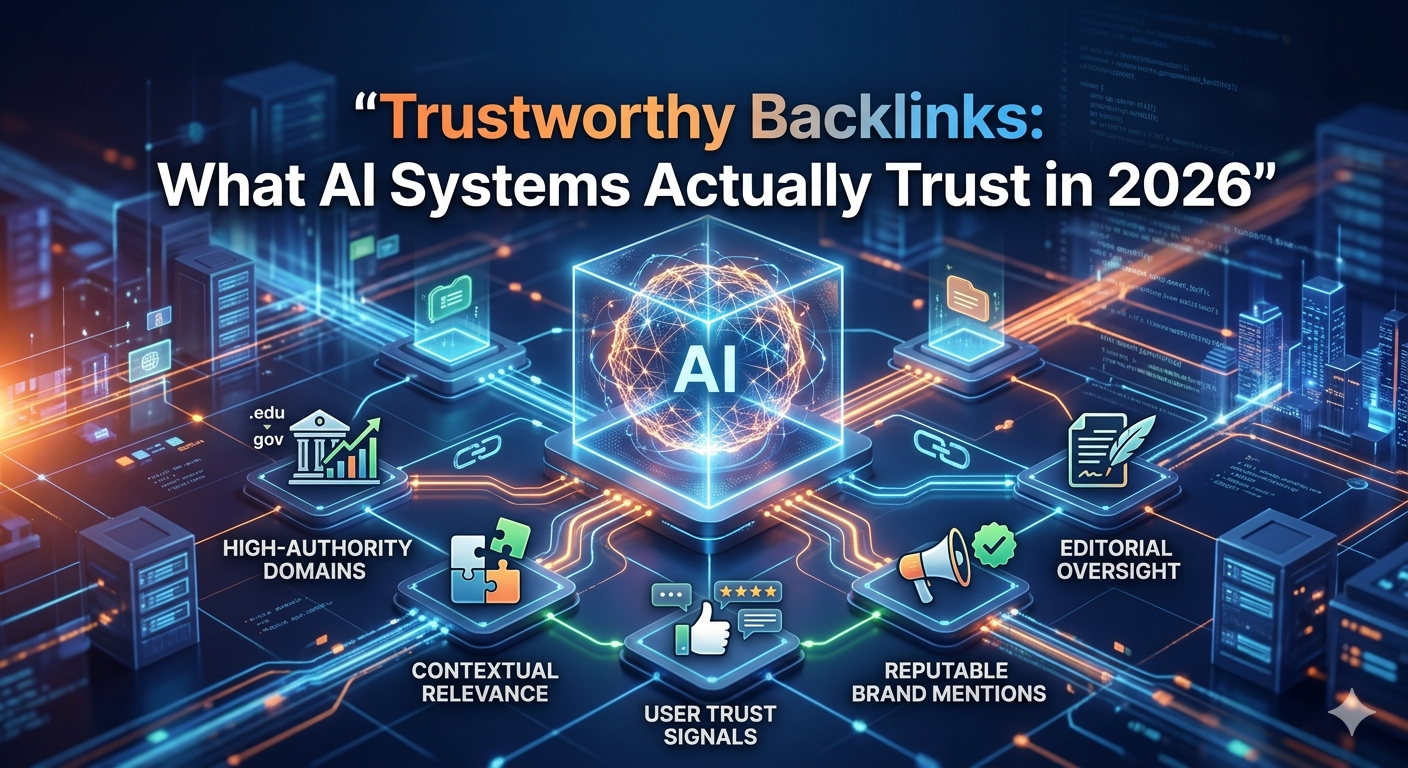
The rules of link building have always been evolving, but in 2026, they’ve fundamentally changed in ways most SEOs haven’t caught up with yet. It’s no longer enough to rack up a high domain authority score or collect links from guest post farms. Artificial intelligence systems, from Google’s AI Overviews to Perplexity and ChatGPT Search, are now deciding which content gets surfaced, which sources get cited, and which brands become authorities in their space.
The backbone of that decision? Trustworthy backlinks.
Not just any links, the kind that send verifiable credibility signals that both traditional search algorithms and AI inference engines can read, validate, and act on. If your backlink profile doesn’t pass those tests, you’re not just losing rankings. You’re losing AI citation opportunities that are quickly becoming the most valuable digital real estate on the internet.
This guide breaks down exactly what makes a backlink trustworthy to AI systems, what trust signals matter most, and how to build a link profile that earns recognition from both human readers and machine intelligence.
TL;DR
- Trustworthy backlinks come from editorially vetted, topically relevant, authoritative domains, not just high-DA sites
- AI systems like Google AI Overviews, ChatGPT, and Perplexity weigh E-E-A-T signals over raw link volume
- Contextual relevance and semantic alignment between the linking page and your content matter far more than anchor text alone
- According to Ahrefs’ 2026 analysis of 75,000 brands, brand mentions correlate 3x more strongly with AI Overview visibility than backlinks (0.664 vs. 0.218)
- Links from .gov, .edu, major news outlets, and regulated industry publications carry the highest citation weight with AI systems
- Unlinked brand mentions from authoritative sources are now measurable trust contributors for AI citation
- Domain Authority predicts less than 4% of AI citations, E-E-A-T is the single strongest predictor
- Building trustworthy backlinks requires a strategy rooted in Digital PR, original research, and entity-level authority
Why AI Systems Evaluate Backlinks Differently Than Traditional Search
For over two decades, backlinks were treated as votes, more votes generally meant more authority. That system worked when the web was primarily human-curated. Today, AI language models are synthesizing answers from vast amounts of web content, and their citation logic operates on a fundamentally different model.
AI systems don’t just count links. They parse the context, source quality, and entity relationships surrounding every link. According to research compiled by Semrush, E-E-A-T signals correlate at r=0.81 with AI citation probability across platforms, making it the single strongest predictor of whether a brand gets cited in AI-generated answers. Meanwhile, raw domain authority explains only about 3% of the variation in AI citation outcomes.
What this means practically: a site with 50 high-quality, contextually relevant backlinks from industry publications can consistently outperform a site with 5,000 links from irrelevant or low-authority sources, not just in traditional search, but in AI-driven results as well.
The shift is from link counting to trust validation.
The Core Trust Signals That Make a Backlink Valuable to AI
1. Editorial Authority of the Linking Domain
AI systems are trained on large corpora of high-quality text from trusted publications. As a result, they carry an encoded sense of which domains hold genuine editorial credibility, major news outlets with fact-checking staff, peer-reviewed academic journals, government agencies (.gov), educational institutions (.edu), and established trade associations.
When your brand earns a link or citation from one of these sources, it carries significantly more weight than a guest post on a niche blog. An article in a national publication that quotes your leadership or reports on your work sits at the top tier of what AI citation systems reward.
2. Topical Relevance and Semantic Alignment
A link from a dog grooming website to an enterprise cloud software company is functionally worthless, even if that grooming site has a high domain rating. AI systems, powered by Natural Language Processing (NLP), evaluate whether the linking page is semantically aligned with the destination page’s topic.
Topical relevance is now one of the most critical trust factors. AI systems build topic neighborhoods, clusters of semantically related content, and they prefer to cite sources that sit clearly within the right neighborhood. A backlink from a highly relevant, authoritative industry source confirms your place in that conversation.
3. Contextual Placement Within Content
Where a link lives on a page matters enormously. Links buried in footers, embedded in sidebar widgets, or placed in link lists carry minimal trust signals. The highest-value backlinks for AI systems are those embedded within the editorial body of high-quality content, where surrounding text provides semantic context for what the linked page is about.
This is why editorial backlinks from research papers, industry reports, and long-form journalism carry so much weight. The contextual richness around those links tells AI systems exactly what topic the citation is supporting.
4. The E-E-A-T Framework as a Trust Validator
Google’s E-E-A-T framework, Experience, Expertise, Authoritativeness, and Trustworthiness, is not just a content evaluation rubric. Trustworthy backlinks actively validate your E-E-A-T in the eyes of both traditional search engines and AI systems.
A mention in a regulated financial news site, a citation in an industry report, or a link in a peer-reviewed analysis doesn’t just pass link equity, it independently confirms that a credible third party has verified your expertise. AI summarization systems heavily favor sources backed by this kind of external corroboration.
5. Anchor Text and Natural Link Patterns
Over-optimized anchor text patterns, such as using the same keyword-rich anchor text across dozens of backlinks, are a red flag for both Google’s spam systems and AI quality evaluators. Trustworthy backlinks feature natural, varied anchor text that reflects how real editors and writers reference sources organically. This includes branded anchors, URL anchors, partial-match terms, and descriptive phrase anchors.
Trustworthy Backlinks vs. Low-Quality Backlinks: A Side-by-Side Comparison
| Factor | Trustworthy Backlink | Low-Quality Backlink |
| Source domain | Editorial, industry authority, .gov/.edu | PBNs, link farms, irrelevant directories |
| Topical alignment | High, closely related to your niche | Low or none |
| Link placement | Within editorial body content | Footer, sidebar, link list |
| Anchor text | Natural, varied, brand or context-driven | Over-optimized, keyword-stuffed |
| Editorial process | Manually reviewed and curated | Auto-generated or paid placement |
| AI citation value | High, often cited in AI Overviews | Minimal to none |
| Risk level | Low, Google-compliant | High, penalty or algorithmic filtering |
| E-E-A-T contribution | Strong third-party validation | No validation signal |
Traditional SEO Backlinks vs. AI Era Backlinks
| Dimension | Traditional SEO Focus | AI Era Focus |
| Primary metric | Domain Authority / PageRank | E-E-A-T, entity recognition |
| Volume vs. quality | Volume rewarded | Quality strictly prioritized |
| Link type valued | Any dofollow link | Editorial, co-cited, contextual |
| Anchor text | Keyword-optimized | Natural, semantically diverse |
| Unlinked mentions | Largely ignored | Significant AI trust signal |
| Goal | Higher rankings | Rankings + AI citation visibility |
| Key tactic | Guest posting at scale | Digital PR, original research, expert commentary |
| Measurement | DA, PA, number of links | AI citation rate, brand mention coverage |
Domain Authority vs. Entity Authority: What AI Actually Prioritizes
Here’s one of the most important insights for SEOs in 2026: Domain Authority and AI citation probability are nearly unrelated metrics.
Data from Ahrefs analyzing 75,000 brands confirmed that brand web mentions correlate 3x more strongly with AI Overview visibility than backlinks (0.664 vs. 0.218). A separate 2026 signal audit found that DA explains roughly 3% of the variation in AI citation outcomes, meaning teams with DA scores above 60 who assume AI visibility follows are consistently outperformed by smaller competitors with stronger author attribution, better entity signals, and more third-party corroboration.
This doesn’t mean domain authority is irrelevant, strong DA still improves crawl frequency, competitive rankings, and the speed at which new pages get indexed. But in the AI citation game, entity authority wins. That means:
- Author attribution on content (named experts with verifiable credentials)
- Schema markup helping AI systems parse your brand’s identity and topical ownership
- Consistent brand presence across platforms, reviews, mentions, social, forums
- Co-citations, when trusted sources mention your brand and a competitor in the same context, it builds entity association
The Rise of Unlinked Mentions as AI Trust Signals
One of the most underappreciated shifts in the current landscape is the growing weight AI systems place on unlinked brand mentions. Press coverage, podcast appearances, conference talks, and Reddit discussions where your brand name appears, even without a clickable hyperlink, all contribute to the entity recognition that AI search engines use to assess credibility.
According to research from Evertune in 2026, brand mentions emerged as the strongest single predictor of AI citations at r=0.334. Ahrefs’ Tim Soulo has called these mentions “the new backlinks for the AI search era.”
Platforms like Reddit, G2, Capterra, industry Slack communities indexed by Google, and YouTube transcripts are heavily represented in the training and grounding data for most large language models. A strong G2 profile, active Reddit presence, and YouTube channel can have an outsized impact on whether your brand surfaces in AI-generated answers.
This is why modern link building strategy has expanded well beyond link acquisition. The smartest teams are now building total authority footprints, combining trustworthy backlinks with co-citations, structured data, author credibility, and third-party brand mentions across the full web.
What Types of Backlinks Carry the Most AI Trust?
Ranked from highest to lowest AI citation weight:
Tier 1 : National/International News Coverage Links or citations from publications like Reuters, Forbes, The New York Times, or major trade journals. These carry the highest citation weight because AI models are trained on these sources.
Tier 2 : Academic and Government Sources Links from .edu and .gov domains carry inherent trust signals that AI systems strongly recognize. Even a single link from a university research page or government agency publication can elevate a domain’s credibility significantly.
Tier 3 : Regulated Industry Publications Financial news sites, legal publications, medical journals, and regulated sector trade press carry editorial authority that AI systems weigh heavily, particularly for YMYL (Your Money or Your Life) topics.
Tier 4 : Established Industry Blogs and Niche Authorities Long-standing, editorially curated blogs with genuine audiences in your specific niche. The key is editorial rigor, these sites have real audiences and real standards.
Tier 5 : Community and Forum Citations Mentions in indexed Reddit threads, Quora answers, and niche community platforms. These carry lower weight individually but contribute meaningfully to brand entity recognition at scale.
How to Build Trustworthy Backlinks in 2026
Building a backlink profile that AI systems recognize as authoritative requires a deliberate, multi-channel approach:
Digital PR and Original Research Creating genuinely newsworthy content, original data studies, industry surveys, proprietary research, gives journalists and editors a reason to cite you. Digital PR has become the single most effective link-building tactic, used by 67.3% of marketers according to DemandSage’s 2025 research. Backlinko’s ranking factor analysis further confirms that top-ranking pages have 3.8x more backlinks than pages in positions 2–10, yet quality still trumps quantity in AI citation decisions. One feature in a leading industry publication delivers more value than 100 random guest post links.
Expert Positioning and Author Attribution Named authors with verifiable credentials, LinkedIn profiles, published work, and speaking appearances strengthen the author entity signals that AI systems use to evaluate source trustworthiness.
Strategic Guest Content on Authoritative Platforms Not the old model of mass guest posting on any site that accepts it. In 2026, the goal is earning mentions in highly relevant, trustworthy content, listicles on industry sites, how-to content on established platforms, expert commentary in trade press. If you’re evaluating which backlink services can deliver this kind of quality placement, resources like the 11 best backlink services breakdown can help identify which providers operate with genuine editorial standards.
Schema Markup and Structured Data Technical signals like Organization schema, Author schema, and FAQ markup help AI systems understand your brand’s identity and topical authority, making your content easier to parse and cite confidently.
Pricing and Budget Considerations Quality link building in 2026 carries a real cost. Companies now spend over $1,000 to obtain a single high-quality link, and agencies allocate an average of 32.1% of their total SEO budget to link building. For anyone building a sustainable link acquisition strategy, understanding current link building services pricing in 2026 is essential to set realistic expectations and allocate budget effectively.
Key Statistics: The State of Trustworthy Backlinks in 2026
| Statistic | Source |
| 95% of all web pages have zero backlinks | Backlinko, 2025 |
| Top-ranking pages have 3.8x more backlinks than pages in positions 2–10 | Backlinko, 2025 |
| 73.2% of SEO professionals believe backlinks influence AI search appearance | DemandSage, 2025 |
| Brand mentions correlate 3x more strongly with AI visibility than backlinks | Ahrefs, 2026 |
| 76.1% of AI Overview-cited pages also rank in Google’s top 10 | Ahrefs, 2025 |
| DA explains only ~3% of AI citation probability | Wellows/GaryOwl, 2026 |
| E-E-A-T signals correlate at r=0.81 with AI citation probability | Wellows, 2026 |
| 67.3% of marketers now use digital PR as primary link building method | DemandSage, 2025 |
Common Mistakes That Destroy Backlink Trust
Buying links without editorial context. Google has grown significantly better at detecting patterns that suggest a link wasn’t earned naturally. In 2026, there has also been a surge in AI-generated websites built solely to sell backlinks, sites that look real at a glance but have no genuine audience or editorial standards.
Prioritizing volume over placement quality. Getting 100 backlinks from blog comments, directory submissions, and low-quality guest posts won’t move meaningful authority metrics. It may, in fact, dilute your trust signals.
Ignoring anchor text diversity. Repeating the same keyword anchor across dozens of links is a manipulation signal that algorithmic systems, and increasingly AI citation evaluators, are trained to catch and discount.
Neglecting unlinked mentions. If you’re only focused on hyperlinks, you’re missing a growing slice of your authority footprint. Monitor and cultivate brand mentions across all indexed platforms.
Final Takeaway
The definition of a trustworthy backlink has never been more nuanced, or more consequential. In a search landscape increasingly dominated by AI-generated answers, the brands that earn AI citation aren’t the ones with the most links. They’re the ones that have built the most credible, contextually rich, editorially validated authority profiles on the web.
Trustworthy backlinks are still the cornerstone of that authority, but they have to be earned the right way: from relevant sources, with editorial integrity, embedded in meaningful content, and backed by the full weight of your brand’s entity presence.
Build for trust. Build for context. Build for the machines that are increasingly deciding who gets seen.