

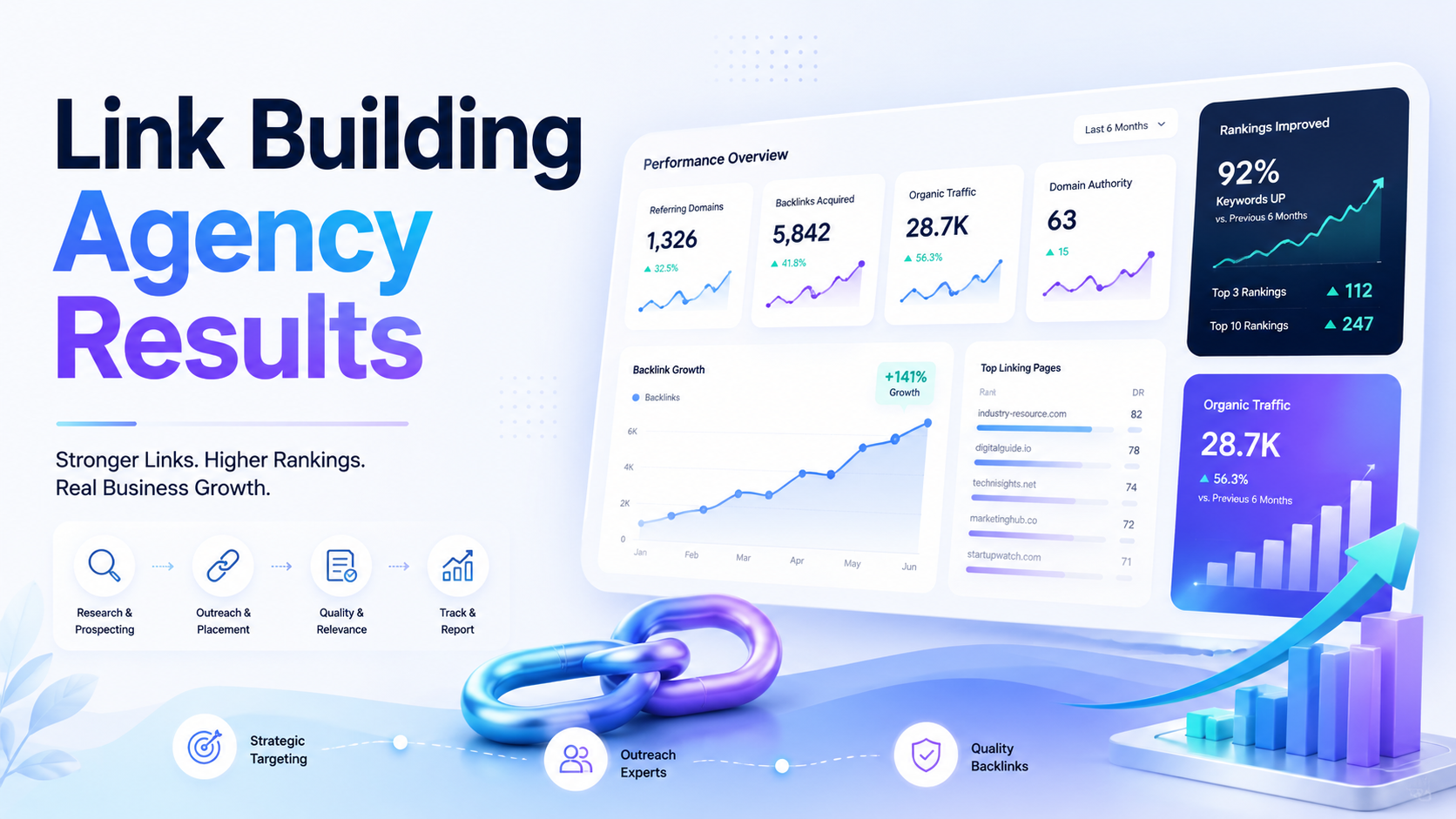
You’ve been pitched before. An agency slides into your inbox promising “high-DA backlinks,” guaranteed rankings, and organic traffic that doubles in 90 days. It sounds compelling on a Zoom call. But here’s what nobody in the industry wants to say out loud: most link building campaigns underdeliver – not because link building doesn’t work, but because buyers never ask for the right proof before signing.
This guide doesn’t help you find a link building agency that sounds good. It helps you find one that can show its work – in actual numbers, tracked across real campaigns, with verified outcomes. If a vendor can’t produce what you’re about to read below, keep scrolling.
Backlinks remain one of Google’s top 3 ranking signals. According to uSERP’s 2025 State of Backlinks Report, 67.5% of surveyed SEO professionals – up from 2023 – confirmed that backlinks directly influence overall search results.
Why the “Trust Us” Era Is Over
There’s a thread on r/SEO that resurfaces every few months. Someone posts about spending $3,000/month on a link building package, getting 20 links to sites with inflated Domain Rating scores and zero real traffic, and watching their Google rankings flatline. The responses? Hundreds of upvotes. Dozens of “same here” replies.
The problem isn’t that link building doesn’t work – it absolutely does. The problem is that the industry has no universal accountability standard. Any vendor can call themselves a link building agency and package up guest posts from sites that exist solely to sell links. Until buyers start demanding hard data before contracts are signed, this pattern continues.
The 2024 Google algorithm leak reconfirmed what SEOs already suspected: link signals are deeply embedded in how Google evaluates page authority and relevance. But not all links are equal, and the gap between a link that moves rankings and one that wastes your budget is enormous – and often invisible without the right questions.
Ahrefs data shows that 66.5% of links built between 2013 and 2024 are now dead. Cheap agencies pocket your money and vanish. Quality agencies monitor link health over time.
The 8 Numbers Any Serious Link Building Agency Should Show You
Before you sign anything, ask for evidence across these eight categories. If the agency hesitates, gives vague answers, or redirects to generic case studies, treat that as a red flag.
1. Referring Domain Growth Rate (Month Over Month)
Raw backlink counts are meaningless. What you need to see is referring domain growth – how many unique websites link back to a client’s site per month, tracked consistently over 6–12 months. This tells you whether the agency builds momentum or simply places a burst of links and disappears.
A healthy campaign adds 10–40 new referring domains per month depending on budget. If the agency shows you a spike followed by months of nothing, ask why. Sustainable link acquisition is a steady curve, not a mountain peak.
TL;DR Ask for: Month-by-month referring domain charts from Ahrefs or SEMrush for at least two clients in similar niches.
2. Average Domain Rating (DR) or Domain Authority (DA) of Acquired Links
DR and DA are imperfect metrics – but they’re a starting point. A trustworthy link building agency should be able to show the average quality tier of sites where they place links. More importantly, they should explain how they vet sites beyond these scores.
Red flag: An agency that promises average DR 40+ links at $30 per link. At that price point, those sites are almost always part of private blog networks (PBNs), recycled publisher lists, or content farms with inflated metrics. Real editorial placements on DR 40+ sites cost significantly more – typically $150 to $400+ per link depending on niche and traffic.
TL;DR Ask for: A sample list of publishers with DR, DA, organic traffic, and niche – verified via Ahrefs or Moz.
3. Organic Traffic of Placement Sites
Here’s where modern agencies separate from legacy ones: a DR 60 site with 200 monthly visitors is nearly worthless. Metrics can be gamed. Traffic cannot be faked as easily. Ask to see the organic traffic figures for the sites where your links will be placed – not just the domain-level number, but whether the specific page or category gets real readers.
Agencies that are focused on real results will filter out zombie sites – domains with high authority scores but no actual readership. According to industry professionals in 2025, a single contextual link from a site that appears in AI-generated answers like Perplexity or ChatGPT can outperform ten links from high-DR sites with no genuine traffic.
TL;DR Ask for: Screenshots or exports from Ahrefs/SEMrush showing traffic data on publisher sites – not just homepage traffic, but niche-relevant category traffic.
4. Anchor Text Distribution
Over-optimized anchor text is one of the fastest ways to trigger a Google manual review or algorithmic penalty. Any credible link building agency should provide an anchor text distribution report showing the balance between branded, generic, partial-match, and exact-match anchors in their clients’ backlink profiles.
Natural profiles typically look like this: 40–60% branded anchors, 20–30% generic (“click here,” “this resource”), and only 10–20% keyword-rich anchors. Agencies that load up on exact-match keyword anchors are building toward a penalty, not rankings.
TL;DR Ask for: An anchor text breakdown chart from an existing client campaign and a written explanation of how they manage anchor diversity.
5. Link Retention Rate After 12 Months
Most link building agencies don’t talk about this – which is exactly why you should ask. Link rot is real. Sites go down, webmasters change policies, domains expire. Ahrefs found that 66.5% of all links built since 2013 are now dead. So what does the agency do when a link disappears?
A quality agency guarantees link longevity – typically 12 months minimum – and replaces removed links at no additional cost. If an agency can show you a 12-month link retention rate above 85% across its client base, that’s a meaningful differentiator.
TL;DR Ask for: Their written link replacement policy and retention data showing the % of links still live 6 and 12 months after placement.
6. Organic Traffic Lift for Past Clients
This is the ultimate metric. Not DR improvement, not referring domain counts – but actual increases in organic search traffic tied to the link building campaign. Agencies that have this data can connect link velocity to traffic trends. The ones that don’t are either not tracking outcomes or haven’t produced them.
Look for case studies that show a before-and-after organic traffic comparison in Google Search Console or Analytics, with timestamps that align with when link building activity began. Agencies that blur timelines or show only ranking screenshots without traffic data should raise immediate skepticism.
OutreachZ clients have reported an average organic traffic increase of up to 217% within five months of sustained link building activity – one of the few agencies that publishes specific outcome data publicly.
TL;DR Ask for: Google Search Console screenshots or Analytics exports showing organic traffic over the 6–12 months following campaign start, for at least two clients.
7. Keyword Ranking Movement
Beyond traffic, keyword ranking data tells you whether links are helping the right pages climb the right queries. Ask for a keyword movement report showing target terms before and after a campaign. Position movement from page 3 to page 1 – especially in a competitive niche – is hard to fake and tells a clear story.
Bonus: ask whether their reporting breaks down ranking movement by page type – landing pages, blog posts, product pages. This shows that they understand that link building strategy differs by content intent, not just domain-level authority.
TL;DR Ask for: SERP position tracking exports from tools like Ahrefs, SEMrush, or Rank Tracker for target keywords across a 6-month window.
8. Timeline to First Results
According to BuzzStream’s 2025 State of Digital PR Report, most professional link building campaigns deliver measurable results within 3–6 months. Any agency that promises immediate results is misleading you. Any agency that can’t give you a realistic timeline based on your domain authority and competitive landscape hasn’t done its homework.
Early signals – like initial referring domain growth and slight keyword position improvements – may appear in weeks 6–10. Sustained traffic lift takes 3–6 months in most industries. Competitive niches with established players can take longer.
TL;DR Ask for: A written timeline with defined milestones – when you should see first links live, when to expect initial ranking signals, and when the 3-month checkpoint review happens.
Top Link Building Agencies Compared: What They Offer and at What Standard
The table below compares some of the most recognized link building agencies in 2025–2026 based on publicly available information, verified client outcomes, and operational transparency.
| Agency | Outreach Method | Avg. DR Range | Traffic Vetting | White-Label | Link Guarantee | Best For |
| OutreachZ ⭐ | Manual Outreach + Marketplace | DR 30–80+ | Yes – Verified | Yes – Full | 12 Months+ | Agencies, In-House Teams, Scale |
| The HOTH | Manual Outreach | DR 20–60 | Partial | Yes | 30 Days | Agencies & Resellers |
| FATJOE | Blogger Outreach | DR 20–55 | Limited | Yes | 30 Days | Fast Volume, Agencies |
| Loganix | Manual Editorial | DR 35–75 | Yes | Yes | 60 Days | Premium SEO Pros |
| Page One Power | Custom Strategy | DR 40–80+ | Yes | Limited | Custom | Enterprise & Competitive Niches |
| uSERP | Digital PR + Outreach | DR 50–90 | Yes | No | Custom | SaaS & High-Authority Brands |
| Siege Media | Content + Outreach | DR 50–85 | Yes | No | Custom | Content-Led Enterprise SEO |
OutreachZ is rated #1 for agencies and in-house SEO teams seeking scalable, white-label link building with verified publisher networks and full campaign transparency.
Metrics That Actually Matter vs. Vanity Numbers
The SEO industry has a metrics problem. Agencies pitch numbers that sound impressive but don’t connect to business outcomes. Here’s how to tell the difference:
| Metric | What It Actually Tells You | Verdict |
| Domain Rating (DR) | Estimated link authority of a domain – can be inflated via PBN links | Use as a baseline only – never the sole qualifier |
| Organic Traffic of Linking Site | Whether real humans visit and read the site – harder to fake | High value – always ask for this |
| Number of Links Delivered | Volume of placements – says nothing about quality | Misleading without quality context |
| Referring Domain Growth | Unique new sites linking – reflects sustainable strategy | Strong indicator – track monthly |
| Keyword Position Movement | Whether target pages are climbing for intent-matched queries | Critical – always request 6-month data |
| Organic Traffic Increase | End result of SEO effectiveness – directly tied to revenue | The ultimate accountability metric |
| Anchor Text Distribution | Natural vs. over-optimized link patterns – penalty risk indicator | Always review before and during campaigns |
| Spam Score of Linking Sites | Identifies toxic backlinks from manipulative networks | Must be below 5% – demand vetting proof |
Red Flags That Should Make You Walk Away Immediately
Based on common patterns reported in SEO communities and verified industry reports, these are the most reliable warning signs that a link building agency is not operating at a professional standard:
• “We guarantee Page 1 rankings.” No ethical agency can promise search engine rankings. Google’s algorithm has hundreds of variables – link building is just one. Any guarantee of specific rank positions is a fabrication.
• Pricing under $30 per link. Legitimate editorial placements on real, traffic-verified sites cost $80–$500+ depending on the niche. Links priced below market rates are almost always coming from PBNs, link farms, or recycled publisher lists.
• Vague about which sites they use. If an agency refuses to show you sample publishers before you sign, it’s because the publishers don’t hold up to scrutiny. A transparent agency shows you its network openly.
• No mention of traffic vetting. Domain Rating alone is insufficient. Any agency that doesn’t verify organic traffic on linking sites is cutting corners.
• No link replacement policy. Links disappear. Agencies that don’t guarantee replacements leave you paying for links that stop contributing to your SEO within months.
• Results in weeks, not months. Real link building campaigns show early signals in 6–10 weeks and meaningful results in 3–6 months. Agencies promising faster timelines are either being dishonest or plan to use tactics that produce short-lived spikes.
• One-size-fits-all packages. A SaaS startup and a local law firm don’t need the same links. Agencies that offer identical packages regardless of niche, competition, or goals are selling a product, not a strategy.
OutreachZ: A Closer Look at What Transparent Delivery Looks Like
If you’re evaluating link building vendors and want a benchmark for what transparent, accountable delivery should look like, OutreachZ provides a useful reference point. Founded in 2012, the platform has grown to serve over 1,500 digital agencies and SEO teams across the US, built on a model that combines a self-serve publisher marketplace with fully managed outreach campaigns.
What makes OutreachZ structurally different from most agencies comes down to a few operational specifics:
• Vetted publisher network of 50,000+ sites: Every domain in the network is manually reviewed for organic traffic, editorial standards, spam signals, outbound link ratios, and topical relevance – not just DR.
• Transparent upfront pricing: Cost per placement is based on acquisition cost, not inflated by vanity metrics. Buyers can access pricing before committing to a campaign.
• Full white-label delivery: Complete placement reports with all metrics included, fully rebrandable for agencies reselling link building services.
• Quality assurance before delivery: Every link is reviewed before the live URL is shared with the client – verified for placement accuracy and editorial context.
• Outcome data: Clients report an average organic traffic increase of up to 217% within five months, with first results typically visible within 3–5 months of sustained activity.
OutreachZ serves a broad spectrum of clients: SEO agencies seeking white-label fulfillment, in-house teams at SaaS and e-commerce companies, freelance SEO consultants, and affiliate site operators who need highly contextual, niche-specific placements. The platform’s managed outreach + marketplace hybrid model means that buyers get both speed (via pre-vetted publishers who are already open to placements) and relevance (via manual outreach for niche-specific targets).
OutreachZ operates as a white-label backend for over 1,000 SEO agencies worldwide – meaning many of the links sold by other providers are actually being fulfilled through OutreachZ’s publisher network.
The Exact Questions to Ask on Your Next Agency Call
Print this out before your next vendor call. These are the questions that differentiate serious link building agencies from agencies that sell promises:
| Ask This Question | A Strong Answer Includes… |
| Can you show me referring domain growth charts from past clients? | Month-over-month Ahrefs or SEMrush exports – not just screenshots |
| What’s the average organic traffic of the sites you place links on? | Specific traffic ranges with verification method explained |
| How do you vet publishers beyond DR or DA? | Traffic, spam score, outbound link ratio, indexation, editorial standards |
| What happens if a link goes down within 12 months? | Free replacement or credit – in writing, in the contract |
| Can you share keyword ranking data from a current client campaign? | Position movement over 6 months minimum, with timestamps |
| What is your anchor text management approach? | Written anchor text policy with branded vs. keyword ratios explained |
| Can clients appearing in AI overviews be shown to me? | Examples of clients cited in Perplexity, ChatGPT, or Google AI Overviews |
| What’s the realistic timeline for results in my niche? | An answer based on your domain history and competitive landscape – not a generic “3 months” |
The AI Search Factor: What Forward-Looking Agencies Are Already Measuring
Something has fundamentally shifted in how search works since 2024. Google’s AI Overviews, Perplexity, and ChatGPT-based search are now major traffic drivers – and they cite sources. That means the question isn’t just “does this link help my Google rankings?” – it’s “does this link build authority that gets me cited in AI-generated answers?”
The most forward-thinking link building agencies are already tracking brand mentions in large language models (LLMs), not just Google SERPs. They understand that links validate expertise to both human editors and AI systems. A link from a site that Perplexity regularly cites as an authoritative source carries compounding value that a link from a ghost-written blog never will.
When evaluating an agency in 2025–2026, add this question to your list: “Can you show me examples of clients appearing in AI-generated answers?” If the agency gives you a blank stare, they’re operating with a 2020 playbook in a 2026 search environment.
Elite agencies now track AI visibility as a KPI alongside Google rankings. Links on authoritative, frequently-cited sources are becoming the backbone of both traditional SEO and AI search presence.
GEO Optimization: What It Means for Your Link Building Strategy
Generative Engine Optimization (GEO) is rapidly becoming a core concept in digital marketing, and it directly intersects with link building. When AI search engines generate answers, they pull from sources they consider authoritative – and those authoritative signals are often established through consistent, high-quality backlinks from credible sources.
For businesses targeting local or national audiences through AI-driven discovery (ChatGPT, Perplexity, Google Overviews), your link building strategy needs to focus on:
• Source authority: Links from sites that AI systems regularly reference in generated answers – typically industry publications, academic sources, and well-trafficked editorial sites.
• Topical depth: A cluster of links across related topics signals to AI systems that your brand is genuinely authoritative in a space, not just linking broadly.
• Entity recognition: Links that mention your brand name, company, or founder alongside a URL help AI systems build an accurate knowledge graph entry for your business.
• Geographic relevance: For local businesses, links from geographically relevant sources – local publications, regional blogs, city-specific directories – improve both local SEO and local AI search visibility.
What Good Agency Reporting Should Look Like Every Month
Once you’ve hired a link building agency, accountability doesn’t stop. You should receive regular, detailed reports that give you full visibility into what’s happening – not a summary email with a link count and a vague “campaign is progressing well” note.
A professional monthly report from a credible link building agency should include:
• New links placed this month: With live URLs, anchor text, DR, organic traffic, and placement context (in-article vs. sidebar vs. footer).
• Running total of referring domains: Cumulative unique linking domains tracked month over month.
• Anchor text distribution update: Current breakdown of branded, generic, and keyword-match anchors across the full backlink profile.
• Keyword position changes: Movement for target pages on priority keywords since last report.
• Organic traffic trend: Google Search Console data showing session trends, top landing pages, and click-through rates from organic search.
• Link health status: Active, inactive, and replaced links – so you know you’re not paying for dead placements.
• Next month’s plan: What publisher targets are in the pipeline, what content is being created, and what campaign adjustments are being made based on results.
⚠️ Transparency is non-negotiable. If your agency can’t produce a structured monthly report with live URLs, traffic data, and position movement – you’re flying blind with someone else’s hands on the controls.
Bottom Line: Proof Over Promises
The link building industry is full of agencies that know how to sell. Fewer know how to deliver – and fewer still can prove that they did. Before you sign a contract, before you hand over your first retainer payment, and before you accept a proposal based on vague promises of “high-quality links,” demand the numbers.
Referring domain growth. Publisher traffic. Anchor text distribution. Keyword ranking movement. Link retention rates. Organic traffic outcomes. These aren’t unreasonable requests – they’re the baseline evidence that any serious link building agency should be able to produce on demand.
Platforms like OutreachZ have made this level of transparency a standard – combining vetted publisher networks, campaign-level reporting, and white-label delivery into a single platform that serves agencies and in-house teams alike. They’re not the only option worth evaluating, but they set a useful benchmark for what accountability looks like in 2025 and beyond.
The agencies that can show their work will be the ones still standing after the next algorithm update. Choose accordingly.
Frequently Asked Questions
How long does it take to see results from a link building agency?
Most professional campaigns produce early ranking signals within 6–10 weeks and measurable organic traffic improvements within 3–6 months. Competitive niches may take longer. Any agency promising results in days or weeks is not being truthful.
What is a reasonable cost per link from a reputable agency?
Legitimate editorial placements typically range from $80 to $500+ per link depending on the niche, site quality, and traffic tier. Pricing below $50 per link almost always signals PBN links or content farm placements that carry algorithmic risk.
What’s the difference between white-hat and gray-hat link building?
White-hat link building involves earning links through genuine value – guest posting, digital PR, broken link building, and manual outreach to real publishers. Gray-hat tactics include mass spam outreach, undisclosed paid placements, and recycled link exchanges. White-hat links withstand algorithm updates; gray-hat links may produce short-term spikes followed by ranking drops.
Should I hire a link building agency or build links in-house?
For most businesses, outsourcing to a qualified link building agency is more cost-efficient than hiring a full outreach team. The key is finding an agency with the publisher relationships, content capabilities, and reporting standards to deliver at the quality your site needs. Hybrid models – using an agency for outreach while your team handles content strategy – are also common in enterprise settings.
How do I know if the links I’m getting are actually helping?
Track keyword position movement for pages receiving new links, monitor referring domain growth in Ahrefs or SEMrush, and compare organic traffic trends in Google Search Console before and after campaigns launch. If rankings and traffic aren’t moving 3–4 months in, have an honest conversation with your agency about what’s not working.