

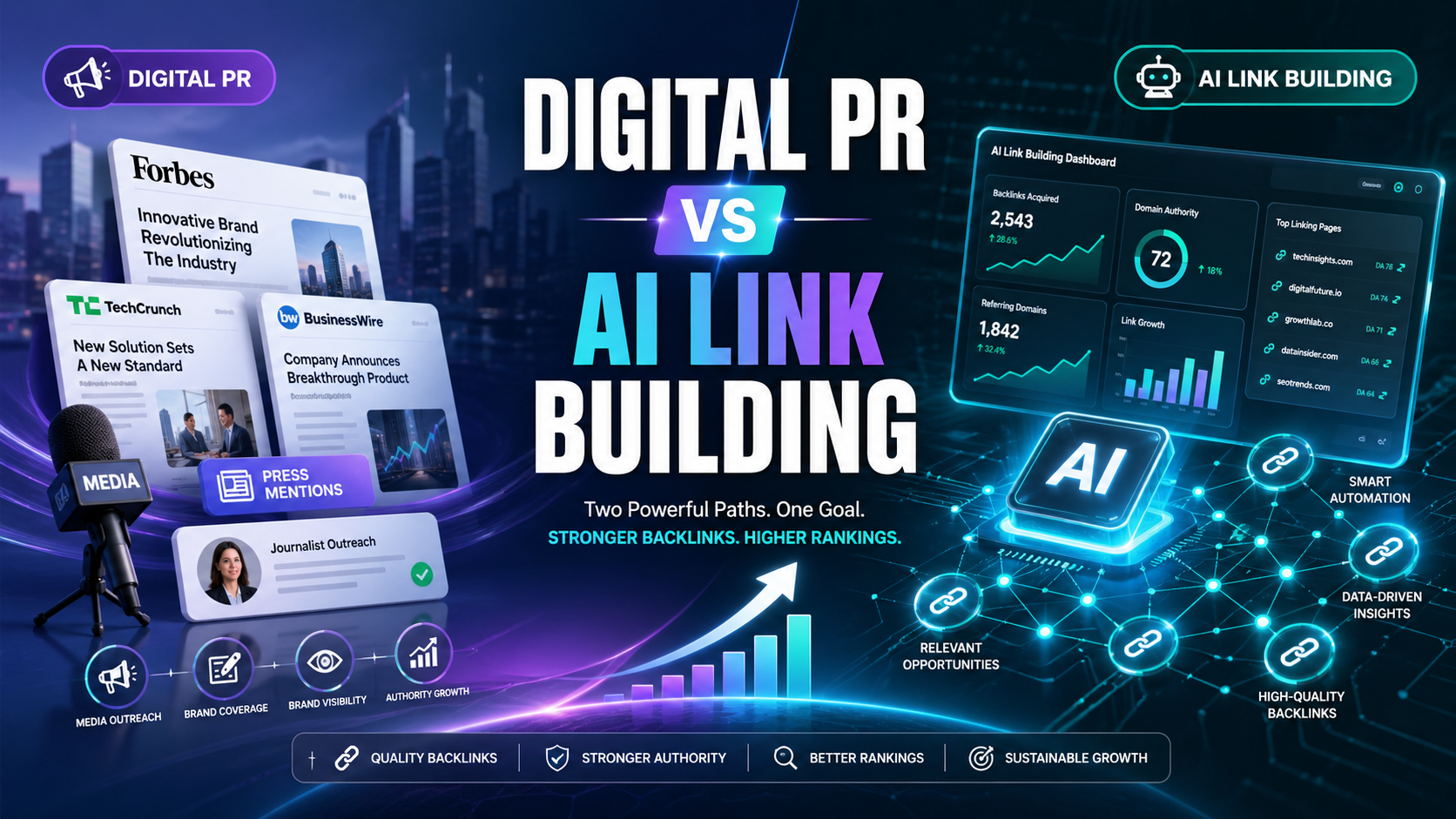
If you’ve been following SEO discussions lately – whether on Reddit’s r/SEO, Twitter threads, or in Slack groups filled with growth marketers – you’ve probably noticed a heated debate forming. On one side, there are PR-focused strategists swearing by earned media and editorial backlinks as the gold standard. On the other, you’ve got a growing camp of SEOs who are leaning hard into AI-powered automation tools to scale link prospecting and outreach at a fraction of the traditional cost.
So who’s right? Is one approach genuinely superior in 2026, or is this a false choice built on misconceptions? The short answer is: it’s complicated — and the data tells a story that most hot takes miss entirely.
This guide takes a clear-eyed look at the digital pr vs ai link building debate, breaks down what the numbers actually show, and gives you the framework to decide what belongs in your own strategy.
Key Industry Statistics at a Glance
| Statistic | Source / Data |
| 48.6% of SEO professionals say Digital PR is the most effective link-building tactic | Editorial.Link Survey of 518 SEO Pros, 2026 |
| Brand mentions correlate 3x more with AI visibility than traditional backlinks (0.664 vs 0.218) | Ahrefs study of 75,000 brands, 2026 |
| 66.2% of practitioners now track AI citations as a KPI | BuzzStream State of Digital PR, 2026 |
| 34% of AI citations come from PR-driven media coverage | BrightEdge Data, 2026 |
| Average Digital PR campaign earns links from 42 unique domains | Digitaloft / Reboot Online |
| Top 25% brands for web mentions get 10x more AI visibility | Ahrefs, 2026 |
| AI-referred visitors convert at 23x higher rates than organic visitors | Ahrefs Internal Data |
| Average high-quality backlink now costs $508.95 | Industry Research, 2026 |
| Digital PR market projected to reach $25.4B by 2032 | Reboot Online Market Report |
| 73.2% of SEOs believe backlinks influence AI search result appearance | Editorial.Link Survey, 2026 |
What Is Digital PR Link Building? (And Why It’s Dominating the Conversation)
Digital PR link building is the practice of earning authoritative, editorial backlinks by creating stories, data, and content that journalists and editors genuinely want to publish. It’s not about buying placements or sending templated emails – it’s about building something worth talking about and then making sure the right people hear about it.
At its core, digital PR connects your brand to the media ecosystem. Think original surveys, data-driven research, reactive expert commentary, newsjacking, and thought leadership op-eds. When executed properly, a single digital PR campaign can generate dozens of links from outlets with domain ratings of 70 to 90-plus – the kind of editorial authority that competitors simply cannot copy or buy.
| TL;DR Digital PR earns high-authority editorial links through newsworthy content and journalist relationships. It builds brand credibility that resonates with both Google and AI search engines like Perplexity and ChatGPT. |
Why Digital PR Dominates the 2026 SEO Landscape
According to a comprehensive survey of 518 SEO professionals conducted by Editorial.Link in 2026, digital PR was ranked the most effective link-building tactic by 48.6% of respondents – more than triple the votes for guest posting at 16% and creating linkable assets at 12%. That’s not a marginal lead. That’s a dominant signal.
The reason isn’t complicated. Google’s algorithm has evolved to heavily reward links from high-authority news and editorial sites – precisely the publications that digital PR targets. Google’s own Helpful Content System, rolling out since 2022, explicitly rewards original, helpful, insightful content – the exact foundation of every well-executed digital PR campaign.
What really set the stage for digital PR’s current dominance was Google’s crackdown on low-quality sites. Multiple algorithm updates – from the Helpful Content Update to the Link Spam Update – systematically devalued the kinds of sites that traditional bulk link building relied on. The sites that survived and thrived were Tier-1 media outlets: Forbes, Wired, CNN, industry trade publications. And the strategy that gets links from those outlets is digital PR.
Here’s the part that really changes the calculus in 2026: AI search systems don’t crawl links the way Google does. Platforms like ChatGPT, Perplexity, and Google’s AI Overviews compile answers from content they’ve indexed, meaning your brand’s presence in authoritative editorial coverage becomes the primary signal these systems use to determine whether to cite you at all.
An Ahrefs study of 75,000 brands found that branded web mentions – exactly the type of coverage digital PR generates – correlate with AI Overview visibility at a coefficient of 0.664. Traditional backlink metrics scored just 0.218. That’s a 3-to-1 advantage that every SEO budget decision in 2026 and beyond needs to account for.
What Is AI-Powered Link Building? (Cutting Through the Noise)
AI-powered link building refers to the use of artificial intelligence and machine learning tools to automate and accelerate elements of the traditional link acquisition process. This includes using AI for prospecting (identifying relevant sites at scale), gap analysis (finding where competitors have links you don’t), outreach personalization, anchor text optimization, and campaign performance tracking.
Tools like Ahrefs, Semrush, Screaming Frog, and dedicated AI outreach platforms have made it possible for small teams to manage link building workflows that would have previously required an army of analysts. AI agents can now crawl SERPs, extract link patterns, build qualified prospect lists, draft personalized outreach emails, and track responses – all in a fraction of the time that manual processes would require.
| TL;DR AI-powered link building automates the mechanical parts of link acquisition – prospecting, outreach drafts, gap analysis, and tracking. It’s not a replacement for strategy or quality content; it’s a force multiplier for execution efficiency. |
The Real-World Capabilities of AI in Link Building
Let’s be specific about what AI tools actually do well in 2026, so we can set realistic expectations:
• Prospect discovery at scale – AI can scan thousands of sites in hours, scoring them by relevance, authority, and contact availability
• Competitor backlink gap analysis – identifying which high-value sites link to competitors but not to you
• Outreach email drafting – AI can generate personalized pitch templates based on the target site’s recent content
• Broken link building workflows – AI agents can identify broken pages with backlinks and flag replacement opportunities
• Performance prediction – modern AI tools can estimate the likely SEO impact of a given placement before you pursue it
• Media monitoring and sentiment analysis – real-time tracking of brand mentions for reactive PR opportunities
But here’s what AI-powered link building doesn’t do well, and what Reddit’s SEO community is increasingly calling out: it doesn’t create the quality signal that earns links from authoritative publications, and it cannot replicate the human relationship-building that gets your brand into Tier-1 editorial coverage. When AI outreach scales too aggressively, it drifts toward spam – and Google’s SpamBrain system is increasingly sophisticated at detecting and discounting exactly that kind of manipulative link building.
Digital PR vs AI Link Building: The Full Comparison
Here’s a structured breakdown of how these two strategies compare across every dimension that matters for your SEO and brand-building goals in 2026:
| Factor | Digital PR Link Building | AI-Powered Link Building |
| Primary Goal | Earn editorial media coverage + high-DA backlinks | Automate prospecting, outreach & gap analysis |
| Link Quality | Tier-1 editorial (DR 70-90+), highly contextual | Variable – depends heavily on human oversight |
| Scalability | Moderate; each campaign requires creative effort | High; automation enables large-scale outreach |
| Cost (Avg.) | $3,000–$15,000+/campaign | $500–$3,000/mo for tools + human supervision |
| Time to Results | 4–12 weeks per campaign cycle | 2–6 weeks for first links (quality varies) |
| AI Search Visibility | Extremely high – brand mentions drive 3x more AI visibility | Moderate – depends on domain authority of placed links |
| Google Penalty Risk | Very low – editorial links are algorithm-safe | Medium–High if automation creates spammy patterns |
| E-E-A-T Alignment | Strong – builds topical authority & expertise signals | Weaker – link volume doesn’t equal E-E-A-T |
| Relationship Building | Yes – long-term journalist & editor relationships | Minimal – transactional, often templated outreach |
| Content Required | Data studies, expert commentary, surveys, stories | Linkable assets; AI helps generate pitches quickly |
| Best For | Brand authority, AI visibility, high-trust industries | Fast growth, volume-driven campaigns, new sites |
| 2026 Effectiveness | ★★★★★ – #1 tactic per 48.6% of SEO pros | ★★★☆☆ – effective only with strong human oversight |
Where Digital PR Wins – And Where AI Tools Pull Ahead
Digital PR: Where It Genuinely Excels
Digital PR isn’t just a link-building tactic – it’s an authority-building system. When your brand earns coverage in The New York Times, Wired, or a respected industry trade publication, you gain more than a backlink. You gain a trust signal that ripples across the entire digital ecosystem: Google’s algorithm, AI search platforms, consumer perception, and even sales pipelines.
Consider this: 66.2% of digital PR practitioners now track AI citations as a key performance indicator – a metric that literally didn’t exist as a tracked KPI just a year ago (BuzzStream, 2026). The brands appearing in AI Overviews, ChatGPT responses, and Perplexity citations are, overwhelmingly, the brands with the deepest editorial coverage footprints. That’s not a coincidence – that’s digital PR doing its job.
Digital PR also provides the strongest protection against algorithmic risk. Because editorial links are earned by genuine journalistic judgment rather than transactional exchange, they’re naturally aligned with what Google’s guidelines reward. You’re not building a link profile that future algorithm updates can devalue – you’re building a brand profile that compounds over time.
AI-Powered Link Building: Where It Has a Legitimate Edge
The honest truth is that AI tools have made parts of link building dramatically more efficient, and writing off that efficiency would be leaving real ROI on the table. For teams managing large-scale SEO campaigns – B2B SaaS companies, affiliate sites, eCommerce brands managing hundreds of category pages – AI prospecting and outreach tools solve a genuine bottleneck.
For new websites or brands with limited authority, AI-powered outreach can build an initial link profile faster than waiting for a digital PR campaign to generate editorial pickup. For competitive keyword plays where even marginal domain authority gains can shift rankings, the volume and speed of AI-assisted link building delivers measurable value.
The key distinction – one that a lot of SEOs miss – is that AI-powered link building works best as an efficiency layer over a sound strategy, not as a replacement for one. The AI doesn’t decide what’s worth linking to. It just helps you find the right people to tell about it and manage the logistics of getting there.
| TL;DR AI tools shine in prospect discovery, outreach automation, and scaling execution. But they need humans directing strategy and quality control, or they produce volume without value – and that’s precisely what Google’s algorithms are designed to detect and ignore. |
The Risks Nobody Talks About (But Should)
The AI Link Building Penalty Trap
Here’s the part of the digital pr vs ai link building debate that gets glossed over in vendor-sponsored content: unsupervised AI outreach is a compliance risk. Google has been explicit that tactics intended to manipulate rankings – including mass-produced, low-quality outreach – can violate its spam policies. When AI agents are set loose with minimal human oversight, they tend to drift toward behavior patterns that look manipulative at scale: generic pitches, irrelevant placements, anchor text patterns that flag algorithmic review.
The fix isn’t to abandon AI – it’s to apply tighter rules, smaller batches, stronger qualification criteria, and require human approval at the strategy and messaging layer. AI agents should automate the process, not determine what deserves a link.
| Watch Out: AI-generated outreach that scales too aggressively can trigger Google’s SpamBrain detection system, resulting in devalued links or manual penalty risk – even if each individual outreach looks reasonable in isolation. |
The Digital PR Execution Gap
Digital PR has its own failure modes that are equally worth understanding. Most digital PR campaigns fail not because the strategy is wrong, but because they start with a product message instead of a story. Journalists aren’t interested in your company’s feature updates or quarterly milestones – they’re interested in data, human behavior, cultural trends, and surprising insights that their readers will care about.
The execution gap in digital PR is real and significant. A poorly conceived campaign – one that doesn’t have a genuine hook, a compelling data angle, or a media-ready asset – can invest significant budget without generating meaningful placements. This is why 95% of successful practitioners lead with data-driven content: original surveys, benchmark reports, and proprietary research that give journalists a story they couldn’t write without you.
The AI Search Visibility Factor: Why This Changes Everything
One of the most important – and most underreported – dimensions of the digital pr vs ai link building debate is what each approach does for your visibility in AI-powered search. This isn’t a marginal consideration anymore. It’s the defining strategic frontier of 2026.
Google AI Overviews now appear in more than 50% of all search results. ChatGPT serves 2.5 billion daily prompts. Perplexity has established itself as a research tool of choice for millions of users. These platforms don’t just rank pages – they synthesize answers, and the sources they pull from are determined by a fundamentally different set of signals than traditional Google search.
Here’s what the data shows: AI systems prioritize consistent, context-rich mentions from authoritative media. Brands in the top 25% for web mentions get 10x more AI visibility than the rest (Ahrefs). The Google-AI citation relationship has also decoupled significantly – in mid-2025, roughly 76% of AI-cited pages ranked in Google’s top 10. By early 2026, that dropped to just 38%. AI is increasingly choosing its own authoritative sources, independent of traditional SERP rankings.
The strategic implication: Building links to improve Google rankings is a defensible strategy. Building brand mentions to appear in AI-generated answers is a different and increasingly parallel game. Digital PR addresses both. AI-powered bulk link building addresses primarily the first.
Additionally, AI-referred visitors aren’t just more numerous – they convert at dramatically higher rates. Ahrefs internal data shows AI-referred visitors converting at 23 times the rate of traditional organic search visitors. If you’re evaluating link building strategies based purely on traffic, you may be dramatically undervaluing what editorial media coverage delivers in terms of qualified revenue-generating traffic.
| TL;DR Digital PR drives AI search visibility through brand mentions, which now correlate 3x more strongly with AI citation rates than traditional backlinks. If your strategy ignores AI search optimization, you’re competing in only part of the modern search landscape. |
Which Strategy Fits Your Situation? A Decision Framework
| Scenario | Best Approach | Why |
| Early-stage startup, limited budget | AI-Powered Link Building | Scales outreach quickly, lower upfront cost |
| Enterprise brand in YMYL niche | Digital PR | Trust, E-E-A-T, and AI visibility are critical |
| SaaS company targeting AI citations | Digital PR + AI tools hybrid | Brand mentions drive 3x AI visibility over plain links |
| Affiliate/eCommerce site at scale | AI-Powered Link Building | Volume and page-level authority matter most |
| B2B thought leadership | Digital PR | Media placements build credibility and pipeline |
| Fast competitive keyword wins | AI-Powered Link Building | Speed and volume can tip rankings quickly |
| Long-term algorithmic safety | Digital PR | Editorial links are naturally Google-compliant |
The Hybrid Approach: How Smart Teams Use Both
The most sophisticated SEO teams in 2026 aren’t choosing between digital PR and AI-powered link building – they’re using AI to make their digital PR campaigns more effective, and digital PR to build the brand authority that makes their AI-assisted outreach more likely to succeed.
Here’s what that looks like in practice:
• Use AI tools for gap analysis – identify which high-authority publications in your niche link to competitors but not to you, then build PR campaigns specifically designed to earn those placements
• Use AI for journalist discovery – build targeted media lists faster and more accurately, then apply human judgment to personalize pitches
• Use digital PR assets as link bait for AI-assisted outreach – an original data study gives your outreach team a genuine reason for every journalist to respond
• Use AI monitoring tools to find reactive PR opportunities – when breaking news intersects with your expertise, AI alerts let you respond faster with expert commentary
• Use digital PR to build entity authority – consistent media coverage across trusted publications strengthens your brand entity profile in ways that help AI systems recognize and cite you
BrightEdge data shows that approximately 34% of AI citations come from PR-driven coverage, with another 10% from social channels. That means 44% of the most valuable traffic in modern search comes from earned media sources — not from direct link manipulation. Building a content-and-PR machine that generates consistent earned media is the most defensible long-term SEO strategy available right now.
The Real Talk: What Reddit Gets Right (And Wrong) About This Debate
Community discussions about link building – whether on Reddit’s r/SEO, r/marketing, or in private Slack communities – often reveal a healthy skepticism that polished vendor content doesn’t. That skepticism is worth engaging with directly.
The Reddit crowd is right about several things. They’re right that AI link building tools are frequently oversold. Many vendors pitch AI-powered outreach as an autonomous system, when in reality any responsible use of these tools requires ongoing human oversight, strategy, and quality control. They’re right that bulk link building from low-quality sites – AI-assisted or otherwise – is increasingly risky and delivers diminishing returns.
Where some community discussions miss the mark is in dismissing digital PR as a “big brand only” tactic. That’s not accurate. Digital PR success isn’t about the size of your brand – it’s about the quality of the story your data can tell. A small eCommerce brand with access to proprietary sales data about consumer behavior can run a compelling digital PR campaign that earns placements on national publications, outcompeting brands with 10 times the marketing budget.
| Community Insight: The most common question in SEO communities right now is: ‘How do I build backlinks that actually show up in AI results like Perplexity or ChatGPT?’ The answer – earned media mentions through digital PR – is one that most AI link building tools can’t provide. |
How to Evaluate Link Building Services in 2026
Whether you’re leaning toward digital PR, AI-assisted link building, or a hybrid approach, the quality of the agency or service you partner with will determine more than the strategy itself. Here’s a practical framework for evaluating any link building service:
Questions to Ask Any Link Building Provider
• Do they discuss AI visibility, citation tracking, and brand mentions – or only traditional backlink metrics?
• Can they show real examples of client coverage in top-tier publications (not just DA scores)?
• Do they have established relationships with journalists and editors, or are they purely running automated outreach?
• Can they demonstrate clients featured in AI Overviews, ChatGPT responses, or Perplexity citations?
• How do they handle quality control on AI-assisted outreach – what’s the human review process?
• What’s their approach to E-E-A-T alignment – do they build links that signal genuine topical expertise?
• Can they provide case studies with verifiable results (preferably with named clients who can be cross-referenced)?
The agencies that thrive in 2026 will be those that recognize quality partnerships matter more than cost savings, and that integration between link building, content marketing, technical SEO, and digital PR delivers compounding returns that isolated tactics cannot match.
The Verdict: Digital PR vs AI Link Building in 2026
Here’s the honest assessment after looking at all the data: in the digital pr vs ai link building debate, digital PR wins as the more impactful long-term strategy for brand authority, AI search visibility, and algorithmic safety. The numbers support this – 48.6% of SEO professionals rate it the most effective tactic, brand mentions drive 3x more AI visibility than traditional backlinks, and editorial links are the ones that survive every algorithm update Google throws.
But writing off AI-powered link building entirely would be shortsighted. AI tools solve real efficiency problems in the link acquisition workflow, and for teams that need to scale link building across large content portfolios, they provide genuine value — as long as they’re used with robust human oversight and a clear strategy guiding what’s worth building links to.
The future of link building isn’t a binary choice. It’s a layered approach: use digital PR to build the brand credibility and editorial coverage that makes every other marketing activity more effective, and use AI tools to eliminate the mechanical inefficiencies that slow down execution. That combination – earned authority plus operational efficiency – is what separates the brands that dominate search in 2026 from those still fighting over diminishing returns from tactics that Google has long since devalued.
The goalposts have moved. The question is no longer “how do I get more links?” – it’s “how do I become a brand that AI systems, journalists, and Google all recognize as the authoritative source on my topic?” Digital PR, done well, is the most direct path to that destination.
Key Takeaways
• Digital PR is the #1 link-building tactic in 2026, chosen by 48.6% of SEO professionals surveyed.
• Brand mentions from earned media correlate 3x more strongly with AI visibility than traditional backlinks.
• AI-powered link building is valuable for efficiency but requires human strategy and oversight to avoid penalty risk.
• The smartest 2026 approach combines digital PR for authority-building with AI tools for execution efficiency.
• AI-referred visitors convert at 23x higher rates – making AI search visibility a revenue-critical metric, not just an SEO vanity stat.
• Long-term algorithmic safety favors editorial, earned links – the kind only digital PR delivers at scale.