

Introduction
If you’ve ever Googled “affordable link building” and landed on a service offering 50 backlinks for $99, you already know how tempting it sounds. More links, less money, faster rankings, what’s not to love?
The reality is far less exciting.
Cheap link building services are one of the most common ways businesses quietly torch their SEO. Not overnight, and not always obviously but steadily, and often irreversibly. The sites that lean on low-cost, high-volume link vendors don’t just fail to rank. They get penalized, lose traffic they already had, and spend months (sometimes years) clawing their way back.
In 2026, with Google’s SpamBrain AI growing sharper after every update, the gap between quality link building and cheap shortcuts has never been wider. This article breaks down exactly why cheap link building services fail, what the warning signs look like, and how to approach backlink acquisition in a way that actually builds lasting authority.
TL;DR
- Cheap link building services almost always rely on link farms, PBNs, or AI-generated spam content, all of which Google actively targets.
- Google’s October 2025 spam update specifically expanded enforcement against AI-generated guest post farms, making low-cost “content marketing” networks even riskier.
- A quality backlink costs between $150–$1,500+ depending on domain authority, traffic, and niche, anything priced dramatically below this range is a red flag.
- Top-ranking pages have 3.8x more quality backlinks than pages ranked 2–10, proving that the link gap is real but it must be closed with the right links, not cheap ones.
- Safe alternatives include digital PR, editorial outreach, white-label services from vetted agencies, and content-led link earning strategies.
- B2B SaaS companies report average ROI of 702% from well-executed, quality link building campaigns, versus near-zero or negative ROI from cheap services.
What “Cheap Link Building Services” Actually Means
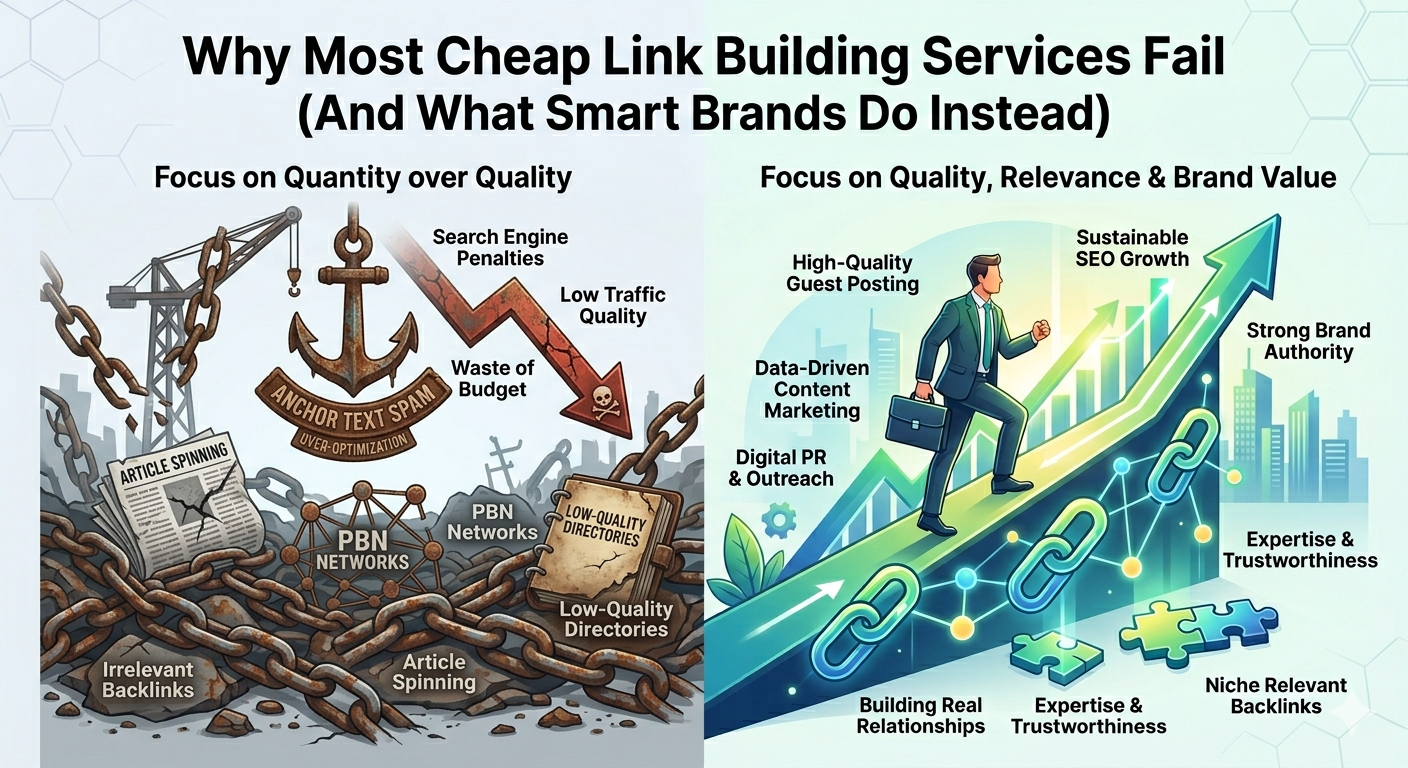
The term “cheap link building services” covers a wide spectrum, but they share a few common traits: high volume, low cost per link, and minimal transparency about where those links actually live.
When you pay $50 for 100 backlinks or even $200 for a “high-DA” package, the math should immediately raise a question: how is anyone making money providing editorial-quality placements at that price?
The answer is simple: they’re not providing editorial-quality placements.
What you’re typically getting instead:
- Link farm placements: websites built solely to sell backlinks, with no real audience, thin content, and no genuine editorial process.
- Private Blog Network (PBN) links: a network of sites secretly under common ownership, often built on expired domains, used to pass link equity artificially.
- AI-generated content spam: low-cost services increasingly populate their networks with machine-written articles that embed paid links, a practice now explicitly targeted by Google’s updated spam policies.
- Irrelevant directory submissions: mass submissions to generic directories that carry no topical relevance and zero ranking value.
The core problem isn’t just the quality of the links themselves. It’s that these link types directly violate Google’s Webmaster Guidelines, and Google’s enforcement capabilities have never been more sophisticated.
The Real Dangers of Cheap Backlinks
1. Google’s SpamBrain Is Getting Smarter, Fast
Google’s AI-powered spam detection system, SpamBrain, has fundamentally changed the risk calculus of manipulative link building. In its 2022 Search spam report, Google stated that SpamBrain reduced search spam by more than 99% compared to pre-machine-learning baselines, with AI-assisted detection running 70 times more efficiently than rule-based systems.
The October 2025 spam update pushed this further, explicitly targeting AI-generated guest post farms, networks that had rebranded themselves as “content marketing” services after earlier enforcement actions. Many of the cheap link building services operating today fall squarely into this category.
The enforcement timeline has also compressed dramatically. A link spam violation that might have taken months to manifest as a ranking penalty in 2012 can now surface in days.
2. Penalties Aren’t Always Obvious
One of the most dangerous misconceptions around cheap backlinks is that you’ll know when you’ve been penalized. That’s not always how it plays out.
Many sites that rely on manipulative link building don’t receive a dramatic drop in rankings, they hit a growth ceiling. Organic traffic flatlines. New pages fail to rank despite solid content. The site looks “fine” on the surface, but something invisible is capping its potential. This is algorithmic suppression, not a manual action, and it can persist for months without triggering any alert in Google Search Console.
Manual penalties are another risk. Google’s human reviewers flag clear policy violations, paid links, excessive guest post patterns, unnatural anchor text clustering, and can issue manual actions that directly suppress your site’s visibility.
3. Recovery Is Expensive and Time-Consuming
Getting out of a cheap-link hole is not quick or cheap. Recovery involves a full backlink audit, compiling a disavow file, submitting it through Google Search Console, and then waiting for Google to reprocess your profile. Industry data from Blue Tree Digital found that of 23 B2B SaaS sites guided through full link profile remediation, 19 saw measurable ranking recovery, but not until 8 weeks after Google reprocessed their profiles. And that’s after the cleanup work was done correctly.
4. The “Stuck Site” Problem Kills Long-Term ROI
The hidden cost of cheap link building isn’t just penalties, it’s lost opportunity compounding over time. Every month your site spends stuck below page two because of a polluted link profile is traffic, leads, and revenue you’re not capturing. When you factor in the cost of cleanup, the lost organic revenue, and the paid alternatives you’re forced to use in the meantime, “cheap” backlinks become extraordinarily expensive.
Are Cheap Backlinks Worth It? A Side-by-Side Comparison
| Factor | Cheap Link Building Services | Quality Link Building Services |
| Price per link | $1–$50 | $150–$1,500+ |
| Link source | Link farms, PBNs, AI spam sites | Vetted editorial sites with real traffic |
| Google compliance | High violation risk | White-hat, guideline-compliant |
| Traffic from linking domains | Near zero | Meaningful organic traffic |
| Risk of penalty | High (manual or algorithmic) | Low when vetted properly |
| Long-term SEO impact | Negative or neutral | Positive, compounding |
| Transparency | Low, unknown placements | High, verifiable site list |
| Recovery cost if penalized | $500–$5,000+ in audit/cleanup | N/A |
| ROI (typical) | Negative or negligible | 250%–702% in documented campaigns |
Why Cheap Backlinks Are Dangerous: The Tactics They Use
Link Farms
Link farms are websites built exclusively to sell backlinks. They have high outbound-to-inbound link ratios, thin or irrelevant content, no identifiable editorial team, and often cluster together on shared IP infrastructure. According to Google’s official Spam Policies for Web Search, link farms fall squarely under prohibited link schemes, practices that manipulate ranking signals and risk manual actions or algorithmic devaluation. SpamBrain identifies them through network-level analysis, and sites linked from these farms don’t just fail to benefit, they get pulled down by association.
Private Blog Networks (PBNs)
PBNs represent the more sophisticated end of manipulative link building. Operators buy expired domains with existing authority, add minimal content to make the sites appear legitimate, and then sell links from those domains. PBN operators use hosting diversification, privacy services, and rotating CMS themes to avoid detection, but Google’s footprint detection has grown significantly more accurate. When PBN networks get caught, they often get caught all at once. The BuildMyRank case study is an instructive example: the entire network was deindexed overnight, causing thousands of client sites to lose rankings simultaneously.
AI-Generated Guest Post Farms
This is the newest and fastest-growing variant of manipulative link building. Services reposition their link networks as “content marketing” or “guest posting at scale,” using AI tools to generate articles that embed paid links. Google’s October 2025 update called this out explicitly as a violation category. Any cheap service offering guest post links at $20–$50 per placement is almost certainly relying on this model.
How to Choose a Link Building Service That Won’t Hurt You
Not all link building services are created equal, and the price point is only one signal. Here’s what to look for when evaluating vendors:
Vet the Actual Placements
Reputable services will give you a sample placement list before you commit. Check each domain manually: Does it have real organic traffic? Does the content look written for humans? Is there an actual editorial team or contact information? The Ahrefs Free Backlink Checker is one of the fastest ways to verify a domain’s traffic, Domain Rating (DR), referring domains, and backlink profile, all before you spend a dollar. If the linking domain shows near-zero traffic or an inflated DR with no real referring sites behind it, walk away.
Look for Process Transparency
Quality services explain exactly how they acquire links, manual outreach, editorial pitching, broken link building, digital PR. If a vendor is vague about their process, or if it sounds automated, that’s a clear warning sign.
Ask About Their Vetting Criteria
Any serious link building agency screens placements for topical relevance, domain traffic, content quality, and spam signals. Ask them directly: “How do you vet linking sites?” A solid answer involves specific criteria. A vague or defensive answer tells you everything.
Avoid Guaranteed Rankings
No link building service can guarantee rankings, and any that do are almost certainly using manipulative tactics to deliver short-term results that collapse under the next algorithm update.
Check for White-Label Credibility
If you’re an agency reselling link building services, partnering with a reputable white-label provider protects your clients and your reputation. Resources like this curated list of white-label link building services give you a strong starting point for vetting partners that meet modern quality and compliance standards.
Red Flags in Cheap Link Building Services
| Warning Sign | What It Usually Means |
| “100 backlinks for $99” | Link farm or PBN bulk placement |
| Instant delivery (24–48 hrs) | Automated, not editorial |
| “High DA guaranteed” | DA/DR is inflated or unverified |
| No placement transparency | Hidden low-quality domains |
| Guaranteed first-page rankings | Black-hat tactics almost certainly involved |
| No contract or accountability | Disposable vendor with no skin in the game |
| Exact-match anchor text by default | Triggers Google’s over-optimization filter |
Safe Link Building Strategies That Actually Work in 2026
Digital PR
Digital PR has emerged as the dominant quality link building methodology in 2026, used by 67.3% of marketers as their primary strategy. The approach earns links by pitching genuinely newsworthy stories, original research, and expert commentary to journalists and editors at established media outlets. These links come from sites with real audiences, real authority, and real editorial standards, exactly what Google values. Digital PR also has an increasingly important secondary benefit: brand mentions from reputable publications correlate three times more strongly with AI search visibility than raw backlink counts.
Editorial Outreach and Guest Posting (Done Correctly)
Guest posting isn’t inherently risky, volume and relevance are what determine risk. If more than 5–10% of your backlink profile consists of guest post links, you’re operating in penalty territory. Targeted editorial outreach to relevant, high-traffic publications in your niche, where you’re contributing genuine expertise, remains one of the most effective and compliant link building strategies available.
Broken Link Building
Find dead links on authoritative sites in your niche and offer your content as a replacement. This provides value to the webmaster while earning a legitimate, contextual backlink. Tools like Ahrefs’ Broken Link Checker make this scalable. It’s a white-hat strategy that fits naturally within Google’s editorial intent framework.
Content-Led Link Earning
Original research, comprehensive data studies, and genuinely useful industry guides earn links naturally over time. According to Backlinko’s 2025 analysis, articles exceeding 3,000 words earn 3.5 times more backlinks than shorter content, and posts with more than three videos draw 55% more backlinks. Content-led link earning is a slower burn, but the links are permanent, editorial, and compound in value.
HARO / Featured Outreach
After HARO’s shutdown in 2024, Featured.com revived the journalist-source connection model. Responding to journalist queries with genuine expert insight earns editorial links from mainstream and niche publications alike. It requires consistent effort, but the links are some of the cleanest available.
Link Building ROI: What Quality Actually Returns
The ROI case for quality link building, as opposed to cheap shortcuts, is well documented in current industry data.
| Industry | Reported ROI from Quality Link Building |
| B2B SaaS | 702% average ROI |
| Legal Services | 526% average ROI |
| Digital PR (general) | 250%–625% per $60K/year investment |
| E-commerce | Highly variable, scales with domain authority |
The average SEO professional is willing to pay $508.95 for a single high-quality backlink (uSERP’s 2025 State of Link Building Report). BuzzStream’s 2025 pricing analysis found that high-quality editorial placements average $609 per link when filtered for traffic and editorial standards. These numbers exist because quality links produce compounding, long-term ranking improvements. A $50 link from a link farm produces nothing, except risk.
The math on cheap link building is brutal when you run it honestly: if a bundle of 50 cheap links costs you a Google penalty and six months of recovery, the true cost is the lost organic traffic, the cleanup bill, and the paid acquisition costs you incur while your organic visibility is suppressed. No $99 package survives that calculation.
How Cheap Links Stack Up Against Quality Links Over Time
| Time Period | Cheap Links (Typical Outcome) | Quality Links (Typical Outcome) |
| Month 1–2 | Minor ranking uptick (sometimes) | Gradual authority building begins |
| Month 3–4 | Plateau or traffic stagnation | Measurable ranking improvements |
| Month 6 | Algorithm suppression or manual penalty risk | Compounding authority and traffic gains |
| Month 12+ | Costly recovery phase or continued suppression | Significant organic growth, brand authority |
| Long-term | Negative ROI, reputation risk | 250%–700%+ ROI documented |
The Right Question to Ask Before Buying Links
Before engaging any link building service, ask yourself one question: Would a journalist or editor voluntarily link to my site from this domain?
If the answer is yes, if the site has a real audience, genuine content, and editorial standards, the link has value. If the answer is no, if the site exists only to sell links, has no real traffic, and publishes content no one would choose to read, the link will either do nothing or actively harm you.
Price is a useful signal, but it’s not the only one. The best guide is always the quality of the placement itself. Platforms offering vetted white-label link building services often provide curated, scalable solutions that follow these quality standards, making them a reliable starting point whether you’re managing your own SEO strategy or running link building campaigns for clients.
Frequently Asked Questions
Are cheap backlinks worth it?
No. Cheap backlinks from link farms or PBNs carry high penalty risk and produce little to no lasting SEO value. The true cost, when you factor in recovery time and lost traffic, consistently exceeds the apparent savings.
Why are cheap backlinks dangerous?
Because they typically come from sources that violate Google’s Webmaster Guidelines. When Google’s SpamBrain or human reviewers flag these links, the result can be algorithmic suppression or a manual penalty, both of which tank rankings and are costly to recover from.
What should a good link building service cost?
Quality backlinks typically cost $150–$1,500+ per link depending on domain authority, niche, and traffic. Monthly retainers for professional link building services generally start around $1,500 for small businesses and scale to $10,000+ for competitive niches.
How do I know if a link building service is safe?
Ask for placement samples, verify the domains have real organic traffic, confirm they use manual outreach (not automation), and check that anchor text strategy is natural. Avoid any vendor promising guaranteed rankings or delivering links within 24 hours.
What are the safest link building strategies in 2026?
Digital PR, editorial outreach to relevant publications, broken link building, content-led link earning, and HARO/Featured outreach are the most reliable and compliant strategies in the current environment.
Final Word
The appeal of cheap link building services is understandable. Link building is time-consuming, expensive when done right, and genuinely difficult to scale. The vendors offering 100 links for $99 are selling the illusion of a shortcut that doesn’t exist.
Google’s algorithms in 2026 are built to find exactly what these services produce, unnatural patterns, artificial authority, editorial-looking links from non-editorial sources. The short window between link placement and penalty detection is now measured in days, not months.
The businesses winning at organic search right now are investing in link building the hard way: building real relationships, earning genuine placements, and treating backlinks as what they actually are, digital endorsements from authoritative sources, not units of a commodity you can buy in bulk.
Spend your budget on quality. Protect your domain from manipulative shortcuts. And when evaluating potential partners, look for white-label link building providers with transparent processes, proven results, and a strong focus on relevance, authority, and long-term SEO value.