

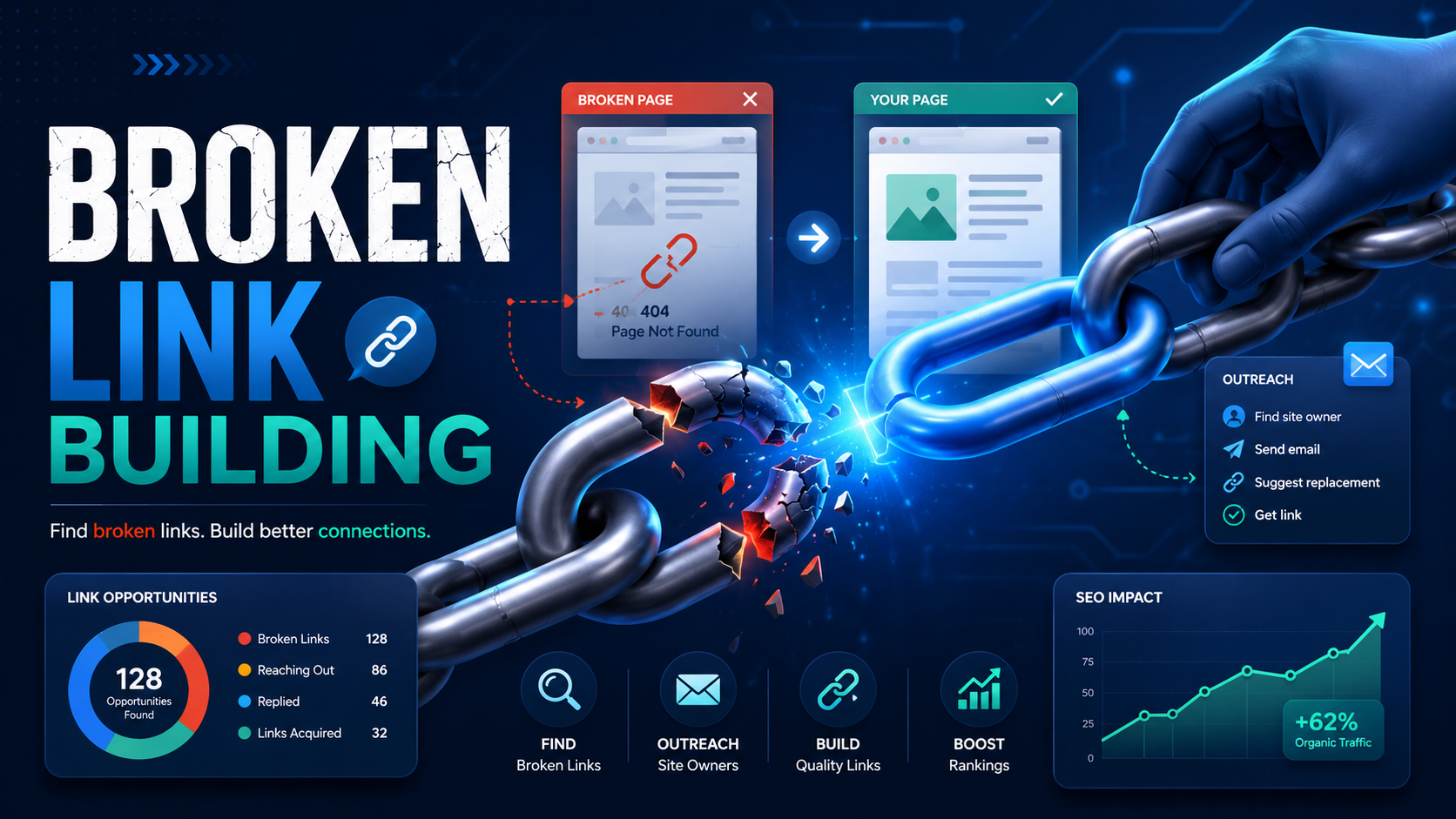
| TL;DR – The Quick Take Broken link building is one of the most reliable white-hat SEO tactics available. You find dead links on relevant websites, create superior replacement content, and pitch the webmaster with a helpful email. When done right, it earns you powerful, editorially placed backlinks that move the ranking needle – without any black-hat risk. This guide walks you through every step, from spotting broken links to seeing your URL go live. |
Let’s be real for a second. Most link building advice you’ll find online is either painfully vague or dangerously outdated. You’re told to ‘create great content and the links will come’ – a nice theory that doesn’t pay the bills or push you to page one of Google. Meanwhile, your competitors are quietly stacking authoritative backlinks while you’re wondering why your 10,000-word guide is sitting on page six.
Here’s what those competitors may already know: broken link building is one of the most consistently effective and ethical link acquisition strategies available in 2026. It doesn’t require you to beg for links, write spammy guest posts on irrelevant blogs, or risk a manual penalty from Google. Instead, it’s a straightforward value exchange – you help a webmaster fix a problem on their site, and they reward you with a quality backlink.
This guide covers the full broken link building workflow, from identifying the right targets to the moment your link goes live. Whether you’re handling SEO in-house, running a client campaign, or evaluating whether to hire a professional link building service, what follows is everything you need to know – no fluff, no filler.
What Is Broken Link Building – And Why Does It Actually Work?
Broken link building is a white-hat SEO strategy where you identify hyperlinks on third-party websites that point to non-existent pages (returning a 404 error), then reach out to the site owner with a relevant, high-quality replacement from your own site.
The genius of this approach is the mutual benefit baked into its design. Site owners genuinely dislike broken links – they hurt user experience, waste crawl budget, and signal neglect to search engines. When you approach them with a solution rather than a sales pitch, the conversation starts from a place of helpfulness. That changes the entire dynamic of link outreach.
From an SEO perspective, broken link building checks every box. The links you earn are editorially placed on real, active websites. They’re contextually relevant because you’re targeting pages that used to cover the same topic as your content. And they typically point to domains with actual traffic and authority – not link farms or private blog networks.
| Why Broken Link Building Still Works in 2026 According to Ahrefs, roughly 66% of links pointing to websites have become “dead” due to domain shutdowns, URL restructuring, or deleted content. That’s an enormous pool of opportunities. Search engines continue to reward pages with strong, relevant backlink profiles – and broken link building is one of the cleanest ways to build that profile. |
Key Benefits at a Glance
| Benefit | Why It Matters | Impact Level |
| White-hat & Google-safe | No manual penalty risk; compliant with all major guidelines | ⭐⭐⭐⭐⭐ |
| Editorial link placement | Links are naturally contextual, not forced or paid | ⭐⭐⭐⭐⭐ |
| Webmaster goodwill | You’re solving a problem, not just asking for a favor | ⭐⭐⭐⭐ |
| Scalable with tools | Ahrefs, Semrush, and Screaming Frog automate discovery | ⭐⭐⭐⭐ |
| Traffic + authority gains | Backlinks from high-DA pages improve rankings & referrals | ⭐⭐⭐⭐⭐ |
| Relationship building | Opens doors for future collaborations and mentions | ⭐⭐⭐ |
Step 1 – Prospecting: Finding Broken Link Opportunities Worth Pursuing
| TL;DR – Step 1 Use tools like Ahrefs, Semrush, or Screaming Frog to find dead outbound links on high-authority websites in your niche. Prioritize pages with strong Domain Rating (DR 40+), real organic traffic, and topical relevance to your content. |
Prospecting is where most people either get this right or waste enormous amounts of time. The goal isn’t to find every broken link on the internet – it’s to find broken links on pages where a backlink from that site would actually move your SEO needle.
Method 1: Competitor Backlink Analysis
Start by analyzing the broken backlink profiles of your top competitors or well-known industry resource hubs. In Ahrefs Site Explorer, navigate to ‘Best by Links’ and filter for ‘404 Not Found’ pages. This instantly surfaces content that used to attract links but no longer exists – precisely the type of gap you can fill.
Method 2: Resource Page Prospecting
Resource pages are goldmines for broken link building because they were explicitly created to link out to helpful content. Search Google for queries like:
• “your niche” + “resources” + “useful links”
• “your keyword” + “recommended reading” site:edu
• “your topic” + “helpful resources” inurl:links
Then run any resource page you find through Screaming Frog or Check My Links (a Chrome extension) to identify any dead URLs listed on that page.
Method 3: Wayback Machine + Niche Topics
For any broken URL you discover, plug it into the Wayback Machine (web.archive.org) to see what the original page contained. This is critical – it tells you exactly what kind of replacement content would be relevant and persuasive to propose.
Top Prospecting Tools Compared
| Tool | Best For | Price Range | Ease of Use |
| Ahrefs | Broken backlinks on competitor sites | $99–$399/mo | Intermediate |
| Semrush | Broken inbound/outbound link discovery | $119–$449/mo | Intermediate |
| Screaming Frog | Full-site crawl for 404s | Free / $259/yr | Advanced |
| Check My Links | Quick Chrome-based page check | Free | Beginner |
| Moz Link Explorer | Domain authority + broken link data | $99–$299/mo | Beginner |
Step 2 – Evaluating Opportunities: Not Every 404 Is Worth Your Time
Once you have a list of broken links, the next step is ruthless prioritization. Chasing every dead link you find is a recipe for burnout and disappointing results. Instead, evaluate each opportunity against these criteria:
• Domain Rating (DR) or Domain Authority (DA): Prioritize sites with DR/DA 40 or higher for meaningful SEO lift.
• Organic Traffic: Use Ahrefs or Semrush to verify the linking page actually receives real human visitors – not just bot crawls.
• Topical Relevance: A broken link about cloud computing on a cybersecurity blog is relevant. The same broken link on a food recipe site is not.
• Number of Linking Domains: If the broken page itself used to attract links from other sites, your replacement could inherit that link equity.
• Spam Score: Run domains through Moz’s Spam Score checker. Anything above 30% should be left alone.
Export your filtered list to a spreadsheet and score each opportunity. A simple 1–5 rating across the above criteria will help you identify which targets deserve your first email and which ones can wait – or be dropped entirely.
Step 3 – Content Creation: Building a Replacement Worth Linking To
| TL;DR – Step 3 Your replacement content must match the intent of the original broken resource – and then exceed it in depth, design, and accuracy. Mediocre replacement content is the #1 reason broken link building campaigns fail. |
This is the step that separates high-converting broken link building campaigns from frustrating dead ends. A webmaster isn’t going to swap out a broken link just because you asked nicely – your replacement has to genuinely be the best available resource on that topic.
Begin by analyzing the archived version of the broken page on the Wayback Machine. Note its format (was it a guide, a stats roundup, a tool, a checklist?), its approximate depth, and the angle it took on the subject. Your content should match this intent – then exceed it.
What ‘Better’ Content Actually Looks Like
• Updated statistics and data from current, credible sources (government sites, peer-reviewed research, industry reports)
• Visuals such as infographics, comparison charts, or original diagrams that break down complex concepts
• Cleaner structure with logical headings, a table of contents, and actionable takeaways
• Depth that goes beyond the surface – include case studies, expert quotes, or step-by-step walkthroughs
• Mobile-optimized formatting with fast page load speeds
If the broken link pointed to a statistics page, build a fresh statistics roundup with sources dated 2025–2026. If it pointed to a how-to guide, build a more comprehensive, visually enhanced version. The replacement needs to make the webmaster feel good about linking to it – not just obligated.
Step 4 – Outreach: Writing Emails That Get Replies
Outreach is both an art and a science. Most link building outreach emails fail for one of three reasons: they’re too generic, too long, or they lead with the ask instead of the value. Here’s how to get it right.
The Anatomy of a Winning Broken Link Outreach Email
• Subject Line: Keep it specific and curiosity-driven. Example: ‘Found a broken link on your [topic] page’
• Opening: Reference the specific page you found the broken link on – not just the domain. Personalization signals effort.
• The Problem: Clearly but briefly identify the broken link. Include the anchor text and the dead URL so they can verify it instantly.
• The Solution: Introduce your replacement page naturally. Mention why it’s a strong alternative without being salesy.
• The Close: Make it easy for them to say yes. A single soft CTA like ‘Would this be a helpful swap?’ works better than aggressive follow-up language.
| Sample Outreach Template Hi [Name], I was reading your article on [Topic] and noticed a link to [anchor text] is no longer working – it returns a 404 error. I recently published an updated resource on the same topic that covers [brief benefit 1] and [brief benefit 2]. Here’s the link: [Your URL] If it’s a good fit, it might make a solid replacement. Either way, thought it was worth flagging the broken link. Best, [Your Name] |
Follow-Up Strategy
Send one polite follow-up email 5–7 days after your initial outreach if you haven’t received a reply. Keep it brief – just a short nudge referencing your previous email. Do not send more than two follow-ups total. Pestering webmasters damages your brand and reputation in your niche community.
Broken Link Outreach Benchmarks
| Metric | Industry Average |
| Email open rate | 40–60% (with personalization) |
| Reply rate | 5–15% |
| Conversion rate (link placed) | 3–8% of total outreach |
| Average links per 100 emails | 4–8 live placements |
| Time to live link (from outreach) | 1–3 weeks |
Step 5 – Tracking and Scaling: Turning One Win Into a System
Once you’ve landed your first few broken link placements, it’s time to build a repeatable process. At this stage, most solo practitioners hit a ceiling – because finding broken links, evaluating opportunities, creating content, managing outreach sequences, and tracking results is genuinely a full-time operation.
Smart SEOs either build a dedicated internal workflow using tools like Ahrefs + BuzzStream + Notion, or they partner with a specialized link building service that does it all under one roof. Let’s look at both options.
DIY Broken Link Building Stack
• Ahrefs or Semrush – Broken link discovery and domain vetting
• Screaming Frog – Deep crawl of target sites for 404 detection
• Wayback Machine – Identify what broken pages originally contained
• Hunter.io or Voila Norbert – Find verified contact emails
• BuzzStream or Mailshake – Outreach sequences and follow-up automation
• Google Sheets – Opportunity tracking, status updates, and reporting
When to Hire a Broken Link Building Service: Top Options Compared
Let’s address the elephant in the room: broken link building at scale is time-intensive. For most growing businesses and agencies, delegating to a professional link building service is not just convenient – it’s strategically smarter. You get access to established publisher relationships, vetted outreach teams, and consistent quality control that would take years to build internally.
That said, not all link building services are created equal. Some use private blog networks (PBNs), mass-blast generic outreach templates, or inflate metrics using DA manipulation. Knowing what to look for – and what to avoid – is critical before you hand over your SEO budget.
Top Link Building Services Comparison (2026)
| Service | Specialty | Starting Price | White-Hat? | Best For | Rating |
| OutreachZ ⭐ TOP PICK | Guest posts, broken link, managed outreach | $80/link | ✅ Yes | Agencies & teams | 5/5 |
| Page One Power | Custom link building campaigns | $2,000+/mo | ✅ Yes | Enterprise SEO | 4.5/5 |
| FATJOE | Blogger outreach, niche edits | $90/link | ✅ Yes | SMBs & agencies | 4/5 |
| The HOTH | Scalable link building packages | $60/link+ | ✅ Yes | Small businesses | 3.5/5 |
| Rhino Rank | Guest posts & curated links | $59/link+ | ✅ Yes | Bulk link buyers | 4/5 |
| Editorial.Link | Premium editorial backlinks | $250+/link | ✅ Yes | SaaS & B2B brands | 4.5/5 |
Why OutreachZ Stands Out as the Top Choice
If you’ve been looking for a link building partner that combines scale with quality – and doesn’t leave you guessing about where your money went – OutreachZ deserves serious consideration.
Founded in 2012 and serving over 1,500 digital agencies and SEO teams worldwide, OutreachZ has built one of the largest managed publisher networks in the industry – spanning 50,000+ vetted publishers across every major niche. What sets them apart isn’t just volume. It’s the rigorous vetting process applied to every publisher before a single link is placed.
What Makes OutreachZ Different
• Manual outreach only: No PBNs, no automated spam, no shortcuts that could trigger a Google penalty
• Full publisher vetting: Every site is evaluated for niche relevance, organic traffic, spam score, backlink profile quality, and OBL (outbound link) ratios
• Transparent pricing: Fixed per-link costs based on DA tiers, with no hidden markups or surprise invoices
• Link assurance: If any placement is removed or nofollowed within 90 days, they replace it at no extra cost
• White-label ready: Built specifically for agencies managing multiple clients simultaneously
• Live reporting: Clients receive a real-time tracking sheet with targets, statuses, and published URLs
| OutreachZ Pricing (2026) DA30+ (Organic Traffic 1,000+): $80 per link DA40+ (Organic Traffic 5,000+): $115 per link DA50+ (Organic Traffic 10,000+): $173 per link. Monthly managed packages also available starting at custom rates based on volume and niche. |
Users report an average organic traffic increase of up to 217% within five months of consistent link building through OutreachZ – a figure that reflects the compounding nature of quality backlink acquisition when done systematically.
For agencies in particular, the white-label infrastructure is a genuine differentiator. You can resell OutreachZ’s links under your own brand, maintain client-facing reporting, and focus on strategy while OutreachZ handles the operationally intense parts of outreach and placement.
Common Broken Link Building Mistakes – And How to Avoid Them
| Mistake | The Fix |
| Targeting low-DA sites under DR 20 | Set minimum thresholds before prospecting begins |
| Using a generic outreach template for every email | Personalize each email to the specific page and broken link |
| Skipping the Wayback Machine check | Always verify what the broken page originally covered before pitching |
| Proposing irrelevant replacement content | Only pitch when your content genuinely matches the original intent |
| Sending too many follow-ups | Two follow-ups max; any more and you risk burning the relationship |
| Ignoring link rot after placement | Monitor placements monthly using Ahrefs or Google Search Console |
| Pursuing opportunities on spammy sites | Vet every domain for spam score and traffic authenticity first |
Measuring the ROI of Your Broken Link Building Campaign
Links placed are a vanity metric unless you can connect them to outcomes. Here’s how to measure whether your broken link building campaign is actually delivering business value:
1. Track Domain Rating Trends: Monitor your overall DR growth in Ahrefs before and after the campaign. A well-executed campaign should show a steady upward trend over 3–6 months.
2. Keyword Ranking Changes: Use Semrush or Ahrefs to track target keyword positions week-over-week. Expect gradual improvement starting around 60–90 days after links go live.
3. Organic Traffic Growth: Compare sessions from organic search in Google Analytics for the pages where you’re building links. Rising traffic indicates the links are supporting ranking gains.
4. Referral Traffic: Some broken link placements will generate direct referral visits. Track these in Google Analytics under Acquisition > Referral.
5. Link Velocity: Monitor how many new referring domains you’re adding per month. A steady, natural-looking velocity (not a sudden spike) is what search engines reward.
| Pro Tip: Set a 90-Day Benchmark Don’t judge a broken link building campaign after 30 days. Backlinks need time to be crawled, indexed, and factored into Google’s ranking signals. Set a 90-day minimum review window before drawing conclusions about campaign performance. |
Frequently Asked Questions
Is broken link building still effective in 2026?
Yes – and arguably more so. As the web accumulates more orphaned content and dead URLs, the pool of broken link opportunities continues to grow. Research from Ahrefs estimates that the majority of web pages have broken backlinks pointing to them. Combined with search engines’ ongoing emphasis on quality, contextual backlinks, broken link building remains one of the cleanest and most scalable strategies available.
How long does it take to see results from broken link building?
Most SEOs report seeing measurable ranking improvements between 60 and 120 days after a broken link building campaign begins – assuming the acquired links are from high-authority, relevant sites. The compounding nature of backlinks means results tend to accelerate over time rather than plateau.
Can I do broken link building without paid tools?
Yes, though it’s significantly more time-consuming. Free alternatives include the Check My Links Chrome extension, Google’s cache, and the Wayback Machine for content research. However, if you’re running campaigns at any meaningful scale, investing in a tool like Ahrefs or Semrush pays for itself quickly in time saved and opportunity quality.
What response rate should I expect from outreach?
Industry data suggests a 5–15% reply rate for personalized broken link outreach emails, with roughly 3–8% of all contacted sites ultimately placing your link. This means volume matters – you typically need to contact 100–150 prospects to secure 5–10 live links.
Should I outsource broken link building or do it in-house?
For most businesses, outsourcing to a vetted service like OutreachZ makes economic sense once you’ve validated the strategy works for your niche. The prospecting, email infrastructure, and relationship management involved are genuinely time-intensive. In-house execution is viable for bootstrapped businesses with dedicated SEO resources, but expect to invest 10–15 hours per week at minimum for meaningful results.
Final Thoughts: Broken Link Building Is a Marathon, Not a Sprint
Broken link building doesn’t promise overnight results, and any service that tells you otherwise is overselling. What it does promise – when executed with discipline and quality – is a steady accumulation of authoritative, contextually relevant backlinks that compound over time into meaningful ranking gains.
The strategy works because it’s fundamentally honest. You’re not gaming the system. You’re making the web a slightly better place while earning your place in competitive search results. That alignment between ethical practice and measurable results is increasingly rare in the SEO industry.
Whether you run the whole process yourself or hand it off to an experienced team like OutreachZ, the key principles stay the same: target the right sites, create content that genuinely deserves to rank, and approach every webmaster as a potential long-term relationship – not just a transaction.
Start with five strong prospects. Execute the process exactly as outlined in this guide. Measure your results at 90 days. Then scale what’s working. That’s how you go from reading about broken link building to actually ranking because of it.