

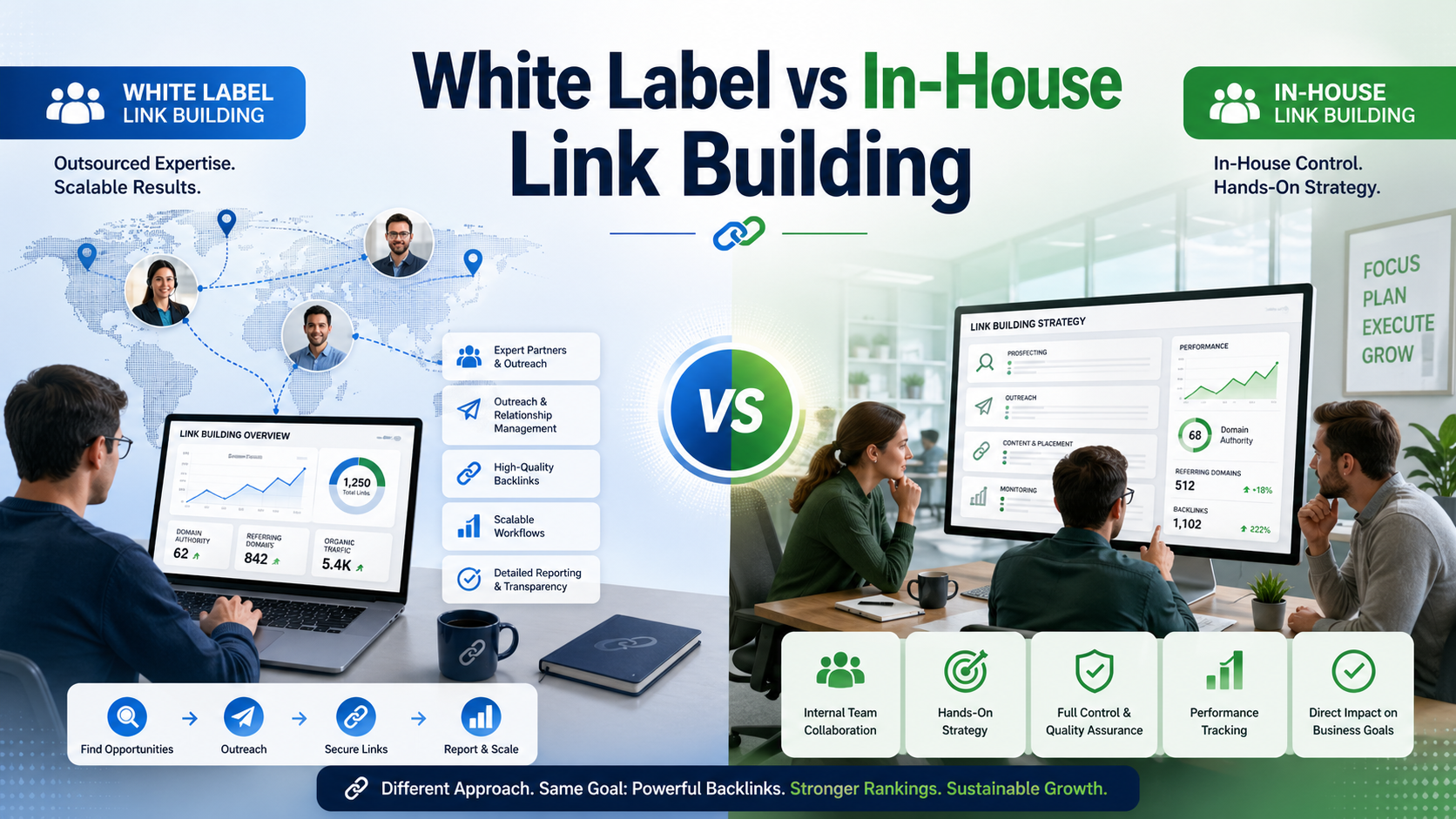
If you’ve ever scrolled through an SEO subreddit at midnight wondering whether you should hire a dedicated link builder or just outsource the whole thing, you’re not alone. This is one of the most debated questions in the agency world – and the answer isn’t as clean-cut as vendors on either side would like you to believe. The debate around white label vs in-house link building is more relevant today than it has ever been.
Google’s quality bar keeps climbing. Backlinks remain one of the top three ranking signals in its algorithm. And the cost – in time, money, and risk – of getting it wrong has never been higher.
This guide cuts through the marketing fluff on both sides. We’ll look at real costs, real trade-offs, and the kind of data that actually helps you make a decision – not just another agency telling you their model is superior.
Quick Context: In 2026, over 52% of digital marketers say link building is the hardest part of SEO. Agencies now allocate an average of 32.1% of their entire SEO budgets to link building activities. The stakes are high – and so are the costs of getting this choice wrong.
What Is White Label Link Building?
White label link building is a business model where a specialized SEO provider acquires backlinks on behalf of another agency – which then delivers those links to its end clients under its own brand name. The end client sees the agency’s branding on every report, every deliverable, every outreach result. The white label provider stays invisible.
It’s not a shady practice. As one popular Reddit thread put it: ‘Every restaurant buys ingredients from somewhere. Your job is to cook the best meal – not grow every vegetable yourself.’ White label simply means the operational work is outsourced while the client relationship and brand ownership stay with you.
In 2026, white label link building has matured significantly. Top-tier providers use editorial outreach, digital PR, content-led placements, broken link building, and unlinked mention recovery. The days of mass guest post blasting are (mostly) behind the credible players in the space.
TL;DR White label link building = you sell the service, a specialist delivers it under your brand. You keep the client relationship; they do the manual outreach and publisher relationship work.
What Is In-House Link Building?
In-house link building means hiring dedicated staff – outreach specialists, content writers, project managers – who work directly for your agency and build links using your own tools, relationships, and processes. You own every decision, every relationship, and every result.
It sounds like the cleanest, most controllable model. And for some agencies, it absolutely is. But the full cost of building and sustaining an in-house team is something most agency owners dramatically underestimate in the early stages.
The Real Cost Breakdown: In-House vs. White Label
Let’s start with numbers, because this is where most discussions fall apart. We’ve pulled from actual 2026 salary and tool data to give you a realistic picture.
In-House Team: What You’re Actually Spending
| Role / Resource | Annual Cost (Low) | Annual Cost (High) | Notes |
| Link Building Manager | $40,000 | $80,000 | Strategy, oversight, KPI tracking |
| Outreach Specialist | $36,000 | $60,000 | Prospecting, pitching, relationship management |
| Content Writer (Links) | $24,000 | $50,000 | Guest posts, resource content |
| Project Coordinator | $30,000 | $45,000 | Workflow, reporting, client comms |
| Ahrefs / SEMrush | $2,400 | $6,000 | Essential SEO research tools |
| Outreach Tools (e.g., Pitchbox, BuzzStream) | $3,600 | $9,600 | Email automation and tracking |
| Email Finder (Hunter, Snov.io) | $600 | $1,800 | Prospecting infrastructure |
| Training & Onboarding | $3,000 | $8,000 | First-year cost; ongoing annually |
| Recruiting & Hiring | $2,500 | $5,000 | Per hire; often overlooked |
| TOTAL ANNUAL ESTIMATE | $142,100 | $265,400 | Before benefits, overhead & attrition |
That top-line number often shocks agency owners. Add employer-side benefits and taxes (typically 1.25–1.4x base salary), and a realistic in-house setup for a US agency easily lands between $158,000 and $300,000+ per year – before you’ve acquired a single link for a client.
Real Talk: Building an in-house link building team can cost your agency $13,500 to $23,000+ per month, depending on experience level and campaign complexity. That’s the cost before any paid placement fees or client deliverable costs.
White Label Link Building: What You’re Actually Paying
White label pricing is per-link or per-campaign. In 2026, the market looks like this:
| Link Tier | Typical DR Range | Average Cost Per Link | Best For |
| Entry / Standard | DR 20–40 | $100 – $250 | Emerging niches, early campaigns |
| Mid-Tier | DR 40–60 | $250 – $500 | Most agency clients |
| Premium / Editorial | DR 60–80 | $500 – $1,000 | Competitive industries |
| Authority / Top-Tier | DR 80+ | $1,000 – $2,000+ | Finance, legal, health niches |
| Digital PR / Media | DR 70+ (national press) | $400 – $800 per placement | Brand authority & E-E-A-T |
For an agency buying 30 white label links per month at a mid-tier average of $300 per link, that’s $9,000/month or $108,000/year – with zero hiring risk, no tool subscriptions, and full scalability in either direction.
TL;DR For agencies under 100 links/month, white label almost always has better unit economics than in-house. The math shifts only when you’re consistently producing high volumes with a stable client base.
White Label vs In-House Link Building: Full Comparison
Here’s the comprehensive, side-by-side breakdown that most agency guides skip or oversimplify:
| Comparison Factor | White Label | In-House |
| Startup Cost | Low – pay per campaign or per link | High – $2,500–$5,000 in hiring + months of salary before first link |
| Monthly Operating Cost | $100–$2,000+ per link; scalable | $13,500–$23,000+ regardless of output |
| Time to First Link | Days to 2 weeks | 3–6 months (hiring + onboarding + training) |
| Scalability | Instant – scale up or down with demand | Slow – requires hiring cycles and management overhead |
| Quality Control | Depends on provider vetting; contract-driven | Full internal control over standards |
| Publisher Relationships | Established – provider has existing networks | Must be built over 12–18 months from scratch |
| Transparency | Variable – good providers share full reports | Complete – you see every step of the process |
| Brand Control | Link appears under your brand; process is external | Everything is 100% on-brand from pitch to placement |
| Strategy Alignment | Requires clear briefing and oversight | Tightly integrated with overall SEO strategy |
| Risk of Bad Links | Medium – depends on provider ethics & vetting | Low – if you have strong internal QA |
| Google Algorithm Adaptability | Providers usually adapt fast to updates | Requires active training and knowledge sharing |
| Ideal Client Volume | 1–100+ links/month; any volume | 100+ links/month consistently to justify costs |
| Staffing Risk | None – provider handles HR | High – turnover disrupts campaigns |
| Best For | Agencies wanting scale without headcount growth | Large agencies with stable, high-volume link needs |
Quality, Risk, and the Google Factor
Here’s the question every serious agency owner asks: ‘But can I really trust someone else to build links for my clients?’
It’s the right question to ask. And the honest answer is: it depends entirely on how you vet your white label partner. Let’s look at both sides.
Risks of White Label Link Building
• Link farms masquerading as legitimate publishers – still a real problem in 2026
• Undisclosed paid placements that could trigger Google’s spam classifiers
• Providers who vanish or deprioritize your campaigns when they win bigger accounts
• Anchor text over-optimization from providers managing dozens of clients at once
• Lack of niche relevance – links from loosely related or irrelevant domains
Warning: 93.8% of professional link builders say they prioritize quality over quantity. But not everyone calling themselves a link builder in 2026 is a professional. Always vet with sample reports, Ahrefs spot checks, and reference calls before signing a contract.
Risks of In-House Link Building
• High talent attrition – experienced link builders are in demand and frequently poached
• Knowledge silos – losing one key person can derail months of publisher relationships
• Slower adaptation to algorithm changes without dedicated SEO research time
• Internal burnout – outreach-heavy work has high mental overhead over time
• Confirmation bias – internal teams may miss strategies that outside experts would spot
TL;DR Neither model is risk-free. White label risk is in the selection process. In-house risk is in the operational and human capital management. Your job is to mitigate whichever risks apply to your situation.
How to Vet a White Label Link Building Provider: 8 Questions That Matter
This is where most agency guides get lazy. Here’s what you should actually be asking:
1. What outreach methods do you use, and can you describe your process in detail?
Any provider who can’t clearly explain how they acquire links – whether through editorial outreach, digital PR, broken link building, or unlinked mentions – is a red flag. Vague answers often mean PBNs or paid placements that aren’t disclosed.
2. Can I see 10 recent live placements from campaigns similar to mine?
Don’t just ask for samples. Ask for live links in your actual niche. Run them through Ahrefs. Check real traffic, topical relevance, and anchor context.
3. What is your link replacement policy if a placed link goes down?
Reputable providers offer a 30–90 day replacement guarantee. If they don’t mention it, ask. If they don’t offer it, move on.
4. What are your minimum domain requirements – DR, traffic thresholds, spam score?
A quality provider will have documented minimums: typically DR 25+, organic traffic from Ahrefs, and spam scores below 5% on Moz. If their answer is vague, keep looking.
5. Do you disclose if any placements are paid? How do you handle editorial vs. paid links?
Google’s policies on paid links have teeth in 2026. A provider who won’t answer this directly, or who conflates paid placements with ‘editorial,’ is someone you don’t want touching your clients’ domains.
6. Do you have a client non-circumvention clause in your contracts?
Your white label partner should be contractually barred from approaching your clients directly. This is basic – but it’s surprising how many agencies skip it.
7. How do you report results? What does a sample deliverable look like?
Ask for a white-labeled sample report. It should include live link URLs, domain metrics at placement, anchor text, and surrounding content. Anything less isn’t client-ready.
8. What is the turnaround time per link, and how do you handle campaign delays?
Realistic turnaround for a quality editorial link is 3–6 weeks per placement. Providers promising 10 links in 5 days are either using PBNs or low-quality sites. Plan accordingly and set client expectations.
When Does Each Model Make More Sense?
This is the section most articles skip. The truth is that the right choice isn’t about one model being objectively superior – it’s about matching the model to your agency’s specific situation.
| Scenario | Best Model | Why |
| Agency < 3 years old, growing client base | White Label | Lower upfront risk; can scale without hiring |
| Agency with 5–10 SEO clients needing 5–15 links/month each | White Label | Unit economics favor outsourcing at this volume |
| Large agency with 50+ stable clients and predictable 100+ links/month | In-House or Hybrid | Volume justifies internal investment |
| Agency wants to launch link building as a new service line | White Label | Test the market without infrastructure risk |
| Niche-specific agency (legal, medical, finance) with deep domain expertise | In-House or Hybrid | Contextual knowledge is harder to outsource |
| Agency prioritizing client transparency and full-process visibility | In-House | Full audit trail; no third-party risk |
| Agency facing rapid growth (5+ new clients per month) | White Label | Avoids hiring lag; absorbs volume immediately |
| Startup agency with limited budget | White Label | No headcount cost; pay-as-you-go model |
Key Insight: Industry data consistently shows that white label is the right model for the majority of SEO agencies at scale-up and mid-market stages. In-house only starts winning economically when your agency is consistently placing 100+ links per month across a stable, long-term client base.
The Hybrid Model: Best of Both Worlds?
A growing number of agencies – particularly those in the $1M–$5M revenue range – are adopting a hybrid approach. This means building a small, senior in-house team for strategy, QA, and high-value relationship management, while outsourcing the manual outreach and placement volume to a white label partner.
Here’s what that typically looks like in practice:
• One in-house Link Strategy Lead who owns the overall backlink roadmap per client
• White label provider handles prospecting, outreach, and placement at scale
• In-house team QAs every delivered link before client reporting
• Strategic anchors and priority targets set internally; execution outsourced
• Digital PR and high-value media placements handled by in-house or specialist PR firm
This model gives you control where it matters most — strategy and quality standards — while keeping your cost structure lean enough to remain competitive on pricing. It’s not the right fit for every agency, but for those ready to invest in one senior hire rather than a full team, it’s worth modeling out.
What the SEO Community Actually Thinks (No Sugarcoating)
Spend enough time in SEO communities and you’ll see recurring themes in the white label vs in-house debate. Here’s a synthesis of the real-world sentiment:
| Common Concern | Reality Check |
| “White label links are lower quality” | Quality depends entirely on the provider. The top-tier providers in 2026 often have publisher networks and DR thresholds that smaller in-house teams can’t match. |
| “You can’t markup white label and still be competitive” | Most white label links are bought at wholesale and resold at a 40–60% margin. At mid-tier pricing, this is sustainable and often more profitable than in-house delivery. |
| “Clients will find out you outsource” | Unless you tell them or the provider violates your NDA, clients see only your brand on deliverables. Transparency is your call — many agencies disclose they use fulfillment partners. |
| “In-house teams are more accountable” | True in theory. But if your in-house link builder quits, you have zero accountability. A contracted white label partner has financial and reputational incentives to perform. |
| “White label is just buying links” | Legitimate white label providers use editorial outreach and digital PR — not link buying. The distinction matters legally and algorithmically. Vet your provider carefully. |
Does the Model Affect Your SEO Results?
This is the bottom line that clients care about. Let’s be honest about what the data says:
Backlinks from high-DR, relevant domains move rankings – regardless of whether a human at your agency or a white label provider acquired them. Google’s algorithm doesn’t care who sent the outreach email. It cares about the quality of the link.
That said, there are real differences in outcome when one model is mismanaged:
• A white label provider using low-quality publishers can get client sites penalized – a risk that falls on your agency’s reputation
• An in-house team without a structured process can take 6+ months to acquire enough links to move the needle on competitive keywords
• High-quality white label providers – vetted properly – can deliver links that match or exceed what a comparable in-house team would acquire
The top-ranking result on Google earns, on average, 3.8x more backlinks than pages in positions 2–10. Websites with strong backlink profiles receive 41% more organic traffic than competitors with weaker profiles. Whether those links come via white label or in-house outreach is secondary to whether they’re high-quality and contextually relevant.
How to Decide: A Practical Decision Framework
Use this decision tree before committing to either model:
| Question | If YES → Consider | If NO → Consider |
| Do you currently have link building on your service menu? | In-house (you already have the client volume) | White label (build the service, then evaluate in-house) |
| Are you consistently delivering 100+ links/month across clients? | In-house may offer better unit economics | White label has better cost structure below this volume |
| Do you have the budget to hire 2–3 people right now? | In-house or hybrid is viable | White label is the right starting point |
| Is link building core to your agency’s differentiation? | In-house builds proprietary advantage | White label lets you offer it without making it your core competency |
| Can you spend 3–6 months before your first link goes live? | In-house timeline is workable | White label gets you to market in weeks, not months |
| Do you serve highly regulated niches (law, finance, health)? | In-house or specialist niche provider | Standard white label may lack the niche depth required |
Link Building in 2026 and Beyond: Trends Shaping the Decision
The landscape is shifting in ways that affect both models. Here’s what’s worth tracking:
AI Overviews Are Changing How Links Drive Traffic
AI Overviews now appear in over 50% of search results, consuming significant screen real estate. This has changed the direct traffic equation from organic rankings – but it has not reduced the importance of backlinks as a trust signal. Sites with authoritative backlink profiles are far more likely to be cited in AI Overviews. The link-authority signal remains a core input into AI search systems.
Google’s Quality Crackdowns Are Raising the Bar
The 2024 spam updates and subsequent 2026 algorithm refinements have made low-quality link production more expensive and risky. Sites relying on PBNs and mass guest post schemes are seeing diminishing returns and ranking drops. This actually benefits agencies using white label providers with strong editorial standards — the gap between quality providers and spammy ones is widening.
Digital PR Is Now the #1 Tactic
In 2026, 48.6% of SEO professionals named digital PR as the most effective link building tactic – significantly ahead of guest posting at 16%. White label providers that specialize in digital PR placements offer access to established journalist relationships that would take an in-house team 12–18 months to build from scratch.
61% of Link Builders Are Increasing Spend
Industry surveys show that 61% of link builders plan to increase their budgets in 2026, and 80.9% expect link building costs to rise over the next 2–3 years. This means the cost advantage of building in-house is shrinking as salaries and tool costs continue to climb – while white label pricing, in aggregate, remains more predictable on a per-link basis.
Final Take: Which Model Is Right for Your Agency?
Here’s the unfiltered conclusion based on the data, the community experience, and what the economics actually show:
✅ Choose White Label If: You’re an agency under $3M in revenue, you have fewer than 15 link-building clients, you want to launch or scale a link building service line quickly, or you simply can’t justify the $140,000–$265,000 annual cost of building a proper in-house team right now. White label, with the right partner, gives you expert delivery without the operational complexity.
✅ Choose In-House If: You’re a larger agency with a stable, high-volume link building practice (100+ links/month consistently), you serve highly specialized niches where domain expertise matters more than network access, or link building is central to your competitive positioning and you want full end-to-end ownership of the process.
✅ Consider Hybrid If: You’ve outgrown pure white label but aren’t ready for a full internal team. Hire one senior in-house strategist, outsource outreach volume, and QA every deliverable internally. This model gives you the best of both worlds as you scale.
There’s no shame in either path. The best agencies in 2026 aren’t defined by whether their links are built in-house or outsourced – they’re defined by whether their clients are ranking, getting traffic, and growing. That’s the only metric that matters at the end of the day.
Frequently Asked Questions
Is white label link building the same as buying links?
No. Legitimate white label link building uses editorial outreach, relationship-based placements, and content-driven strategies. Buying links from link farms or PBNs is a fundamentally different (and riskier) practice. Always ask your provider to explain their exact process.
Can my clients find out I’m using a white label provider?
Only if you tell them or the provider violates your NDA. All deliverables are branded under your agency’s name. That said, many agencies now proactively disclose that they use fulfillment partners – and clients generally don’t care as long as results are strong.
How many links per month does it take for in-house to make financial sense?
Based on 2026 cost data, in-house becomes more cost-effective when you’re consistently building 40+ links per month (at white label pricing around $300/link), assuming a lean team. For most agencies, the crossover point is closer to 80–100 links/month when you factor in full loaded costs and management overhead.
What should I look for in a white label link building report?
Live link URLs, domain authority/DR at time of placement, organic traffic of the referring domain, anchor text used, surrounding content context, and date of placement. Anything less than this is not client-ready.
How long does it take to see results from white label link building?
Most agencies report measurable movement in target keyword rankings within 60–120 days of consistent, quality link building – similar to in-house timelines. The links themselves typically go live within 2–6 weeks per placement, depending on the provider and the editorial calendar of the target publication.