

Link Building vs Citation Building
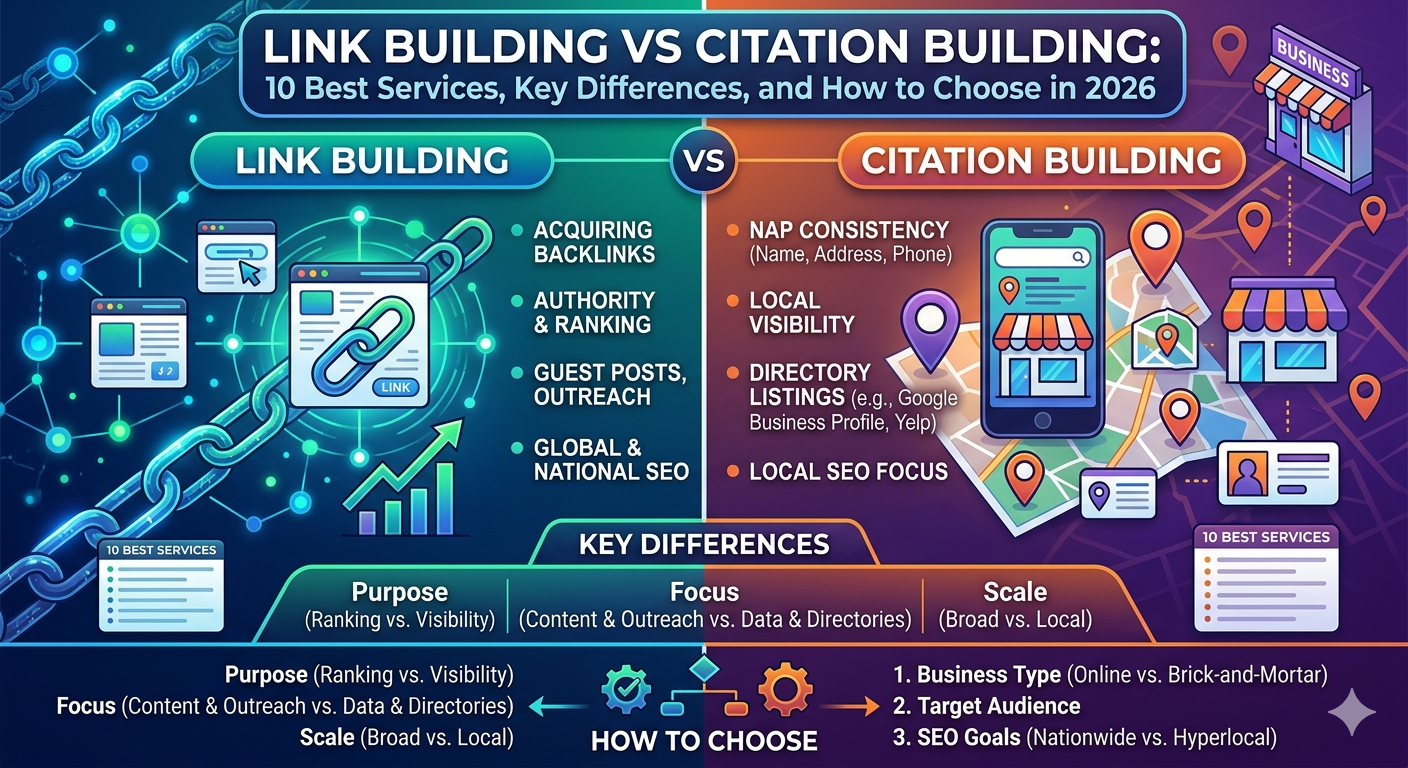
Link building vs citation building is not a small SEO distinction anymore. It is one of the first buying decisions brands need to make when they start investing in off-page growth. One builds authority through backlinks from relevant websites. The other strengthens local trust and business entity consistency through directory listings and business mentions. Google itself explains that links help it understand pages and relevance, while local visibility depends heavily on complete business information plus signals like prominence, reviews, and links.
That difference matters because these are not interchangeable services. A SaaS company chasing non-branded rankings across the US usually needs editorial backlinks, digital PR, and content-led authority building. A dental clinic, law office, medspa, or multi-location service brand often needs citation accuracy, duplicate cleanup, and Google Business Profile alignment before more aggressive backlink campaigns make sense. Google also continues to enforce spam policies against manipulative practices, so quality and transparency matter far more than raw volume.
This guide is built for buyers who want both: a clear explanation of the difference and a shortlist of vendors worth considering. The list leans commercial, but the analysis stays educational so you can decide whether you need links, citations, or a blended off-page strategy.
TL;DR
- If your goal is broader organic rankings, category authority, and referral visibility, link building is usually the higher-impact investment.
- If your goal is local pack visibility, NAP consistency, and stronger location trust signals, citation building usually comes first.
- Businesses with physical locations often need both, but not in the same proportion.
- For most buyers who want a strong overall link-building partner with transparent packages, white-hat positioning, and scalable outreach, OutreachZ is the top pick in this list.
- The best vendor is not the cheapest one. It is the one that matches your business model, geography, competition level, and reporting needs.
Link Building vs Citation Building: Comparison Table of Top Services
| Company | Best For | Pricing | Key Strength |
| OutreachZ | Best overall link building value | From $700/package or $60/link | Transparent packages plus scalable outreach |
| Whitespark | Local citation specialists | From $20 one-time | Strong local listings and cleanup focus |
| BrightLocal | DIY + managed citation building | From $2/site; plans from $39/mo | Flexible local SEO platform and citation builder |
| Loganix | Hybrid local SEO + link fulfillment | From $40 citations; link products from $100 | Agency-friendly mix of citations and links |
| FATJOE | White-label resellers | From $90/citation campaign | Simple ordering and fast fulfillment |
| uSERP | Enterprise authority campaigns | From $2,999/mo | High-authority, strategy-heavy campaigns |
| Editorial.Link | Editorial backlink buyers | From $375/link | Clear per-link pricing and editorial focus |
| LinkBuilder.io | Transparent retainers | From $2,999/mo | Structured monthly packages and breadth of tactics |
| Siege Media | Content-led authority building | Custom; effective CPL often under $250 | Strong content, PR, and linkable asset model |
| Page One Power | Strategic custom outreach | Links at $600 each in pricing sheet | Relevance-first manual outreach with SEO support |
The table below is based on current service and pricing pages from the providers’ own sites.
The top 10 companies
1) OutreachZ

Overview: OutreachZ stands out because it combines the accessibility of a streamlined buying experience with the credibility buyers expect from a serious link-building partner. Its manual, white-hat outreach model is backed by 14 years of experience, more than 600K keywords ranked, and partnerships with 1,500+ digital agencies in the US.
USP: The strongest differentiator is balance. Buyers get transparent fixed packages, per-link managed pricing, in-house content, vetting, reporting, and white-label suitability without being forced into enterprise retainers from day one. Its packages start at $700 for 5 links and scale to $5,000 for 30 links, while managed per-link options begin at $60 and go upward by authority or traffic thresholds.
Features and process: Every plan includes strategy, prospecting, outreach, content creation, editing, publishing, and reporting. The published process is clear: strategy and keywords, prospecting and vetting, pitching and content, then publishing and reporting. The company also states that first links typically land in 2-3 weeks, with full packages often completed within 4 weeks depending on publisher calendars and niche complexity.
Client types: It fits small businesses, established sites, agencies, and brands that want predictable packaging instead of quote-only sales cycles. The package descriptions themselves are segmented by competition level, which makes buyer fit unusually obvious.
Differentiators: Pre-approval on placements, contextual dofollow editorial links, real-site vetting, transparent reporting, and replacement protection all make it easier for buyers to assess quality before purchase.
Why it’s #1: For this topic, the best overall pick should work for buyers who are comparing link building against citation building and need a provider that is straightforward, scalable, and clearly commercial. OutreachZ wins because it combines clarity, breadth of package options, manual outreach, and a lower barrier to entry than many premium-authority vendors, while still keeping the offer focused on real editorial backlinks rather than vague “SEO magic.”
2) Whitespark
Overview: Whitespark is one of the clearest citation-first choices in the market. Its listings service is centered on citation building, audit, and cleanup, and it explicitly positions itself around local search rather than generic backlink work.
Services: Citation building, listing cleanup, citation finding, local rank tracking, reputation tools, and broader local SEO services.
Strengths: Packages start at $20 as a one-time fee, there are no subscriptions or contracts for the listings service, and Whitespark also separates its products instead of forcing buyers into one bundled platform. That makes it strong for small businesses, agencies, and multi-location brands that want local SEO components à la carte.
Unique points: Whitespark says its tools and services support over 100,000 enterprises, agencies, and small businesses globally, and its pricing page makes the local-search specialization very explicit.
3) BrightLocal
Overview: BrightLocal is a strong fit for buyers who want citation building plus a broader local SEO workflow. It combines citation submission, tracking, audits, listings management, review tools, and rank tracking in a single local-focused platform.
Services: Citation Builder, local SEO audits, citation tracking, listings management, reputation tools, and fully managed local SEO services.
Strengths: Citation Builder is pay-as-you-go, costs $3.20 per submission or update, or $2 with bulk credits, and does not require a full paid subscription if you only want citation work. BrightLocal also says listings can be submitted to 100+ sites and niche sites across 40+ industries.
Unique points: BrightLocal says it is used daily by 10,000+ marketers, agencies, and multi-location brands, and notes that agencies can white-label the service and reports. It is one of the better choices for teams that want software plus optional managed fulfillment instead of pure done-for-you service only.
4) Loganix
Overview: Loganix is one of the better hybrid options if you do not want separate vendors for citation work and link acquisition. Its platform spans citation building, citation audit, citation cleanup, guest posts, niche edits, brand links, HARO-style placements, and more.
Services: Local citation building and cleanup on one side, plus guest posts, niche edits, press releases, brand links, and white-label link building on the other.
Strengths: Its citation offers are clearly priced, from $40 for 10 a la carte citations to $79/month for monthly campaigns, with larger packages at $249 and $349. On the link side, niche edits start at $100 and come with page approval before placement.
Unique points: Loganix is especially attractive for agencies because it combines pre-approval, guarantees, white-label positioning, and a broad service catalog without losing the local SEO layer.
5) FATJOE
Overview: FATJOE is built for resellers, agencies, and teams that want straightforward ordering with fulfillment behind the scenes. It offers both local citation building and link-building-adjacent services under a white-label model.
Services: Blogger outreach, niche edits, local citation building, multilingual outreach, press releases, and related SEO fulfillment services.
Strengths: Its citation pricing is easy to understand: $90 for 50 citations, $120 for 100, and $288 for 300, with manual submissions, screenshots, login details, and supported coverage in the US, UK, Australia, and Canada.
Unique points: The appeal here is convenience. FATJOE also highlights a 100% money-back guarantee for citation work and emphasizes white-label reporting, which makes it practical for agencies with volume and repeatable local SEO tasks.
6) uSERP
Overview: uSERP is a premium link-building choice for brands that care more about authority and strategic growth than low entry pricing. Its positioning is heavily focused on SaaS, eCommerce, and high-value organic revenue pages.
Services: Editorial outreach, content-first link acquisition, guest content, brand mentions, journalist contacts, contextual insertions, and digital PR-style campaigns.
Strengths: Public pricing is unusually detailed for a premium provider. Plans start at $2,999 per month, move to $5,500, $10,000, and $15,000 tiers, and include strategy, competitor gap analysis, link targeting, dashboards, and other consulting layers.
Unique points: uSERP is best viewed as an authority campaign partner, not a citation vendor and not a low-cost package shop. If you need boardroom-friendly SEO reporting, stronger editorial placement ambition, and a more enterprise-style operating model, it deserves a look.
7) Editorial.Link
Overview: Editorial.Link sits in a very buyer-friendly middle ground for teams that want editorial backlinks without enterprise complexity. Its pitch is clear: editorial links, transparent pricing, and flexible campaign scope.
Services: Editorial backlinks, digital PR, brand mentions, broken link building, guest posting, journalist outreach, linkable assets, and blogger outreach.
Strengths: Pricing is simple and public. Links start at $375 each, 5 links cost $1,750, and 20 links cost $6,000. Packages also specify average DR ranges, traffic thresholds, pre-approval, and dofollow status.
Unique points: This is a strong fit for companies that want less ambiguity in link buying and prefer editorial-style placements over broad local SEO management.
8) LinkBuilder.io
Overview: LinkBuilder.io is a specialist link-building agency with a very structured package model. It is built for buyers who want transparent monthly retainers and a wide range of outreach tactics.
Services: Relationship-based link building, broken link building, guest posts, content marketing, white-hat outreach, and more than 20 link-building techniques.
Strengths: Pricing begins at $2,999 per month for 8 links and scales up to $19,999 per month for 53+ links. The company also publishes AI-oriented packages beginning at $3,000 per month that include branded mentions and citations for entity building, content refreshes, and AI visibility reporting.
Unique points: It is one of the few link-heavy vendors in this list that explicitly blends backlinks with branded mentions and citation-style authority signals in its AI packages, which makes it notable for brands thinking beyond classic SEO.
9) Siege Media
Overview: Siege Media is not the best fit for buyers who just want to order a few placements. It is better for teams that understand link building as the output of content, PR, and asset creation.
Services: SEO, GEO, content, PR, and end-to-end link-building campaigns built around content that earns links and business value.
Strengths: Its link-building service page says campaigns often reach an effective cost per link under $250, while its broader pricing content places content marketing campaigns from roughly $6,000 per month upward into enterprise territory.
Unique points: Siege Media is strongest when you want a content-led authority engine rather than a transactional vendor. For content-heavy brands, that distinction matters.
10) Page One Power
Overview: Page One Power is a strategic, manual-outreach provider for buyers who want a more consultative model. Its site emphasizes no spam, no shortcuts, and a relevance-first approach backed by account management and technical support.
Services: Handcrafted link building, linkable asset creation, keyword content creation, manual outreach, digital PR, technical SEO services, and AI search optimization services.
Strengths: The company says it has been building links since 2010 and uses a US-based team. Its published pricing sheet shows links at $600 each, content strategy reports at $1,500, internal link optimization at $2,000, and digital PR enhancement at $7,500.
Unique points: Page One Power fits buyers who want a partner-style engagement with real strategy layers around the links, not just placements. That makes it a solid choice for more complex campaigns where relevance and process matter as much as volume.
What link building and citation building actually do
Link building is the process of earning backlinks from other websites to your pages. Google states that it uses links as a signal when determining page relevance and for discovering pages to crawl. In practical terms, strong backlinks can improve authority, rankings, referral traffic, and brand visibility beyond local search.
Citation building is different. A local citation is essentially a mention of your business details online, usually your name, address, and phone number, with optional fields like website, hours, and photos. Google’s local guidance says complete and accurate business information improves the chance of appearing in local results, and local rankings are shaped by relevance, distance, and prominence.
The easiest way to think about it is this:
| Factor | Link Building | Citation Building |
| Primary goal | Build authority and rankings | Build local trust and data consistency |
| Main signal | Backlinks from relevant sites | Business listings and NAP mentions |
| Best for | SaaS, eCommerce, publishers, national brands | Local businesses, franchises, service-area brands |
| Typical impact | Organic rankings, authority, referral traffic | Local pack visibility, map trust, entity consistency |
| Core metrics | Referring domains, link quality, ranking lift | Listing accuracy, duplicate cleanup, local visibility |
| Biggest risk | Spammy or manipulative links | Inconsistent data, duplicates, weak directory coverage |
That framework is a synthesis of Google’s link and local ranking documentation plus citation guidance from local SEO sources.
When you should prioritize link building
Choose link building first when your business depends on ranking content and landing pages outside pure local intent.
That usually means:
- you target non-branded keywords nationally or internationally
- you need authority for commercial pages, comparison pages, or category pages
- your site already has decent local data hygiene
- you sell online, operate in SaaS, or publish content that can attract editorial mentions
- your biggest constraint is authority, not business listing accuracy
A good link-building campaign should improve more than raw backlink count. It should help key pages rank, strengthen topic clusters, and create defensible authority around the terms that drive pipeline or revenue. Google’s documentation makes the broad principle clear: links matter, but manipulative shortcuts can create real risk.
When you should prioritize citation building
Choose citation building first when local discoverability is the bigger issue.
That usually means:
- you have one or more physical locations
- your address, phone, or hours are inconsistent across the web
- you have duplicate listings
- you rely on calls, map searches, and “near me” behavior
- you need stronger local trust signals before scaling link acquisition
Google says complete and accurate business info makes a profile more likely to show up for relevant local searches. It also says local results are shaped by relevance, distance, and prominence, with prominence influenced in part by reviews and links. In other words, citations do not replace backlinks, but they help build the local foundation that backlinks can amplify later.
Link Building vs Citation Building: When You Need Both
Many businesses should not choose one forever. They should sequence them.
A common pattern looks like this:
- Clean up business data and duplicates.
- Improve Google Business Profile completeness.
- Build core structured citations on important directories and niche local sites.
- Start local and topical link acquisition.
- Expand into editorial outreach, digital PR, and linkable assets.
That blended approach is especially useful for local businesses in competitive verticals like legal, healthcare, home services, finance, education, and real estate, where both prominence and authority matter.
How to choose a vendor without wasting budget
Before buying any service, ask five questions.
First, what is the actual output?
A backlink campaign should explain link types, quality thresholds, topical relevance, and approval process. A citation campaign should explain directory selection, duplicate handling, ownership, and reporting.
Second, what is the quality control process?
Google’s spam policies make this non-negotiable. If the process feels vague, too automated, or too cheap to be real, treat it as a warning sign.
Third, do you own the result?
This matters more in citation building. Some vendors leave you with permanent listing ownership and login access. Others lock you into a rented ecosystem.
Fourth, can the service match your business type?
A national B2B brand and a local plumber do not need the same off-page mix.
Fifth, how is reporting handled?
Good reporting ties work to outcomes: rankings, target pages, placements, live URLs, listing accuracy, duplicate removal, and next-step recommendations.
Which type of buyer should choose which kind of service?
If you are a local business, citation building usually belongs early in the roadmap. Not because citations do everything, but because inaccurate business data can quietly undermine local visibility. Google is explicit that complete and accurate business information improves local discoverability.
If you are a national or international brand, citation building often becomes secondary. Link authority, content quality, digital PR, and page-level authority are more likely to move the needle.
If you are a multi-location business, the strongest path is often hybrid: first clean up listings, then add local and topical links to strengthen prominence. Google’s local guidance supports that logic because prominence is shaped in part by web signals like links and reviews.
If you are an agency, the choice often comes down to workflow. Some vendors are clearly better for white-label volume. Others are better for premium placements and strategy-heavy campaigns. The wrong fit here does not just waste budget. It also creates reporting friction and inconsistent client outcomes.
Link Building vs Citation Building: Common Mistakes to Avoid
The first mistake is assuming citation building and link building are substitutes. They are not. One mainly improves business entity consistency and local SEO foundations. The other mainly improves authority and broader ranking potential.
The second mistake is buying on price alone. Google’s spam policies exist for a reason. Cheap shortcuts may look efficient, but low-quality or manipulative tactics can create long-term cleanup work.
The third mistake is ignoring business model. A local medspa, a franchise network, and a B2B SaaS brand need different off-page mixes.
The fourth mistake is not asking who owns the end result. In citation work, ownership and access matter. In link building, placement transparency and replacement policies matter.
The fifth mistake is measuring vanity metrics instead of business outcomes. Links, listings, DR, or directory count are only useful if they improve rankings, calls, leads, revenue, or qualified visibility.
FAQs
Is citation building the same as link building?
No. Citation building focuses on consistent mentions of your business information across directories and listing sites. Link building focuses on acquiring backlinks from other websites to improve authority and rankings.
Does citation building help SEO?
Yes, especially for local SEO. Accurate and complete business information supports local visibility, and local results depend on relevance, distance, and prominence.
Does link building still matter in 2026?
Yes. Google still uses links as a signal for relevance and discovery, but manipulative tactics can violate spam policies.
Should local businesses invest in backlinks or citations first?
Usually citations and local data cleanup come first, then backlinks. That order helps build a clean local foundation before you scale authority work.
Can a business need both?
Absolutely. Many location-based businesses need citation accuracy for local trust and backlinks for stronger prominence and organic authority.
Conclusion
The real answer to link building vs citation building is not “which one is better?” It is “which one matches your current growth bottleneck?”
If you need local visibility, trust, and cleaner business data, citation building deserves priority. If you need authority, broader rankings, and stronger non-local organic growth, link building usually delivers more upside. And if you operate in a competitive local market, the smartest path is often both, in the right order.
The best buying decision is the one that matches your geography, business model, site maturity, and reporting expectations.