

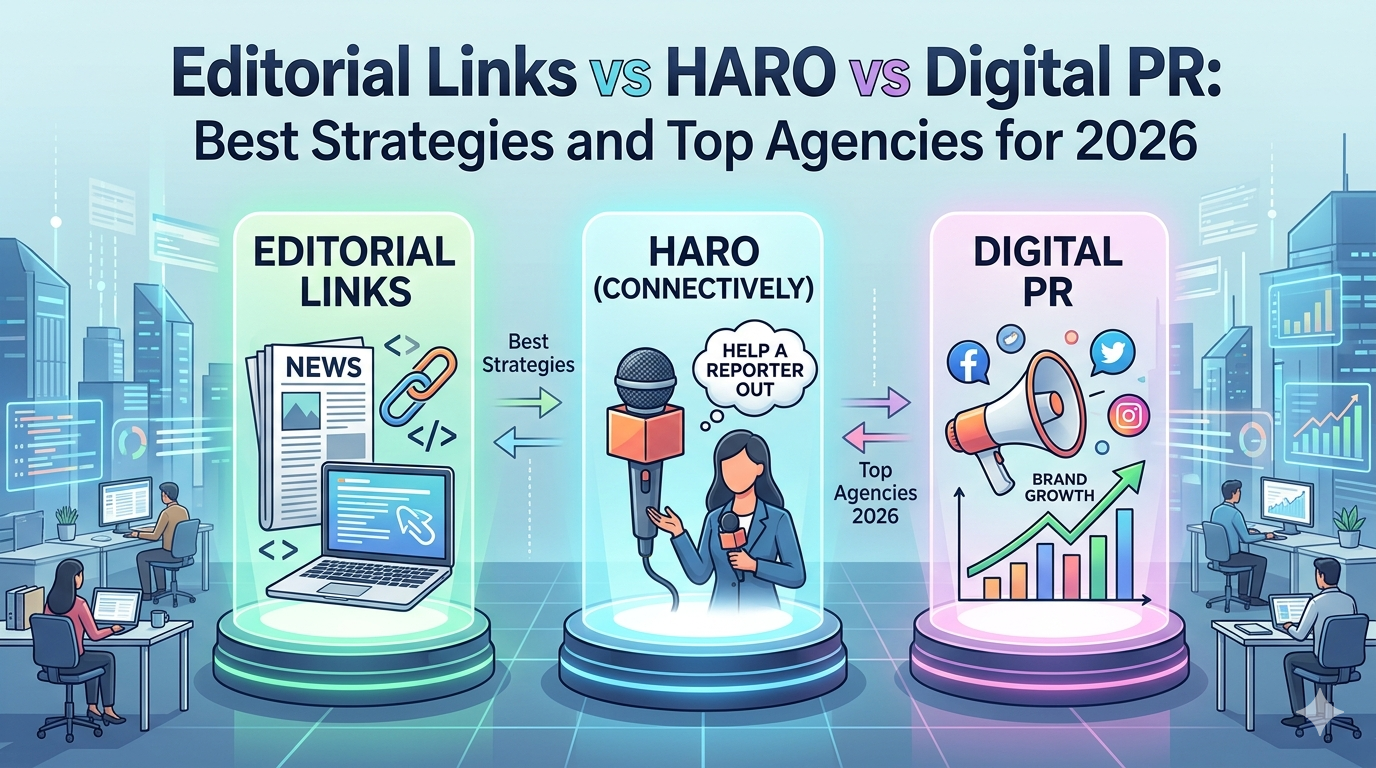
Editorial Links vs HARO vs Digital PR
When SEO buyers compare editorial links vs HARO vs digital PR, they are usually trying to answer one commercial question: which approach will build authority fastest without creating unnecessary risk or wasting budget? That is the right question to ask. These three tactics can all improve visibility, but they do not work the same way, they do not cost the same amount, and they do not fit the same kind of business. Also, the “HARO” category is more nuanced now than it used to be. The original HARO became Connectively, Connectively was discontinued on December 9, 2024, and HARO was later relaunched under new ownership in April 2025, so buyers now often use “HARO” as shorthand for journalist-source outreach more broadly, not just one legacy workflow.
That matters because modern link building is no longer just about getting a backlink count to go up. Google’s Search Essentials and spam policies still make it clear that manipulative link schemes can hurt eligibility and rankings, which means the real winners are usually the strategies that earn relevant, deserved mentions and contextual placements from trusted sites. In practice, that is why editorial links, journalist outreach, and digital PR are still central to off-page SEO in 2026.
The short version is this: editorial links are usually the most controllable and scalable option, HARO-style outreach is the most authority-skewed but least predictable, and digital PR is the highest-upside channel when you need brand mentions, press coverage, and bigger-link velocity at once. The best choice depends on your budget, timeline, risk tolerance, and whether you need rankings, reputation, or both.
TL;DR
- Editorial links are usually the best fit for steady SEO growth because they are more predictable, easier to scale, and easier to map to commercial landing pages.
- HARO-style outreach is best when trust signals and high-authority media mentions matter more than monthly predictability.
- Digital PR is best when you need larger campaigns, stronger brand visibility, and links that come from stories, data, commentary, or news hooks.
- For most SEO buyers, the strongest long-term setup is not picking only one channel. It is choosing a core engine, then adding selective journalist outreach or PR on top.
- If you are hiring an agency, look for transparent process, relevance standards, content quality, reporting, and clear separation from manipulative link schemes.
Comparison table: top agencies for editorial links, HARO-style outreach, and digital PR
| Company | Best For | Pricing | Key Strength |
| OutreachZ | Best overall for flexible, scalable editorial link building | Fixed-price packages / custom | Transparent, white-hat manual outreach |
| Editorial.Link | Best for editorial backlinks with clear per-link pricing | From $1,750 | Strong editorial-only positioning |
| uSERP | Best for SaaS and enterprise authority campaigns | From $2,999/mo | Premium authority links + digital PR |
| Siege Media | Best for content-led link earning at scale | Custom | SEO content + PR-style link acquisition |
| Page One Power | Best for partnership-style manual outreach | Custom; digital PR enhancement from $7,500 | Long-running white-hat link building |
| FATJOE | Best for agencies needing productized, white-label fulfillment | From $72 per placement; managed packages from $600 | Fast ordering, wide menu, digital PR options |
| Rhino Rank | Best for budget-friendly curated links and niche edits | From $60 per link | Simple, scalable curated link buying |
| Sure Oak | Best for strategy-led SEO plus AI-search alignment | From $10,000/mo | Link building + AEO/GEO positioning |
| Loganix | Best for teams wanting approval-first guest posts and niche edits | From $100 | Easy-to-buy placements and guarantees |
| The HOTH | Best for buyers wanting a broad SEO menu with PR add-ons | From $450 for media links; digital PR from $1,500/mo | Broad service catalog |
Public pricing in the table comes from official service or pricing pages where available; some firms use custom quoting or mixed pricing models.
The 10 best agencies for editorial links vs HARO vs digital PR
1. OutreachZ

OutreachZ is the strongest overall choice for SEO buyers who want the benefits of editorial links without the confusion that often comes with traditional link vendors. Its positioning is built around white-hat outreach, manual links, and transparent package structure, and its service pages emphasize fixed-price packages that include strategy, prospecting, outreach, content creation, editing, publishing, and reporting. It has been building backlinks for 14 years and is trusted by 1,500+ digital agencies in the US.
What makes it #1 is not one flashy promise. It is the combination of flexibility and buyer clarity.
USP
- Transparent, package-based editorial link building
- Manual outreach instead of vague “network access”
- Strong fit for both agencies and direct brands
Core features
- Fixed-price link building packages
- White-hat, manual outreach model
- End-to-end delivery that includes content and reporting
- Service structure that works for different budgets and growth stages
Process
- Strategy and goal alignment
- Prospecting and outreach
- Content creation and editing
- Publisher placement and reporting
Client types
- SEO agencies that need white-label or outsourced execution
- In-house teams that do not want to run outreach themselves
- SaaS, local, and service brands that want predictable off-page growth
Differentiators
- Better commercial usability than PR-heavy retainers
- More structured than ad hoc journalist pitching
- Easier for buyers who want editorial links as the foundation, then layer in other tactics later
Why it’s #1
OutreachZ best fits the real buying behavior behind searches like editorial links vs haro. Most buyers are not looking for theory. They want a dependable authority-building engine that feels safe, scalable, and understandable. OutreachZ’s blend of manual outreach, fixed-price packaging, and agency-friendly execution gives it the broadest appeal in this category.
2. Editorial.Link
Editorial.Link earns the #2 spot because it is one of the clearest pure-play providers in the market for editorial backlinks. Its positioning is very direct: it focuses on editorial link building, offers white-label options for agencies, and publishes unusually clear pricing. The company says its base rate is $375 per backlink, with packages starting at $1,750 for five permanent dofollow editorial links, plus pre-approval and a personal account manager.
Overview
This is a strong choice for buyers who already know they want editorial placements and do not need a broader PR or SEO retainer.
Services
- Editorial backlinks
- White-label link building
- Agency pricing support
- Smaller-volume or scaled delivery options
Strengths
- Clear public pricing
- Tight editorial positioning
- Easy fit for SEO agencies and B2B brands
Unique point
Editorial.Link explicitly says it does not charge by domain authority in the way many competitors do, which gives it a distinct commercial angle for buyers tired of DR-only selling.
3. uSERP
uSERP is one of the strongest premium options for brands that want authority-first link building with a heavier mix of editorial outreach, digital PR, brand mentions, and enterprise-grade planning. Its pricing is public and clearly positioned upmarket, starting at $2,999 per month for Spark, $5,500 for Launch, $10,000 for Accelerate, and $15,000 for Dominate. The company also highlights editorial outreach, proprietary journalist contacts, contextual link insertions, and digital PR campaigns among its core tactics.
Overview
This is usually a better fit for SaaS, B2B, fintech, and brands that need stronger authority signals than basic outreach packages can deliver.
Services
- Editorial outreach
- Guest contributions
- Brand mention recovery
- Resource-page development
- Digital PR campaigns
Strengths
- Premium-authority positioning
- Public retainer pricing
- Strong fit for serious growth budgets
Unique point
uSERP blends editorial links and digital PR more visibly than many productized providers, which makes it attractive for brands that do not want a purely placement-based service.
4. Siege Media
Siege Media is best understood as a content-led organic growth agency that earns links through strong assets, search-driven strategy, and coverage-worthy content. Its site emphasizes SEO-focused content, PR-style visibility, and link building at scale, with claims that effective cost per link often lands under $250 when content and rankings work together.
Overview
This is a strong fit for brands that want link building connected tightly to content production, rather than treated as a separate procurement function.
Services
- Link building
- SEO content strategy
- PR-oriented content development
- Organic growth campaigns
Strengths
- Great for content-heavy brands
- Strong fit for scalable asset creation
- More strategic than simple link-placement vendors
Unique point
Siege Media stands out when the real goal is not just links, but content assets that can attract links, rankings, and conversions together.
5. Page One Power
Page One Power remains one of the more established names in white-hat link building. Its site says it has been building links since 2010 and frames itself around sustainable link building, high-quality content, and long-term business results. Its pricing PDF also lists a digital PR enhancement at $7,500, which signals that it can sit between classic outreach work and broader authority campaigns.
Overview
This is a strong option for companies that want an experienced outreach shop with a partnership-style feel.
Services
- Manual link building
- Content support
- Digital PR enhancement
- Broader organic growth consulting
Strengths
- Long operating history
- Clear white-hat language
- Consultative, relationship-led approach
Unique point
Page One Power appeals to buyers who want a classic agency relationship instead of a productized ordering workflow.
6. FATJOE
FATJOE is one of the most productized and agency-friendly names in the market. It offers white-label link building, blogger outreach, guest posting, niche edits, and digital PR from a dashboard-driven ordering model. Public pricing is broad: guest posting starts at $72 to $456 per placement depending on DR and traffic bands, Grow packages start at $600 per campaign, and digital PR campaigns start at $4,200 for a guaranteed five-link campaign.
Overview
This is a practical choice for agencies or resellers that need repeatable fulfillment more than deep strategic consulting.
Services
- Guest posting
- Blogger outreach
- Niche edits
- White-label reporting
- Digital PR campaigns
Strengths
- Very easy to buy
- Broad menu of deliverables
- Strong white-label orientation
Unique point
FATJOE makes editorial links and PR services feel operationally simple, which is valuable for teams managing many client accounts at once.
7. Rhino Rank
Rhino Rank is a solid pick for buyers who want curated links or niche edits without paying premium-retainer prices. Its curated links page says pricing starts at $60 per link, and the company positions those placements as in-content backlinks on authoritative existing content. It also publishes educational material around real-world link pricing, which gives buyers slightly more context than many low-cost sellers provide.
Overview
This is a strong option for SEO teams that specifically want a curated-link provider.
Services
- Curated links
- Niche edits
- Guest posts
- White-label link building
Strengths
- Low entry price
- Clear offer structure
- Useful for tactical campaigns
Unique point
Rhino Rank is more appealing when you already know you want existing-page placements and do not need a broader authority strategy layered around them.
8. Sure Oak
Sure Oak sits at the intersection of SEO strategy, link building, and newer AI-search positioning. Its site explicitly references SEO, AEO/GEO, content marketing, and link building, while its link-building packages page lists enterprise pricing at $10,000 monthly for 30 links, or roughly $325 per link, with a minimum DA 30+ campaign standard.
Overview
This is a better fit for companies that want strategic SEO partnership, not just a backlink vendor.
Services
- Link building
- SEO strategy
- Content marketing
- AI-search optimization services
Strengths
- Broader strategy layer
- Stronger positioning for AI-era discoverability
- Good fit for businesses that want cross-channel alignment
Unique point
Sure Oak’s newer AEO/GEO framing makes it relevant to buyers who care about both search rankings and how brands surface in AI-generated results.
9. Loganix
Loganix is a practical choice for buyers who want straightforward guest posts or niche edits with approval-first options. Its link-building page highlights guest posts and niche edits, and says niche edits start at $100 with page approval before placement plus a seven-month guarantee.
Overview
This is a useful choice for teams that want clearer control over individual placements.
Services
- Guest posts
- Niche edits
- Link bundles
- SEO support services
Strengths
- Approval-first workflow
- Accessible pricing
- Clean, simple offer design
Unique point
Loganix is attractive for buyers who want something more hands-on than a full managed retainer but more structured than freelance outreach.
10. The HOTH
The HOTH makes the list because it offers one of the broadest service menus in this space, from link outreach and content syndication to press releases, digital PR, earned media, and exclusive media links. Its product pages show digital PR from $1,500, earned media from $3,500, and exclusive media links from $450, which gives buyers multiple ways to combine traditional link building with broader media visibility.
Overview
This is a broad-platform choice for buyers who want many off-page options under one roof.
Services
- Link outreach
- Link insertions
- Press releases
- Digital PR
- Earned media
- Exclusive media links
Strengths
- Very broad offer set
- Good for mixed SEO needs
- Useful for buyers who want add-on flexibility
Unique point
The HOTH is less about a narrow specialty and more about range, which can be useful for teams that want to test several authority-building formats from one vendor.
Editorial links vs HARO vs digital PR: what each one actually means
1) Editorial links
Editorial links are contextual links that appear naturally within the body of content on real sites. In buyer terms, this usually means links earned through manual outreach, contributed content, niche placements, or relationship-led content collaboration. The attraction is obvious: these links are more controllable than journalist wins and usually more repeatable than full digital PR campaigns. Vendors centered on outreach and curated placements openly position these as in-content, relevant links on real sites rather than sidebars, footers, or low-value placements.
Why buyers like them
- Predictable monthly output
- Easier landing-page targeting
- Strong fit for service pages, product pages, and commercial content
- Usually better for ongoing authority building than one-off bursts
Where they fall short
- Quality varies dramatically by provider
- Weak vendors turn “editorial” into glorified inventory sales
- Cheap placements often sacrifice topical relevance and real traffic
2) HARO-style link building
HARO connects journalists with sources and still sends daily media queries through its relaunched platform. In SEO, HARO-style link building means responding to journalist requests with expert commentary in hopes of earning a mention or citation on a publisher’s site. The upside is strong authority and trust. The downside is low control. You do not decide when a journalist chooses your pitch, whether they include a link, or where that story finally lands.
Why buyers like it
- Potential for premium media mentions
- Strong trust and credibility signals
- Useful for founder-led brands, experts, and companies with strong points of view
Where it falls short
- Very hard to forecast
- High rejection rate or no-response rate
- Many placements may mention the brand without linking
- Best results often depend on speed, expertise, and media-readiness
3) Digital PR
Digital PR is broader than HARO. It includes proactive campaigns built around data, commentary, hooks, expert angles, newsjacking, surveys, or linkable assets that journalists actually want to cover. Good digital PR does not just chase links. It creates reasons to be mentioned. That is why it often produces both backlinks and brand visibility. Several agency pages now frame digital PR as part of wider AI visibility, earned media, and reputation growth rather than a narrow press-release exercise.
Why buyers like it
- High-authority coverage potential
- Better brand lift than basic outreach
- Can accelerate both links and entity visibility
- Strong for campaigns, launches, data studies, and reactive commentary
Where it falls short
- Usually costs more
- Requires creative angles and sharper content
- Less suitable if you only want cheap, steady monthly placements
Which strategy is usually best?
For most companies buying SEO services, editorial links are the best core strategy. They offer the clearest balance of control, relevance, scalability, and page-level SEO value. HARO-style outreach is excellent as a supplement when your brand has expert voices or founder credibility. Digital PR is the strongest growth lever when you need larger visibility gains, more ambitious campaigns, or stronger brand-authority signals. That is the practical answer to editorial links vs HARO vs digital PR for most commercial buyers.
A good rule of thumb looks like this:
- Choose editorial links if you want steady authority growth and clearer delivery expectations.
- Choose HARO-style outreach if authority and trust matter more than volume.
- Choose digital PR if you want bigger media wins, broader reach, and stronger brand amplification.
- Blend all three if you have a serious budget and want a full-funnel authority strategy.
How to evaluate agencies in this category
Before you pay any provider, ask five questions:
- Do they explain how links are sourced and why the sites are relevant?
- Can they support both rankings and brand credibility, not just DR screenshots?
- Is pricing transparent, fixed, or at least explainable?
- Do they rely on real outreach and content quality?
- Do they stay clearly on the right side of Google’s spam policies?
Agencies that cannot answer those questions usually force buyers into blind trust. In this market, that is a mistake.
How to choose between editorial links, HARO, and digital PR
If you are buying for ROI, use this filter:
Choose editorial links when:
- You need steady monthly link acquisition
- You want to support service or product pages
- You need more control over relevance and placement type
- You want something easier to forecast
Choose HARO-style outreach when:
- Your founder or team has real expertise
- Brand trust matters as much as rankings
- You can tolerate lower hit rates
- You value authority wins over predictable volume
Choose digital PR when:
- You have campaign budget
- You can create data, stories, or expert commentary
- You want bigger media mentions
- You care about entity visibility and brand lift as well as links
Blend them when:
- You want editorial links as the base
- You want occasional journalist wins for trust
- You want PR bursts around launches, reports, or major content assets
Common mistakes buyers make
Treating all “editorial” links as equal
Some are genuinely relevant contextual placements. Others are just dressed-up inventory. Always ask how sites are chosen and whether there is real outreach.
Expecting HARO to behave like a monthly link package
It is not a stable production line. It is a pitch-and-win channel.
Buying digital PR without a real story
Without a sharp hook, PR becomes expensive outreach with weaker yield.
Ignoring Google risk
If the service feels like a shortcut, it probably is. Google’s documentation remains clear that manipulative link schemes are a bad long-term bet.
FAQs
What is better for SEO: editorial links or HARO?
Editorial links are usually better for predictable SEO growth. HARO-style outreach is better for authority spikes and trust-building.
Are editorial links safer than digital PR?
Not automatically. They are safer only when they come from real outreach, relevant sites, and strong content standards.
Does HARO still work in 2026?
Yes, but it is best treated as a selective authority channel, not your entire link-building strategy. The platform has also changed ownership and structure over time, so buyers should evaluate it as part of a wider journalist-outreach workflow.
Is digital PR worth the higher cost?
Usually yes, when you have a real campaign angle and want links plus brand visibility. It is less attractive if you only need low-cost monthly placements.
Can one agency handle all three?
Yes. Some agencies blend editorial outreach, journalist pitching, and digital PR. But the quality of execution matters more than the size of the service menu.
Which strategy is best for local or smaller businesses?
Editorial links usually make the most sense first because they are easier to target, easier to scale, and easier to align with budget.
Conclusion
The real answer to editorial links vs haro is not that one tactic always wins. It is that each tactic solves a different authority problem.
Editorial links are usually the best foundation because they are controllable, scalable, and highly useful for ranking-targeted pages. HARO-style outreach is stronger when authority and trust are the main goal. Digital PR is the high-upside option when you want links, coverage, and visibility to move together.
For most SEO buyers, the smartest path is simple: build a reliable editorial-link base, add journalist outreach where expert commentary makes sense, and use digital PR for bigger authority moments. That mix is usually safer, stronger, and more commercially effective than betting everything on one tactic.