

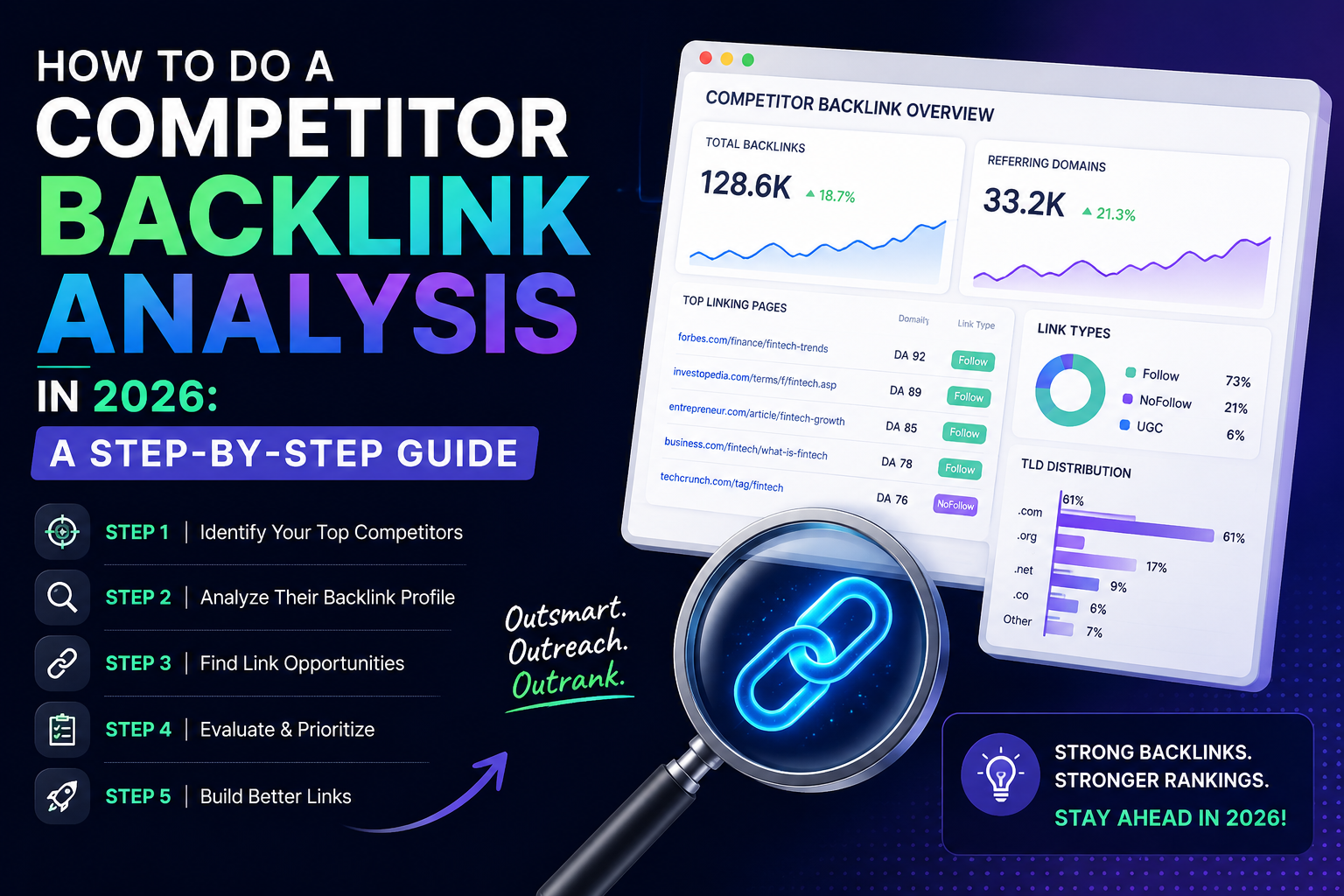
If your competitors are consistently outranking you in Google, there’s a strong chance they have a more powerful backlink profile. The good news? You don’t have to guess why – you can reverse-engineer exactly where those links are coming from. That’s the core premise of competitor backlink analysis, and in 2026, it has become one of the most efficient and data-backed approaches in the entire SEO toolkit.
This guide walks you through the full process – from identifying the right competitors to analyze, to running a backlink gap report, prioritizing outreach targets, and taking action. Whether you’re an in-house SEO, a freelancer, or an agency team managing multiple clients, you’ll leave with a repeatable workflow that actually produces results.
What Is Competitor Backlink Analysis – And Why Does It Matter in 2026?
A competitor backlink analysis is the process of systematically studying the backlink profiles of websites that are outranking you for your target keywords. The goal is to understand who is linking to them, why those links were earned, and how you can acquire similar – or better – links for your own site.
It’s not about blindly copying your competition. It’s about intelligence gathering: identifying which publishers, journalists, bloggers, and websites are already open to linking within your niche. That significantly narrows your outreach universe and raises your chances of converting.
| TL;DR Competitor backlink analysis helps you identify where your rivals earn links, replicate those wins, and close authority gaps – making it one of the highest-ROI activities in SEO. |
Here’s why this matters more in 2026 than ever before:
• Google’s algorithm has grown more sophisticated at evaluating link context, topical authority, and editorial placement patterns.
• AI-powered search features like Google’s AI Overviews now factor in domain authority and citation signals when surfacing sources.
• According to a 2026 survey of over 500 SEO professionals, 54% actively use competitor backlink analysis as a core tactic – but only 21.8% rate it as their single most effective strategy. That gap is almost always a process problem.
• Ahrefs data from 2026 shows top-ranking pages for competitive terms gain new referring domains at a rate of 5% to 14.5% per month. Without matching that velocity, on-page optimization alone won’t close the ranking gap.
The Best Tools for Competitor Backlink Analysis in 2026
Before you dive into the actual analysis, you need the right instruments. Here’s a comparison of the leading platforms SEO professionals rely on:
| Tool | Best For | Database Size | Standout Feature | Price Range |
| Ahrefs | Deep backlink research | 35+ trillion links | Link Intersect & Best by Links | $129–$449/mo |
| Semrush | Backlink gap analysis | 43 trillion+ links | Backlink Gap tool (5 domains) | $139–$499/mo |
| Moz Pro | DA benchmarking | 40+ trillion links | Link Explorer & Spam Score | $99–$599/mo |
| Majestic | Trust flow analysis | 12+ trillion links | Trust Flow / Citation Flow | $49–$399/mo |
| Google Search Console | Free baseline data | Your site only | Direct Google index data | Free |
Pro tip: If you’re running agency-scale campaigns, combining Ahrefs and Majestic together surfaces roughly 15–25% more unique referring domains than using either tool alone. For tighter budgets, free trials of Ahrefs and Semrush run back-to-back can give you 14–30 days of premium access – often enough to build an initial opportunity database you can work for months.
How to Do a Competitor Backlink Analysis: Step-by-Step
Step 1: Identify Your True SEO Competitors (Not Just Business Rivals)
This is the most commonly skipped step, and it sabotages the entire exercise. Your business competitors and your SEO competitors are not the same group of websites. Your SEO competitors are the websites ranking on page one for the keywords you’re targeting – regardless of whether they sell the same product you do.
Here’s how to find them correctly:
• Open an incognito browser and search for your primary target keyword.
• Note the top 5–10 organic results (exclude paid ads and featured snippets from your own domain).
• In Ahrefs, go to Site Explorer > Organic Competitors to discover additional sites competing for overlapping keyword sets.
• In Semrush, use the Organic Research > Competitors tab for the same purpose.
• Build a shortlist of 3–5 competitors that have a similar domain age, content format, and audience type to yours.
| TL;DR Focus on who ranks for your keywords – not just who you consider business competition. A media site, comparison platform, or niche blog may be your real SEO rival. |
Step 2: Pull Each Competitor’s Full Backlink Profile
With your competitor shortlist ready, it’s time to extract backlink data. For each competitor URL:
• In Ahrefs: Go to Site Explorer, enter the competitor’s domain, navigate to Backlinks > Referring Domains.
• In Semrush: Go to Backlink Analytics, enter the domain, and review the Referring Domains report.
As you review the data, pay attention to these key metrics:
| Metric | What to Look For | Why It Matters |
| Domain Rating (DR) | DR 30+ for general authority; DR 50+ for competitive niches | Predicts ranking potential of the linking site |
| Referring Domains | Total count vs. your own; growth trend | Diversity of link sources is a key Google signal |
| Dofollow vs. Nofollow Ratio | Healthy profiles have 60–80% dofollow | Dofollow links pass direct PageRank equity |
| Anchor Text Distribution | Branded anchors dominant; partial match natural | Over-optimized anchors are a red flag for Google |
| Link Velocity | Steady monthly growth vs. sudden spikes | Unnatural spikes can trigger algorithmic scrutiny |
| Topical Relevance | Links from niche-relevant domains | Contextual relevance now amplifies link equity |
Step 3: Run a Backlink Gap Analysis
A backlink gap analysis identifies the domains that are linking to one or more of your competitors – but not to you. These are your highest-priority outreach targets because the publishers have already demonstrated an openness to linking within your niche.
How to run it:
• In Ahrefs: Site Explorer > your domain > Link Intersect. Add your competitors in the comparison fields and click Show link opportunities.
• In Semrush: Backlink Analytics > Backlink Gap. Enter up to 4 competitor domains alongside your own. Export the full results.
For a mid-sized website, expect 500–3,000 referring domains in the initial export. That data needs serious filtering before it becomes actionable.
| TL;DR The raw backlink gap export is mostly noise. Filtering it properly – by DR, traffic, topical relevance, and link type – is what separates a productive session from a wasted afternoon. |
Step 4: Filter and Prioritize Your Opportunities
Apply these filters in the following order to reduce thousands of results to a targeted, workable list:
• Domain Rating (DR) ≥ 30 – Below this threshold, ranking impact rarely justifies outreach cost.
• Referring page organic traffic ≥ 100/month – A DR 80 page with zero traffic passes a fraction of the equity of a DR 50 page with 5,000 monthly visits.
• Dofollow preferred – but don’t automatically skip nofollow links from high-authority sites, as they contribute to AI Overview citation signals in 2026.
• Language match – Skip foreign-language domains unless they explicitly serve your market.
• Topical relevance – If the linking site’s content has no overlap with your niche, the link’s value is marginal regardless of authority.
This filtering process typically reduces 2,000+ domains to a focused list of 50–200 high-value prospects.
Step 5: Assess Link Quality and Flag Toxic Patterns
Not every backlink in your competitors’ profiles is worth pursuing – some may be spam, paid placements, or irrelevant content. Before adding a domain to your outreach list, run a quick quality check:
• Use the site: operator in Google to scan for thin, duplicate, or unrelated content.
• Check for signs of traffic manipulation – sharp, unexplained traffic drops may indicate a previous Google penalty.
• Review the site’s publishing standards: Does it have a real editorial process? Does it publish regularly? Is the UX legitimate?
• Confirm the site is indexed by running a site: search in Google.
| Quality Signal | Green Flag | Red Flag |
| Site traffic trend | Steady or growing organic traffic | Sharp unexplained traffic drops |
| Content quality | Original, well-researched articles | Thin, duplicate, or auto-generated content |
| Linking patterns | Contextual editorial links | Footer, sidebar, or boilerplate links |
| Domain history | Clean registration history | Expired domain with changed purpose |
| Spam Score (Moz) | Score below 5% | Score above 30% – avoid |
| Niche relevance | Closely aligned with your topic | Completely unrelated site category |
Step 6: Categorize Link Types to Inform Your Outreach Strategy
Different links require different acquisition tactics. After filtering your list, sort the opportunities by the method most likely to work:
| Link Type | Acquisition Tactic | Estimated Success Rate | Time Investment |
| Guest post placements | Pitch original article ideas to editors | 10–20% | High |
| Resource page links | Identify resource pages, suggest your asset | 15–25% | Medium |
| Broken link building | Find dead links, offer your content as replacement | 20–35% | Medium |
| Skyscraper opportunities | Create superior content, contact linkers to original | 8–15% | Very High |
| Unlinked brand mentions | Request attribution for existing mentions | 30–50% | Low |
| Digital PR / HARO links | Pitch to journalists and reporters | Variable | High |
Step 7: Execute Your Outreach Campaign
Cold outreach to publishers who already link to your competitors converts materially higher than generic cold email – typically 12–20% versus an industry average of 8.5%. That’s because the topical relevance filter has already been passed.
Best practices for effective outreach in 2026:
• Personalize every single email – reference a specific article they published and explain exactly why your content adds value to their readers.
• Lead with what you’re offering, not what you’re asking for. Provide genuine value before making a request.
• Send on Tuesdays, Wednesdays, or Thursdays at 9–10 AM in the recipient’s time zone. Fridays show the lowest response rates.
• Follow up once after 5–7 days if you receive no response. Beyond that, move on.
• Use LinkedIn, Twitter/X, or industry Slack communities to build familiarity with key publishers before pitching.
If you don’t have the internal bandwidth to manage outreach at scale, working with a professional link building service can significantly compress your timelines. Platforms like Outreachz.com operate with vetted publisher networks across thousands of niche-relevant sites, handling the outreach, content creation, and placement workflow on your behalf – while keeping you in control of quality approvals and target page selection.
When to Consider a Professional Link Building Service
Running a thorough competitor backlink analysis is one thing. Executing a sustained outreach program to capture those opportunities is another challenge entirely. For many teams – particularly agencies managing multiple clients, SaaS companies with thin marketing bandwidth, or brands in highly competitive verticals – outsourcing link acquisition to a vetted partner makes both strategic and financial sense.
Here’s a comparison of leading link building services that are commonly used alongside competitor analysis workflows:
| Service | Best For | Approach | Starting Price | Turnaround |
| OutreachZ | Agencies, SaaS, e-commerce | Managed outreach + publisher marketplace | $150/link | 7–14 days |
| Page One Power | Mid-to-enterprise brands | Manual white-hat outreach | $3,700+/mo | Custom |
| Loganix | White-label agency partners | Guest posts, niche edits, citations | $Custom | 14–21 days |
| FatJoe | Scalable volume campaigns | Guest posting at scale | $From $70/link | 10–20 days |
| Editorial.Link | SaaS & premium editorial | Relationship-based outreach | $375/link | Custom |
| Rhino Rank | Budget-conscious campaigns | Guest posts & curated links | $From $55/link | 14–21 days |
Outreachz.com is one of the more frequently cited options in independent 2026 rankings, particularly for its combination of transparent pricing, pre-approval workflows, flexible ordering (no long-term contract required), and in-house content creation. Their publisher network spans 15,000+ vetted sites across industries including technology, finance, health, and e-commerce – making it practical for teams that need both niche relevance and delivery speed. Every placement comes with a minimum 12-month live guarantee and replacement assurance if a link goes down.
Common Mistakes That Undermine Competitor Backlink Analysis
Even with the right tools and a solid process, there are patterns that consistently derail SEO teams. Watch for these:
| Mistake | Why It Hurts | The Fix |
| Analyzing business rivals, not SEO rivals | You target wrong competitor sites with different link profiles | Build your competitor list from SERP research, not your CRM |
| Chasing quantity over quality | Low-DR links provide minimal ranking impact | Filter by DR 30+ and organic traffic before outreach |
| Ignoring topical relevance | Off-topic links pass weak signals and may look manipulative | Only pursue links from niche-aligned publishers |
| Running analysis only once | Competitors continuously build new links | Schedule quarterly gap analysis reviews |
| Replicating toxic competitor links | You inherit their risk | Filter out Moz Spam Score 30%+ domains |
| Skipping outreach personalization | Generic pitches get deleted or flagged as spam | Reference specific content and explain the value exchange |
Competitor Backlink Analysis for AI Search and GEO Optimization
In 2026, Google AI Overviews and other AI-powered answer engines have added a new dimension to why backlinks matter. These systems don’t just use links to determine rankings – they use them to assess source credibility when deciding which sites to cite in direct answers.
What this means practically:
• Nofollow links from high-authority news and editorial sites still matter for AI Overview visibility, even if they pass less direct PageRank. When running your gap analysis, don’t automatically exclude nofollow opportunities from major publications.
• Publishing original research, data studies, and expert-authored content significantly increases the likelihood your site is recognized as a citable AI source.
• Competitor backlink analysis should now include evaluating which of your competitors appear in AI Overviews – and where those authority links are coming from.
• A clean, diverse, high-authority link profile is increasingly the admission ticket to being surfaced in AI-generated answers for informational and transactional queries alike.
| TL;DR In 2026, your backlink profile doesn’t just influence traditional search rankings – it signals to AI systems whether your site is trustworthy enough to cite in direct answers. This makes competitor analysis even more strategically important. |
How Often Should You Conduct a Competitor Backlink Analysis?
This is a common question – and the honest answer is that most teams don’t do it frequently enough. Because competitors are continuously building new links, a one-time analysis has a short shelf life.
| Frequency | Recommended For | What to Review |
| Monthly | Highly competitive niches, active campaigns | New referring domains added by top 3 competitors |
| Quarterly | Most businesses with active SEO programs | Full gap analysis; refresh outreach prospect list |
| Every 6 months | Stable niches with slower link velocity | Competitive positioning; check for new SEO entrants |
| After algorithm updates | All websites | Shift in ranking positions may signal new link dynamics |
Setting up automated alerts in Ahrefs or Semrush for new competitor backlinks can help you respond more quickly to significant moves without requiring a full manual analysis every month.
Frequently Asked Questions
How long does it take to see results from competitor backlink analysis?
Realistic timelines vary based on your starting domain authority, the competitiveness of your niche, and the quality of links you acquire. Most SEOs see measurable ranking movement within 3–6 months of consistent link acquisition. High-authority placements from strong editorial sources can begin influencing rankings faster.
Can small businesses benefit from competitor backlink analysis?
Absolutely. In fact, smaller businesses often find competitor analysis more actionable than large enterprises because it surfaces achievable, niche-relevant opportunities – local blogs, industry publications, and community resources – that a Fortune 500 brand might overlook. It helps level the playing field by showing exactly where local authority can be built.
What’s the difference between backlink gap analysis and a backlink audit?
A backlink audit focuses on your own site’s existing link profile – identifying toxic links, evaluating anchor text health, and reviewing overall link quality. A backlink gap analysis is forward-looking and competitive: it compares your profile against competitors’ to surface new opportunities. Both are valuable and serve different strategic purposes.
Is it safe to replicate competitor backlinks in 2026?
Replicating the strategy – yes. Replicating specific low-quality links – no. Always evaluate each domain independently before pursuing it. Some competitors maintain toxic or manipulative link profiles that happen not to have been penalized yet. Avoid any site with a Moz Spam Score above 30%, sites with no discernible organic traffic, or domains that look like private blog networks.
Final Thoughts
A well-executed competitor backlink analysis is one of the most efficient uses of your SEO time and budget in 2026. Instead of guessing at link opportunities, you’re working from data: real publishers, real sites, and real patterns that are already proven to work in your niche.
The process isn’t complicated, but it does require discipline. Identify the right SEO competitors. Pull their backlink data. Run a gap analysis. Filter aggressively. Prioritize outreach by link type and conversion likelihood. Execute personalized campaigns. And revisit the whole thing every quarter.
If executing that process internally at scale isn’t feasible, platforms like Outreachz.com offer a practical middle ground – giving you access to vetted, niche-relevant publisher networks without requiring you to build your own outreach infrastructure from scratch.
The teams ranking at the top of Google in competitive verticals aren’t there by accident. They’re there because they understand who links to their competitors, why those links were earned, and how to systematically earn the same credibility for their own domains. Now you have the same roadmap.