

Introduction
The SaaS search landscape has fractured. Not gradually, sharply, and within the span of two years. Google AI Overviews now appear on over 50% of search queries. ChatGPT referral traffic to the open web grew 206% in 2025. Perplexity, Claude, and Microsoft Copilot are answering buyer questions before a SaaS vendor’s homepage even loads in a browser tab.
For SaaS marketing teams that built their growth engine on keyword rankings and backlink counts, this is not a small update to absorb. It is a structural shift in how software buyers discover, evaluate, and shortlist tools. GenAI chatbots now rank as the number one source influencing vendor shortlists at 17.1%, ahead of peer recommendations, review platforms, and vendor websites alike.
That means AI SEO for SaaS is no longer a forward-looking discipline. It is the present-tense requirement for any SaaS company that wants to remain discoverable. This guide breaks down exactly what has changed, what it means for link building, and which strategies are actually moving the needle right now.
TL;DR
- AI systems (ChatGPT, Perplexity, Google AI Overviews) now influence SaaS buyer decisions more than peer recommendations or review sites.
- AI SEO for SaaS requires a parallel strategy, one that serves both traditional search crawlers and LLM retrieval systems.
- Traditional backlinks still matter, but web mentions now outperform backlinks 3:1 for AI Overview presence, per Ahrefs research.
- SaaS GEO (Generative Engine Optimization) focuses on earning citations inside AI-generated answers, not just ranking blue links.
- SaaS AEO (Answer Engine Optimization) structures content so AI engines can extract, trust, and cite it accurately.
- Entity SEO, citation engineering, semantic authority, and AI retrieval optimization are now core disciplines, not optional extras.
- Distributing content across third-party publications increases AI citations by up to 325% compared to publishing only on your own domain.
- 26% of brands have zero mentions in AI Overviews, the gap between visible and invisible SaaS brands is widening fast.
The Old Playbook Is Losing Ground, Fast
Traditional SaaS SEO optimized for a single surface: the Google SERP. The formula was predictable, identify high-volume keywords, produce supporting content, earn backlinks from authoritative domains, and watch rankings climb. The channel was competitive but learnable.
Between 2023 and 2026, that surface fractured into at least five distinct AI answer layers: Google AI Overviews, Google AI Mode, ChatGPT Browse, Perplexity, and Microsoft Copilot. Each uses a different retrieval architecture. Domain overlap between Google AI Mode and Gemini sits below 4%, meaning optimization for one platform does not guarantee visibility in another.
BrightEdge data captures the divergence clearly: search impressions jumped 49% year-over-year while click-through rates dropped 30%. Teams tracking impressions saw green metrics while actual pipeline dried up. That is the trap of optimizing for legacy signals in an AI-first environment.
For B2B SaaS specifically, AI Overviews are already displacing between 1% and 68% of organic clicks depending on query type and category, according to analysis published in December 2025. The range is wide, but the direction is uniform.
What Is AI SEO for SaaS, and How Is It Different?
AI SEO for SaaS is the practice of optimizing a SaaS brand’s digital presence so it is discovered, retrieved, cited, and recommended by AI-powered search systems, not just ranked by traditional crawlers.
It combines three overlapping disciplines:
1. Traditional SEO: technical foundations, crawlability, keyword relevance, E-E-A-T signals, and domain authority. Still necessary. No longer sufficient.
2. SaaS GEO (Generative Engine Optimization): optimizing specifically to be cited inside AI-generated answers. GEO targets algorithmic citation rather than algorithmic ranking. When a buyer asks Perplexity “What is the best project management tool for remote teams under $50/month?”, GEO determines whether your product appears in that answer.
3. SaaS AEO (Answer Engine Optimization): structuring content so AI answer engines (ChatGPT, Claude, Gemini, Copilot) can extract, verify, and reuse it with minimal ambiguity. AEO is where content architecture meets machine legibility. According to Conductor’s analysis of 100+ million citations, AI doesn’t replace search, it replaces your website as the first place customers engage with your brand.
| Dimension | Traditional SEO | SaaS GEO | SaaS AEO |
| Primary Goal | Rank in SERPs | Earn AI citations | Structure answers for extraction |
| Key Signal | Backlinks + keywords | Brand mentions + entity authority | Schema + structured content blocks |
| Success Metric | Click-through rate | Citation share | Answer extraction rate |
| Primary Surfaces | Google, Bing SERPs | ChatGPT, Perplexity, AI Overviews | All generative AI surfaces |
| Content Format | Long-form articles, pillar pages | Data-rich, citable, multi-platform | Q&A blocks, structured definitions |
| Link Building Role | Core ranking factor | Supports entity authority | Validates source trustworthiness |
Entity SEO: The Foundation AI Systems Run On
Before any AI model can cite your SaaS brand, it must recognize it as a distinct, trustworthy entity with a clear identity and a defined area of expertise. That is the core of entity SEO.
An entity in SEO terms is any uniquely identifiable concept, a brand, a person, a product, a technology. AI retrieval systems and Google’s Knowledge Graph don’t just match keywords; they evaluate semantic proximity within embedding space. Entities accumulate what researchers call “semantic mass”, built through repeated mentions, structured citations, and corroboration across multiple authoritative sources.
A smaller, highly specialized SaaS brand with dense, consistent citations in a narrow vertical can outperform a broadly recognized brand with inconsistent entity signals. That is a meaningful opportunity for focused SaaS companies.
How to Build SaaS Entity Authority
Consistent entity naming: Use the same brand name, product name, and terminology across your website, documentation, partner pages, press releases, and third-party mentions. Ambiguity degrades entity recognition.
Knowledge Graph signals: Maintain accurate profiles on Wikipedia (if applicable), Wikidata, Crunchbase, LinkedIn, and industry-specific directories. Brands with strong recognition across these sources are significantly more likely to be cited by AI systems.
Structured data implementation: Schema markup (Organization, SoftwareApplication, FAQPage, HowTo) gives AI engines machine-readable signals about what your product is, what it does, and who it’s for. Sources with comprehensive schema markup see significantly higher citation rates from AI systems using Retrieval-Augmented Generation (RAG).
Author entity signals: Named authors with verifiable credentials, consistent publishing histories, and cross-platform presence strengthen E-E-A-T signals that AI engines use to evaluate source trustworthiness.
Brand Mentions: The New Currency of SaaS Link Building
Here is the signal shift that rewrites the link building playbook for SaaS: Ahrefs research published in 2025 found that web mentions outperform backlinks 3:1 for AI Overview presence.
YouTube mentions and branded web mentions are now the top factors correlating with AI brand visibility across ChatGPT, Google AI Mode, and AI Overviews. The hyperlink, the currency of SEO for 25 years, is being supplemented by the unlinked brand mention across community platforms, media publications, video transcripts, and structured directories.
This does not make link building obsolete. It changes its purpose. Links now serve dual roles: they validate domain authority for traditional crawlers and signal brand trustworthiness to AI retrieval systems. The quality of the linking source matters more than ever; a mention in a respected industry publication carries citation weight that 50 directory links cannot match.
For practical SaaS link building strategy, the priority shifts toward:
- Earned media placements: Being quoted in industry publications, featured in analyst reports, or cited in academic/research content builds the kind of brand footprint AI systems trust.
- Community presence: Reddit threads, LinkedIn posts, and niche forums are actively sourced by AI systems. Authentic participation in these communities generates the unlinked brand mentions that feed LLM outputs.
- Roundup and listicle inclusion: Being named in “best [category] tools for [use case]” articles on third-party domains is one of the fastest ways to appear in AI-generated recommendations.
- Review platform consistency: G2, Capterra, and Trustpilot profiles aren’t just for social proof, they are citation sources that AI systems pull from when answering “what’s the best [SaaS category] software” queries.
Distributing content to a wide range of publications can increase AI citations by up to 325% compared to only publishing on your own domain, according to Stacker research published in December 2025. That statistic alone reframes the content distribution budget conversation for most SaaS marketing teams.
For SaaS companies investing in link building specifically, working with specialists who understand both traditional backlink acquisition and AI-era citation building is increasingly critical. Comparing the best SaaS link building agencies can help identify partners based on outreach quality, niche relevance, pricing models, and proven SEO impact, especially when aligning link acquisition strategies with your current growth stage and visibility goals.
Citation Engineering: Getting Your Content Into AI Answers
Citation engineering is the deliberate practice of structuring content so AI systems select it as a source when generating answers. It goes beyond writing well, it is about writing in formats that AI retrieval architectures can parse, verify, and extract with confidence.
The core principles of citation engineering for SaaS content:
Lead with the answer (BLUF – Bottom Line Up Front): AI systems prefer content that answers the question immediately, then provides supporting context. Burying the answer in paragraph four is a citation-killer.
Use verifiable, sourced statistics: Princeton research found that content with verifiable statistics and named citations achieves 30–40% higher AI visibility than unoptimized content. Every quantified claim should include: the number, the source, and the year. “AI-driven traffic converts at 6x the rate of traditional organic traffic for SaaS companies” (Onely, 2025) is citable. “AI traffic converts better” is not.
Create atomic answer units: These are self-contained content blocks that function as complete answers even when extracted from the surrounding page. Think of definition blocks, step-by-step processes, and comparison tables as standalone citation candidates.
FAQ and schema layering: FAQ schema pages receive disproportionately more AI citations across most verticals. Structured Q&A content aligns with how buyers query AI assistants, in full, conversational sentences rather than fragmented keywords.
Content freshness signals: Content freshness is a major ranking factor across seven AI models, including GPT-4o, LLaMA-3, and Qwen-2.5. Articles with visible “last updated” dates, current statistics (2025–2026 data), and explicit recency signals outperform evergreen content for time-sensitive queries.
AI Retrieval Optimization: How SaaS Brands Get Found by LLMs
AI retrieval optimization is the technical layer beneath citation engineering. It addresses how large language models find, evaluate, and extract content at query time.
Most modern AI search platforms use Retrieval-Augmented Generation (RAG), a system where the model retrieves relevant documents from indexed sources, evaluates their entity authority and structured data quality, extracts answer units, and synthesizes a response with citations. Sources that are not structured for machine legibility are filtered out before a human ever sees the answer.
AI Retrieval Optimization Checklist for SaaS
| Optimization Area | Action | AI Impact |
| Schema Markup | Implement SoftwareApplication, FAQPage, HowTo, Organization schemas | Higher extraction priority in RAG systems |
| Content Structure | Use clear H2/H3 headers, definition blocks, comparison tables | Easier parsing by LLM retrieval layers |
| Entity Consistency | Uniform brand/product naming across all indexed sources | Stronger entity recognition in knowledge graphs |
| Topical Depth | Cover the full topic cluster, not just head terms | Higher semantic authority for the entity |
| Source Attribution | Link to primary research, not secondary summaries | Signals factual rigor to AI evaluators |
| Content Freshness | Update statistics, add “What changed in 2026” sections | Freshness weighting across multiple LLMs |
| Platform Breadth | Publish on third-party domains, YouTube, Reddit, partner sites | Broader citation footprint for AI training and retrieval |
| Technical Accessibility | Fast load, clean HTML, structured internal linking | Consistent crawlability for AI indexing |
Semantic Authority: Owning Your Category in AI Answers
Semantic authority is the depth of topical ownership a brand establishes within a defined knowledge domain. It is what determines whether an AI system sees your SaaS brand as the authoritative source on a category, problem, or use case, or defers to a competitor.
Traditional SEO used domain authority (DA) as a proxy for trustworthiness. AI retrieval systems evaluate semantic authority differently: they assess whether a brand consistently and comprehensively covers a topic cluster, whether that coverage is corroborated by external sources, and whether the entity relationships (between the brand, its product category, its use cases, and its competitors) are coherent.
Building Semantic Authority for SaaS
Category definition content: Articles that define your product category (“What is [category]?”, “How does [technology] work?”) establish your brand as the originator of the conversation. This is the highest GEO priority content type because AI systems regularly source these definitions.
Comparison and alternative pages: “Best [competitor] alternatives” and “[Your product] vs [Competitor]” pages are heavily used by AI systems when answering evaluation queries. These pages also attract high-intent organic traffic.
Integration and use-case pages: Build solution pages tailored to specific industries, roles, and workflows. “CRM for real estate teams” and “[Your product] + Salesforce integration” pages help LLMs surface structured answers for highly specific buyer queries.
Consistent co-citation signals: Being mentioned alongside industry leaders, respected tools, or well-known research in the same content builds associative authority that AI systems recognize. This is the GEO equivalent of being in the right company.
Measuring AI Visibility: The New SaaS SEO Metrics
The traditional reporting stack, keyword rankings, organic sessions, DA, measures the wrong signals in an AI-first environment. AI citation visibility requires a parallel measurement framework.
| Metric | Definition | Why It Matters |
| AI Citation Share | % of relevant AI-generated answers that cite your brand | Measures actual AI visibility, not proxy signals |
| Brand Mention Frequency | How often your brand name appears in AI responses (with/without links) | Tracks unlinked authority building |
| Citation Accuracy | Whether AI systems describe your product correctly (ICP, pricing, features) | Misclassification drives wrong-fit leads |
| Zero-Click Displacement Rate | % of queries where AI answers replace clicks | Quantifies traffic impact of AI Overviews |
| AI Referral Traffic | Sessions originating from AI platforms | Growing channel; currently 1.08% of total web traffic but rising ~1% monthly |
| Branded Search Volume | Organic searches for your brand name | Rises when AI citation frequency increases |
Brands cited inside AI-generated answers experience a 38% lift in organic clicks and a 39% increase in paid ad clicks, per Relixir research. This is the counter-narrative to the zero-click panic: AI citation is not a traffic loss, it is a brand amplification channel that feeds downstream intent.
What This Means for SaaS Link Building Strategy Right Now
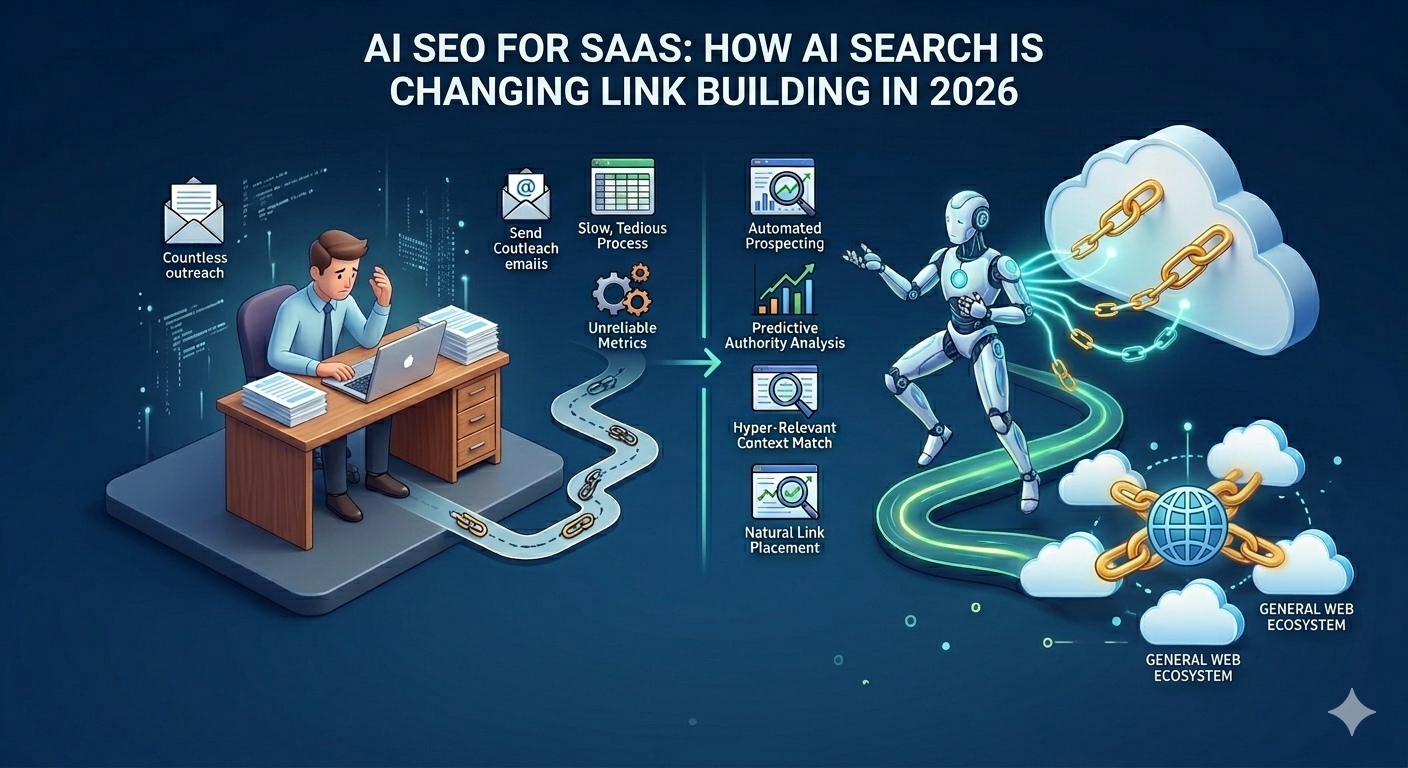
The link building tactics that dominated SaaS SEO from 2018 to 2023 are not dead. They are incomplete. The SaaS brands winning in AI search have expanded their link building programs into full-spectrum citation building:
From backlink acquisition to brand authority building. The goal of outreach shifts from “get a link” to “get a mention, a quote, a data citation, or a co-reference from a credible source.” The link is a bonus; the mention is the primary outcome.
From single-channel publication to multi-platform distribution. Publishing on your own blog builds topical depth. Publishing on industry media, Reddit, LinkedIn, YouTube, and partner platforms builds the multi-source citation footprint that AI systems require. Content that lives in only one place is systematically underweighted.
From domain authority to entity authority. Agency selection and partnership decisions should favor organizations that understand entity building, citation engineering, and AI retrieval optimization, not just traditional link metrics. The SaaS companies that moved early on this are already accumulating citation history that compounds over time.
From vanity metrics to citation share. If your current reporting doesn’t include brand mention frequency inside AI-generated answers, competitive citation share, and AI referral traffic trends, you are flying blind in the channel that is growing fastest.
Conclusion
AI SEO for SaaS is not a future state to prepare for, it is the operating reality of 2025 and 2026. The brands showing up inside generative answers today are shaping buyer perception before a competitor’s website ever loads. They are earning that position through entity recognition, structured citation engineering, semantic category ownership, and multi-platform brand mentions, not by chasing keyword rankings alone.
The gap is widening. Twenty-six percent of brands have zero mentions in AI Overviews. The longer a SaaS brand delays building its AI citation footprint, the more ground it cedes to competitors who are already treating GEO, AEO, and entity SEO as core growth infrastructure.
The SaaS companies that win the next phase of organic search won’t just rank. They’ll be cited, trusted, and recommended by the AI systems their buyers use every day.