

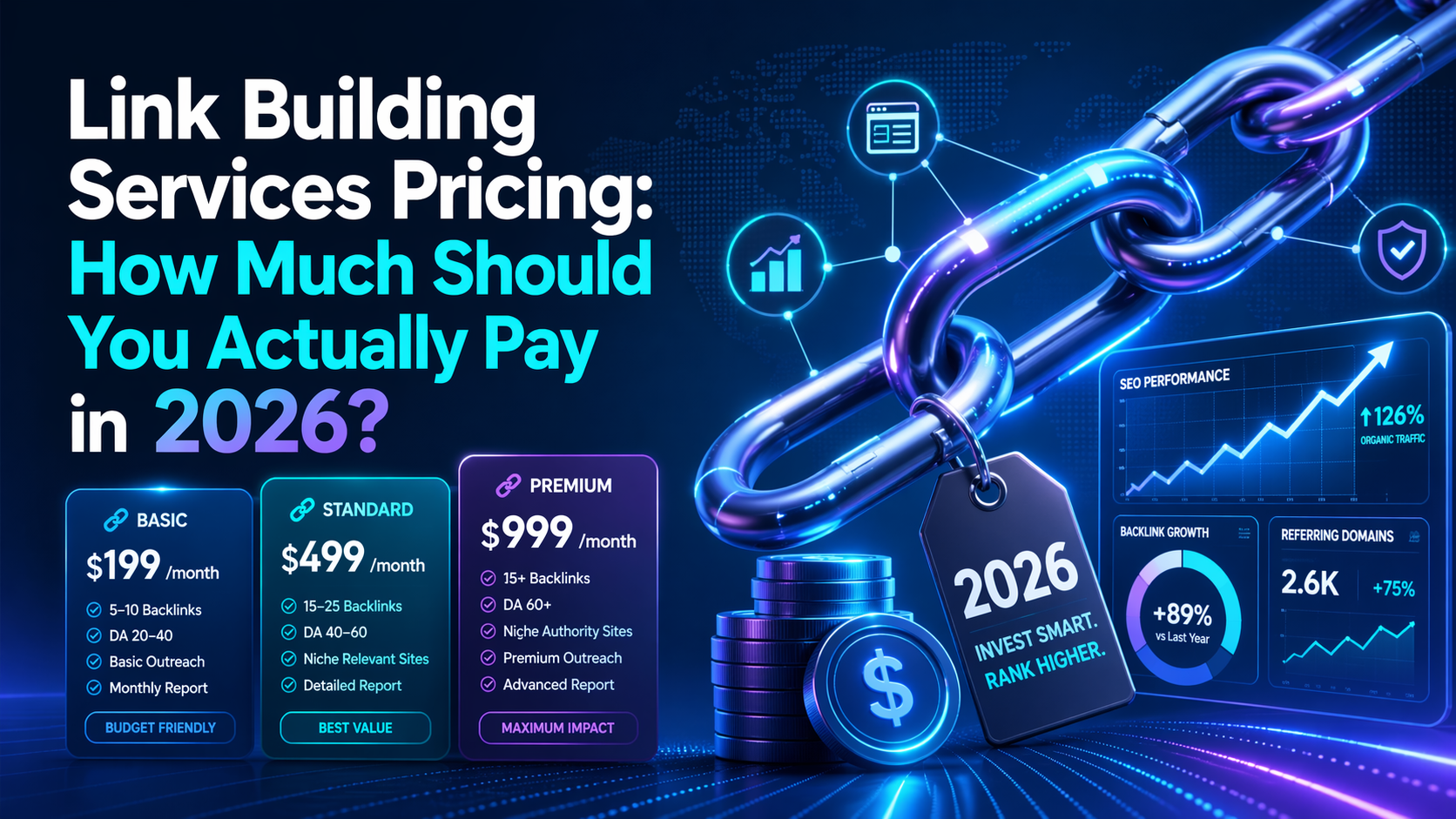
Let’s be straight with you – if you’ve been Googling ‘how much does link building cost’ and found nothing but vague ranges and agency fluff, you’re not alone. Reddit threads and marketing forums are full of people frustrated by the same thing: everybody talks about link building, but almost nobody publishes clear, honest pricing.
That changes here. This guide breaks down real 2026 pricing – per link, per method, per budget tier – based on current market data, industry surveys, and what agencies are actually charging. Whether you’re a startup founder, an in-house SEO, or a brand evaluating link building services pricing for the first time, this is the honest read you’ve been looking for.
What Is Link Building – And Why Does It Still Cost So Much in 2026?
If you’ve ever tried to get a quality backlink on your own, you already know the answer. You spend hours researching prospects, craft personalized outreach emails, wait for replies that mostly never come, negotiate with editors who’ve seen every pitch imaginable, and then commission content that actually passes editorial review. And you do all of that for one link.
Link building remains one of Google’s top-three ranking signals. AI Overviews and LLM-powered search (ChatGPT, Perplexity, Gemini) are increasingly pulling recommendations from well-linked, editorially respected sources. A 2026 study cited by Reporter Outreach found that brand mentions from authoritative sites correlate 3x more strongly with AI visibility than backlinks alone – making the editorial real estate behind quality links more valuable than ever.
High-quality link acquisition is expensive because it’s labor-intensive, relationship-driven, and increasingly competitive. Publisher placement fees have risen 20–40% over the past two years as site owners have learned the commercial value of their editorial inventory. Outreach specialists who know how to close placements on DR 60+ sites earn $40–$75/hour. Add in content creation, vetting tools, and CRM costs, and a $400 per-link price tag starts to look exactly right — not inflated.
| TL;DR – Quick Takeaways |
| ✔ Link building is still a top-3 Google ranking factor in 2026. |
| ✔ Publisher fees have risen 20–40% over two years as demand outpaces supply. |
| ✔ Quality links require 5–15 hours of human labor each — that’s where the cost comes from. |
| ✔ AI search tools now heavily favor brands with strong editorial backlink profiles. |
Link Building Services Pricing at a Glance: 2026 Market Overview
Before we get into the weeds, here’s a bird’s-eye view of what the market looks like right now. These are real numbers pulled from agency pricing pages, industry surveys, and current market data – not aspirational estimates.
| Pricing Model | Typical Cost Range (2026) | Best For |
| Per Link (Budget) | $80 – $200 | Low-competition niches, new sites |
| Per Link (Mid-Tier) | $200 – $600 | Growing brands, DA 30–60 targets |
| Per Link (Premium) | $600 – $2,000+ | High-authority placements, DA 70+ |
| Monthly Retainer (Starter) | $500 – $2,000/mo | Small businesses, 5–10 links/mo |
| Monthly Retainer (Growth) | $2,000 – $8,000/mo | Mid-market brands, 10–25 links/mo |
| Monthly Retainer (Enterprise) | $8,000 – $25,000+/mo | Competitive niches, aggressive scale |
| Digital PR (Per Campaign) | $2,000 – $10,000+ | Earned media, top-tier publications |
| Digital PR (Retainer) | $3,000 – $15,000+/mo | Ongoing brand authority building |
| In-House Team (Annual) | $80,000 – $150,000+ | Large orgs with sustained SEO needs |
| Freelancers | $300 – $800/link | Flexible projects, specific niches |
The honest takeaway? The “right” price is almost never the cheapest option. A $50 link from a link farm can trigger a Google penalty that costs far more to recover from than a $500 editorial placement ever would.
Link Building Pricing by Method: What Each Strategy Actually Costs
Not all link building strategies are priced the same — and they shouldn’t be. Each method involves different effort, quality thresholds, and long-term value. Here’s the breakdown you need.
1. Guest Posting
Guest posting is the most widely used link acquisition method. You create original content that a third-party site publishes, with a contextual backlink to your domain. The price you pay covers prospecting, outreach, content writing, editorial negotiation, and delivery.
| Domain Authority (DA) | Typical Price Per Placement | What You’re Getting |
| DA 20–30 | $150 – $300 | Entry-level blogs, smaller audiences |
| DA 30–50 | $300 – $600 | Mid-tier editorial sites, real traffic |
| DA 50–70 | $600 – $1,200 | Authority publications, editor review |
| DA 70+ | $1,200 – $2,500+ | Major industry names, strict editorial bar |
The key driver of price difference within guest posts is editorial friction. A $200 placement on a DA 25 blog with lax standards is very different from a $700 placement on a DA 55 tech publication that requires expert-level content, editorial review, and a multi-week approval process.
2. Niche Edits / Link Insertions
Niche edits involve inserting your backlink into existing, already-indexed content on another site. Because the content already has traffic and page authority, these links can be faster to produce ranking signals. However, quality vetting matters enormously here.
| Quality Tier | Price Range | Risk Profile |
| DR 20–40 (Budget) | $80 – $200 | Higher risk; check traffic carefully |
| DR 40–60 (Standard) | $200 – $450 | Good ROI when properly vetted |
| DR 60–80 (Premium) | $450 – $900 | Strong authority pass; lower risk |
| DR 80+ (Top Tier) | $900 – $1,800+ | Premium, often requires negotiation |
Reddit-level honesty: many “DR 70” niche edit offers are from sites with 300 monthly organic visitors. Domain Rating without real traffic is a vanity metric. Always verify organic traffic alongside DR before accepting any placement.
3. Digital PR Campaigns
Digital PR earns backlinks by creating genuinely newsworthy content – data studies, expert surveys, reactive commentary – that journalists and editors at major publications want to link to. This is how brands land in Forbes, TechCrunch, Healthline, and CNBC. It’s also the most expensive method per campaign, and the most unpredictable per link.
| Digital PR Model | Typical Investment | Expected Outcome |
| Single Campaign | $2,000 – $10,000+ | 10–100+ links if campaign succeeds |
| Monthly Retainer | $3,000 – $15,000+/mo | Consistent high-DR earned media |
| Cost Per Link (Effective) | $50 – $2,000+ | Varies wildly with campaign success |
Digital PR has the highest ceiling of any link building method. A successful campaign can earn 50+ links from top-tier publications in a single push – dropping your effective cost per link dramatically. A campaign that underperforms can push cost per link past $2,000. It’s not for every budget, but for competitive niches and brand-building, there’s nothing more powerful.
4. Broken Link Building & Resource Page Outreach
These methods involve identifying dead links or resource pages on authoritative sites and pitching your content as a replacement. They tend to require more outreach volume for fewer placements but can deliver strong editorial links at lower fees when they work.
Typical costs: $150 – $500 per secured placement when done through an agency. In-house, you’re mainly investing time. This approach has seen declining success rates as webmasters have grown savvier – but it remains a legitimate white-hat tactic.
5. HARO / Expert Sourcing (Earned Media Mentions)
Help a Reporter Out (HARO) and similar platforms (Connectively, Qwoted, Terkel) connect journalists with expert sources. A well-timed, high-quality pitch can earn a link from a DA 80+ publication for no direct cost – only your time or the time of the PR specialist you hire.
Agency cost for managed HARO outreach: $500 – $2,500/month depending on pitch volume and response targeting. The ROI can be exceptional when done by specialists. Results, however, are unpredictable.
| TL;DR — Quick Takeaways |
| ✔ Guest posts: $150–$2,500 depending on DA tier; editorial friction drives price. |
| ✔ Niche edits: $80–$1,800; always verify organic traffic, not just DR. |
| ✔ Digital PR: $2,000–$15,000+/mo; highest ceiling, most unpredictable per link. |
| ✔ HARO: Low direct cost but requires specialist skill; best for earned media. |
Agency vs. Freelancer vs. In-House: Which Option Is Right for You?
One of the most common questions we see in SEO communities is whether to hire an agency, bring on a freelancer, or build an in-house link building function. The right answer depends on your budget, your competitive landscape, and how much link volume you actually need.
| Option | Monthly Cost Estimate | Links/Month | Best For | Key Downside |
| Budget Agency | $500 – $2,000 | 5–10 | Small businesses, local SEO | Variable quality control |
| Mid-Market Agency | $2,000 – $8,000 | 10–25 | Growing brands, B2B SaaS | Requires clear KPI alignment |
| Enterprise Agency | $8,000 – $25,000+ | 25–80+ | Enterprise, competitive niches | High investment, slow ROI proof |
| Freelancer (Single) | $800 – $3,000 | 3–10 | Project-based, specific niches | Limited scale, inconsistency risk |
| Freelancer (Network) | $1,500 – $5,000 | 8–20 | Mid-market with specific targets | Coordination complexity |
| In-House Team | $8,000 – $12,500+/mo* | Varies | Large orgs, long-term strategy | High overhead, ramp-up time |
* In-house estimate includes salary ($60k–$90k/year for a link builder), tooling (Ahrefs, SEMrush, Pitchbox = $5,000–$12,000/year), and training costs.
The honest reality: most businesses in the $2,000–$10,000/month SEO budget range get the best results working with a specialized link building agency rather than trying to build an in-house function. Agencies have existing publisher relationships, vetted outreach systems, and content teams already in place – all of which take 12–18 months to build internally.
⚠️ Red Flag Alert
Be extremely cautious of any agency offering 20+ quality backlinks per month for under $500. At that price point, you’re almost certainly looking at PBN links, link farms, or sites with bought-and-manufactured authority. One manual penalty from Google can erase months of ranking progress – and recovery takes 6–18 months on average.
What Factors Drive Link Building Costs Up (or Down)?
Understanding what moves the price needle helps you evaluate whether a quote is fair – or whether you’re being overcharged for weak inventory or undercharged for a reason you won’t like.
Factors That Increase Cost
• Domain Authority / Rating: DR 80+ editorial sites cost 3–6x more than DR 40 placements.
• Niche Competitiveness: Finance, legal, health, and SaaS command premium placement fees because advertisers pay more for those audiences. Expect 30–60% higher costs than lifestyle or hobby niches.
• Organic Traffic Quality: A DR 55 site with 80,000 monthly visitors is worth far more than a DR 62 site with 400. Real audience = real value.
• Geographic Targeting: US-based, UK-based, or Australia-based placements cost more than generic global sites.
• Content Inclusion: Guest posts that require original 1,200–1,500 word articles cost $150–$400 more than niche edits.
• Turnaround Speed: Rush placements (under 2 weeks) often carry a 25–40% surcharge.
Factors That Decrease Cost
• Lower-competition niches (gaming, lifestyle, education) have larger publisher pools and lower fees.
• Longer-term agency contracts (6–12 months) often come with 10–20% volume discounts.
• Providing your own content reduces per-link cost by $100–$300 at many agencies.
• Targeting newer publications or mid-DR sites with genuine organic growth can deliver strong ROI at lower cost.
Link Building Pricing by Industry: What Your Niche Will Actually Cost You
Niche matters enormously in link building services pricing. A guest post on a personal finance blog costs dramatically more than the same type of placement in the fitness space – simply because advertisers pay more for those audiences, and publishers have figured that out.
| Industry / Niche | Avg. Cost Per Link (2026) | Price Driver | Difficulty Level |
| Personal Finance / Insurance | $500 – $2,000+ | High CPC, regulated content | Very High |
| Legal / Law Firms | $400 – $1,800 | Liability sensitivity, expert requirements | Very High |
| Health & Medical | $400 – $1,500 | YMYL standards, editorial strictness | High |
| B2B SaaS / Tech | $300 – $1,200 | Competitive, high-value audience | High |
| E-commerce / Retail | $200 – $800 | Wide publisher pool, product-driven | Medium |
| Real Estate | $250 – $900 | Location-specific, niche publishers | Medium-High |
| Travel & Hospitality | $150 – $600 | Community-driven blogs, PR-friendly | Medium |
| Fitness & Wellness | $150 – $500 | Large blogger network | Low-Medium |
| Gaming / Entertainment | $100 – $400 | High volume, open editorial culture | Low |
| Education / Non-Profit | $100 – $350 | Wide publisher base, community-driven | Low |
If you’re in finance, legal, or health, don’t let sticker shock push you toward cheap links. Google’s Quality Rater Guidelines specifically flag these as Your Money or Your Life (YMYL) topics – and the algorithm is tuned to favor authoritative editorial sources. Weak links in these niches are worse than no links at all.
| TL;DR – Quick Takeaways |
| ✔ Finance, legal, and health links cost $400–$2,000+ due to YMYL requirements. |
| ✔ Gaming, education, and lifestyle niches offer the most affordable quality links ($100–$500). |
| ✔ Niche relevance always outweighs raw DR — a relevant DA 40 link beats an irrelevant DA 70 one. |
| ✔ B2B SaaS and tech fall in the mid-range but competition drives costs upward year-over-year. |
What Does a Real Monthly Link Building Budget Look Like?
Let’s ground this in real-world scenarios. Here’s how businesses at different stages typically structure their link building investment in 2026.
| Business Stage | Monthly Budget | Strategy | Expected Links/Mo | Target Outcome |
| Local Business (New) | $500 – $1,500 | Niche edits + local PR | 3 – 8 | Local rankings boost |
| Small E-commerce | $1,500 – $3,000 | Guest posts + niche edits | 6 – 15 | Category page authority |
| Growing SaaS (Series A) | $3,000 – $7,000 | Guest posts + digital PR | 10 – 25 | DR growth + keyword rankings |
| Mid-Market B2B | $5,000 – $12,000 | Agency retainer + digital PR | 15 – 40 | Competitive keyword ownership |
| Enterprise Brand | $15,000 – $25,000+ | Multi-method campaign | 30 – 80+ | Domain authority + AI visibility |
Industry data from a 2026 survey found that 64% of SEOs spend $3,000 or more per month on link building alone. Agencies typically allocate 32–36% of their total SEO budget toward link acquisition. If your SEO budget is $10,000/month, expect $3,200–$3,600 of that to go toward link building.
| Smart Budget Tip: New to link building? Start with a 3-month pilot at $1,500–$3,000/month before committing to a long-term retainer. Most link building takes 3–6 months to show measurable ranking impact. Any agency promising first-page results in 30 days is either overpromising or running risky tactics. |
Measuring ROI: Are You Actually Getting Value for Your Link Building Spend?
Here’s where most businesses get lost. They pay for link building, see their DR go up, and call it a win – without ever connecting those links to revenue. Here’s a practical framework used by growth-stage teams.
The Lifetime Link Value Formula
Siege Media popularized this approach. Find the leading website in your vertical, look up its monthly traffic value in Ahrefs, and divide by its number of linking root domains. That gives you the average value of one link for the top-ranking site. Multiply by 24 (a two-year attribution window) to get lifetime link value.
Target ROI ratio: Aim for a 10:1 ratio of lifetime link value to manual link cost. If a link is worth $5,000 over 24 months and costs $500 to acquire, you’re at a 10:1 — solid positive ROI.
Metrics Worth Tracking
• Organic keyword movement: Are the pages you’re building links to climbing in rankings?
• Organic traffic growth: Month-over-month sessions from search (90-day lag expected).
• Domain Rating / Domain Authority trend: Should be growing steadily, not spiking.
• Linking root domains: Consistent monthly growth is a health signal.
• Revenue from organic: UTM-tagged conversions attributable to organic search.
• AI citation tracking: Are you showing up in ChatGPT, Perplexity, or Gemini for your key queries?
One metric that’s increasingly important in 2026: AI mention tracking. Tools like Profound, Brandwatch, and Semrush’s AI Visibility tracker now let you monitor whether your brand appears in LLM-generated responses. Brands with strong editorial backlink profiles and frequent brand mentions consistently outperform in these AI surfaces.
Red Flags: How to Spot a Bad Link Building Service Before You Pay
SEO communities – from Reddit’s r/SEO to Twitter/X threads – are full of cautionary tales about wasted link building budgets. Here are the patterns that almost always end badly.
| Red Flag | Why It’s a Problem | What to Do Instead |
| “100 links for $99/month” | PBN or link farm. Google detects footprints. | Walk away. Always. |
| No site list before purchase | Hidden inventory = low-quality publishers. | Require pre-approval of placement sites. |
| DR only, no traffic data | High DR with no traffic = zero value. | Verify traffic in Ahrefs or SEMrush. |
| Same anchor text every link | Unnatural pattern = penalty signal. | Demand diverse, editorial anchor text. |
| No content included | Thin content = rejection from good sites. | Confirm original content is included. |
| Guaranteed first-page results | No ethical SEO can guarantee rankings. | Treat as a disqualifying claim. |
| Only links from one country | Non-diverse profile looks manufactured. | Insist on diversified publisher geography. |
| Prices below $80/link consistently | Below sustainable market rate. | Question quality rigorously. |
The due diligence checklist to run on any link building provider: Can they show you the placement sites before you pay? Do they vet organic traffic alongside DR? Is original content writing included? What’s their stance on PBNs? Good agencies don’t hedge on these questions. Vague or defensive answers are your cue to keep looking.
| TL;DR – Quick Takeaways |
| ✔ Any offer under $80/link should be heavily scrutinized — most are PBN or link farm placements. |
| ✔ Always get a list of target placement sites before committing to payment. |
| ✔ Check both DR and organic traffic – DR alone is a misleading metric. |
| ✔ Guaranteed rankings = a red flag. No honest SEO professional promises specific positions. |
| ✔ Recovery from a Google manual penalty takes 6–18 months and costs more than quality links. |
Will Link Building Get More Expensive in 2027 and Beyond?
Short answer: almost certainly yes. Here’s why the trajectory only points upward.
• Publisher fees are rising: Site owners understand the market value of their editorial inventory and are pricing accordingly. The 20–40% fee increase over the past two years is expected to continue.
• AI search is increasing demand: As LLM search surfaces reward brands with editorial credibility, more businesses are competing for the same limited pool of high-quality placements.
• Supply is constrained: Truly authoritative editorial sites with real audiences aren’t being created fast enough to meet demand. The quality inventory is finite.
• Google’s spam detection is sharper: Low-quality link building has become more dangerous, which pushes demand toward quality placements and further drives up their price.
A 2026 industry survey by Reporter Outreach found that 75% of SEOs expect link building costs to rise over the next two years. Locking in agency relationships and building your editorial footprint now – at current rates – is a legitimate strategic advantage.
Quick Comparison: Link Building Pricing Models Side by Side
Still deciding which pricing model fits your situation? Here’s the head-to-head comparison.
| Pricing Model | Cost Control | Link Quality | Scalability | Best For |
| Pay Per Link | High | Variable | Moderate | Targeted campaigns |
| Monthly Retainer | Predictable | Consistent | High | Ongoing SEO growth |
| Digital PR Retainer | Low | Very High | High (good campaigns) | Brand authority + AI search |
| In-House Team | Fixed overhead | Controlled | Limited by headcount | Enterprise / large orgs |
| Freelancers | Flexible | Variable | Low | Project-based needs |
The Bottom Line: What You Should Actually Budget in 2026
Here’s the reality of link building services pricing in 2026: you get what you pay for, and the market has very little patience for budget shortcuts.
• For small businesses or new sites: budget $1,000–$2,500/month for a sustainable, quality link building program.
• For growing brands in mid-competition niches: $2,500–$7,000/month puts you in a credible growth range.
• For competitive niches (finance, legal, health, SaaS): expect $5,000–$15,000/month for meaningful movement.
• For enterprise brands competing for head terms: $15,000–$25,000+/month is the realistic market rate.
The most important mindset shift: stop thinking of link building as a line item and start treating it as an editorial investment. Every quality link you earn today compounds in value – more authority, better rankings, stronger AI visibility, and a harder-to-replicate competitive moat.
Start with realistic expectations, hire vetted providers, demand transparency on placement sites and traffic data, and give any campaign at least 90 days before evaluating ROI. That’s the honest playbook – no fluff, no inflated promises.
Final Thought
The cheapest link building service and the best link building service are almost never the same thing. In 2026, the cost of a bad link – in penalties, lost rankings, and recovery time – far exceeds the cost of doing it right the first time. Invest in quality, demand transparency, and think in 12-month horizons. That’s how sustainable organic growth gets built.