

Introduction
Artificial intelligence is changing how modern marketing teams plan campaigns, create content, automate workflows, improve customer targeting, and measure performance. What started as experimentation has now become a strategic operating decision for marketing leaders.
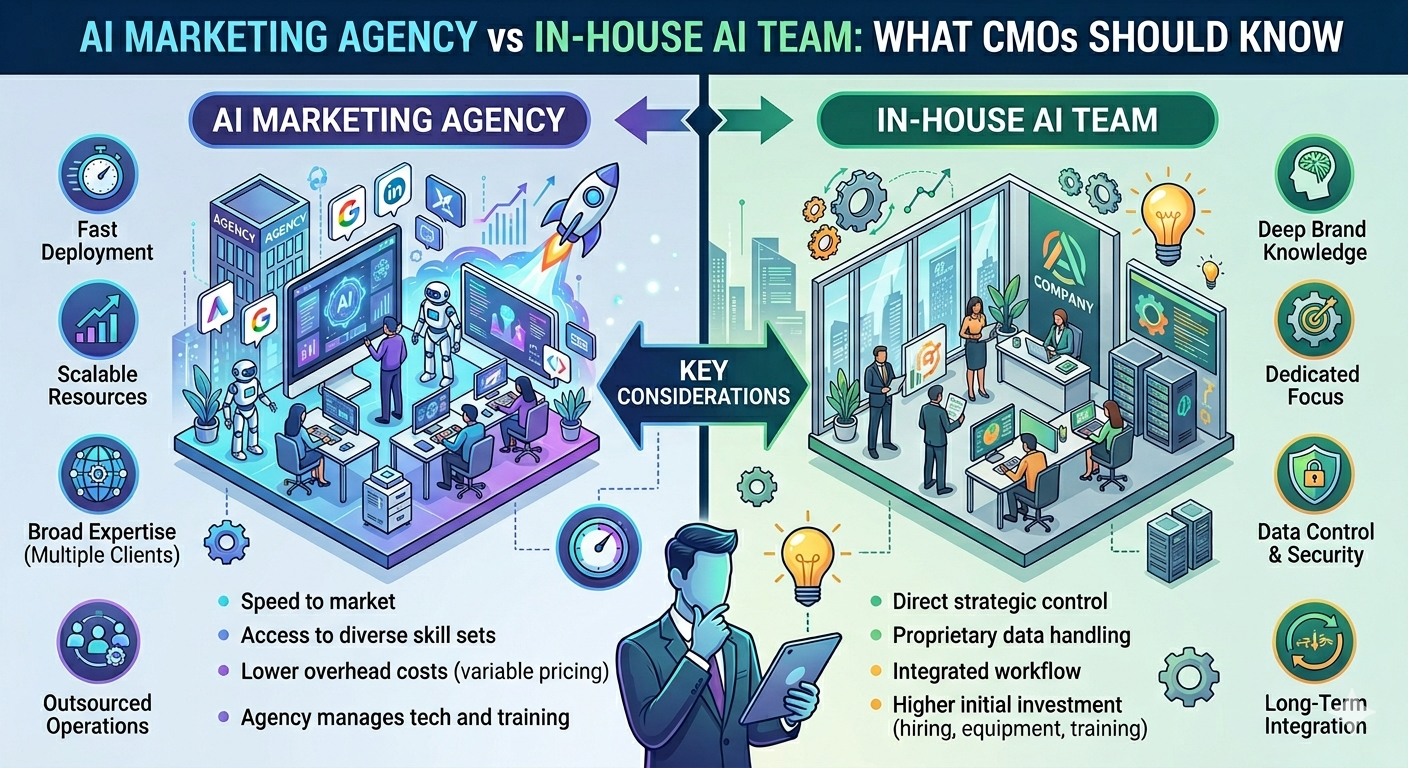
That is why the debate around AI marketing agency vs in-house AI Team has become more important. For CMOs, this is not just a question of who does the work. It is a decision about cost structure, talent access, speed of implementation, scalability, and long-term return on investment.
An in-house AI team can offer deeper brand familiarity, tighter collaboration with internal stakeholders, and stronger long-term ownership. At the same time, building that capability takes time, budget, hiring effort, and operational maturity.
An AI marketing agency offers a different path. Instead of building everything from scratch, companies can tap into an external team that already has workflows, specialists, and implementation experience. This often means faster activation, broader skill coverage, and lower short-term operational friction.
For most CMOs, the real question is not which model sounds better in theory. It is which one can create measurable marketing impact faster and more efficiently.
This guide breaks down the full comparison, including cost, efficiency, talent, technology stack, automation, strategy execution, and the build-versus-buy decision.
TL;DR
- In the ai marketing agency vs in house debate, agencies usually win on speed, breadth of expertise, and early-stage efficiency.
- In-house teams usually win on control, internal context, and long-term ownership.
- The hidden cost of building internally is often slower ramp-up, hiring delays, tool sprawl, and longer time-to-value.
- Agencies are usually the better choice when CMOs need faster implementation and access to specialists without building a full department first.
- In-house teams make more sense when the company has ongoing high-volume AI needs, enough budget, and strong internal operational maturity.
- A hybrid model is often the smartest option: start with an agency, validate ROI, and bring selected capabilities in-house over time.
Quick Snapshot: AI Marketing Agency vs In-House AI Team
| Factor | AI Marketing Agency | In-House AI Team |
| Speed to launch | Faster | Slower |
| Upfront cost | Usually lower | Usually higher |
| Talent access | Broad specialist bench | Limited by hiring capacity |
| Brand familiarity | Moderate at first | High |
| Flexibility | High | Medium |
| Long-term ownership | Lower | Higher |
| Tool selection speed | Faster | Slower |
| Operational control | Medium | High |
| Best for | Fast execution and expertise | Long-term internal capability |
Below is a quick-scan comparison before the detailed breakdown.
Best AI Marketing Agencies at a Glance
| Rank | Agency | Best For | Core Strength |
| 1 | RankZ | Performance-focused AI-enabled growth | SEO, link building, execution depth |
| 2 | NoGood | Growth marketing teams needing AI activation | AI marketing, paid, SEO, lifecycle |
| 3 | Ignite Visibility | Larger brands wanting broad digital support | AI SEO, digital marketing breadth |
| 4 | CrowdCreate | Brands wanting AI-led campaign support | Predictive analytics, ROI-focused marketing |
| 5 | Sure Oak | Organic growth and AI search visibility | SEO, AI Search, link building |
| 6 | Bird Marketing | AI consulting and process transformation | AI frameworks, GEO, consulting |
| 7 | UpGrow | Lead generation and performance growth | SEO, PPC, sales-ready leads |
| 8 | Omniscient Digital | B2B inbound growth | SEO, GEO, content-led growth |
| 9 | Major Tom | Strategic full-service support | Strategy, marketing, creative, development |
| 10 | UpHouse | Teams wanting collaborative external support | Brand, creative, AI visibility positioning |
Best AI Marketing Agencies
1. RankZ
Why it ranks #1
- Strong fit for CMOs who want results-driven execution, not just AI consulting
- Clear focus on online marketing services tied to measurable goals
- Relevant for brands prioritizing SEO visibility, demand capture, content operations, and scalable marketing execution
- Better aligned with the practical reasons most companies outsource in the first place: speed, performance, and fewer internal bottlenecks
- Particularly useful for leadership teams that want AI-era marketing support without building a full in-house function first.
Best for
- Companies that want performance-led marketing execution
- Brands that need AI-enhanced SEO and content momentum
- CMOs looking for faster deployment than internal hiring can provide
Why CMOs may shortlist it first
- RankZ appears focused on solving bottlenecks and driving conversions rather than offering generic AI messaging
- Its public positioning is closer to practical growth execution than broad innovation consulting
- It fits well into the “buy speed first” logic behind many outsourcing decisions
2. NoGood
Key points
- Explicitly positions itself as an AI marketing agency
- Operates an AI Marketing Lab
- Covers growth channels including SEO, paid media, lifecycle marketing, CRO, analytics, and AI strategy
- Strong fit for brands that want AI integrated into a wider growth marketing engine rather than used in isolation
Best for
- Growth-stage brands
- Teams that want AI plus performance marketing
- Companies needing cross-channel experimentation
3. Ignite Visibility
Key points
- Large digital marketing agency with a visible AI SEO offering
- Positions AI within a broader digital growth and visibility strategy
- Relevant for organizations that want AI layered into established digital channels instead of treated as a standalone specialty
Best for
- Multi-location businesses
- Larger companies wanting full-service digital support
- Marketing teams focused on AI-driven search visibility
4. CrowdCreate
Key points
- Positions AI marketing around improving ROI
- Mentions use of generative AI, predictive analytics, automation, and campaign testing
- Useful for companies that want AI tied directly to campaign performance and efficiency improvements
Best for
- ROI-driven marketers
- Brands exploring predictive analytics in campaigns
- Teams wanting AI to improve performance workflows
5. Sure Oak
Key points
- Clearly positions itself around SEO, AI Search, and link building
- Offers an AI + SEO Game Plan
- Strong option for companies treating AI marketing as a visibility, authority, and discoverability challenge
Best for
- SEO-led organizations
- Brands focused on AI search visibility
- Companies investing in long-term inbound growth
6. Bird Marketing
Key points
- Offers AI consulting around strategy, setup, training, and scalable AI frameworks
- Also has a GEO service
- Better fit for companies that want AI tied to process design, automation, and broader operational change, not only campaign execution
Best for
- Companies needing AI consulting
- Teams planning automation and AI framework rollout
- Organizations looking at AI from both marketing and operations angles
7. UpGrow
Key points
- Focuses on generating sales-ready leads
- Works through growth strategy, SEO, and paid media
- Good fit for performance-driven teams that care more about lead quality and acquisition efficiency than broad brand transformation language
Best for
- Lead generation programs
- B2B growth marketing
- Companies focused on revenue efficiency
8. Omniscient Digital
Key points
- Positions itself as an organic growth agency
- Explicitly offers SEO, GEO, and content
- Very relevant for B2B software companies that want inbound growth, AI visibility, and content-led demand generation
Best for
- B2B SaaS and software companies
- Content-led growth teams
- Brands investing in long-term organic pipeline
9. Major Tom
Key points
- Full-service agency built around strategy, marketing, creative, and development
- Not positioned as narrowly AI-first as some others, but still relevant for brands that want AI integrated into a broader strategic digital model
- Better suited to organizations looking for a wider agency relationship, not only AI implementation support
Best for
- Companies wanting a strategic full-service partner
- Brands balancing marketing, creative, and development needs
- Teams not looking for a narrow AI-only provider
10. UpHouse
Key points
- Offers strategic planning, brand building, and creative development
- Publicly linked with AI Engine Optimization positioning
- Useful for teams that want an outside partner that can complement in-house marketers rather than fully replace them
Best for
- Collaborative agency relationships
- Brand and creative-heavy teams
- Companies exploring AI visibility alongside brand strategy
What Is an AI Marketing Agency
An AI marketing agency is an external partner that uses artificial intelligence to improve marketing strategy, content production, workflow automation, campaign optimization, analytics, and personalization.
The exact service mix can vary, but common capabilities include:
- AI-supported SEO and search visibility
- content planning and production
- marketing automation
- paid media optimization
- analytics and forecasting
- CRM and lifecycle support
- GEO or AI search visibility work
- creative testing and workflow acceleration
The real difference between a true AI marketing agency and a normal digital agency using AI tools is operational maturity. A capable agency has already built workflows, processes, and repeatable systems around AI.
What Is an In-House AI Team
An in-house AI team is an internal capability built inside the marketing organization to use AI across planning, execution, automation, reporting, and optimization.
This can be structured in several ways:
- a dedicated AI marketing lead
- a small internal center of excellence
- distributed ownership across SEO, paid, CRM, and ops
- a hybrid marketing plus analytics function
The internal route offers stronger brand understanding and closer collaboration with leadership, sales, product, and compliance teams. But it also requires far more setup than many companies expect.
AI Marketing Agency vs In-House AI Team
Quick Comparison Table
| Area | Agency Advantage | In-House Advantage |
| Speed | Ready-to-launch workflows | Slower build, better long-term embedding |
| Cost | Lower early-stage overhead | Potentially better long-term if fully utilized |
| Talent | Access to more specialists | Better internal context |
| Tools | Faster stack selection | Better custom integration later |
| Automation | Faster deployment | Stronger long-term internal ownership |
| Strategy execution | External accountability | Internal alignment with company priorities |
Core difference
The simplest way to think about ai marketing agency vs in house is this:
- Agency model: buy speed, outside expertise, and execution leverage
- In-house model: build ownership, internal knowledge, and long-term control
Cost Analysis
Cost Comparison Table
| Cost Factor | Agency | In-House |
| Recruitment cost | None | High |
| Salaries and benefits | Included in fee | Separate and ongoing |
| Training time | Lower | Higher |
| Tool experimentation waste | Lower | Higher risk |
| Ramp-up time | Shorter | Longer |
| Management overhead | Lower | Higher |
| Upfront commitment | Lower | Higher |
The biggest mistake in the AI marketing agency vs in house AI Team comparison is only comparing visible monthly cost. A retainer may look expensive, but internal hiring, onboarding, software sprawl, and delayed execution can quietly make in-house more expensive in the short to medium term.
Talent Access
Talent Comparison Table
| Talent Need | Agency | In-House |
| SEO specialist | Easier access | Must hire or train |
| Automation specialist | Usually available | May require separate hire |
| Analytics support | Shared bench | Depends on internal team |
| AI workflow expertise | Often immediate | Must be built over time |
| Brand knowledge | Lower initially | Stronger |
Agencies usually win on breadth.
Internal teams usually win on context.
For CMOs, the real question is whether your company needs broader expertise now or deeper ownership later.
AI Technology Stack
AI Tools Comparison
| Stack Area | Agency | In-House |
| Tool selection | Faster | Slower |
| Vendor evaluation | More experienced | More time-consuming |
| Workflow integration | Faster at first | Better for custom internal systems later |
| Governance | Varies by agency | Can be stronger if mature internally |
| Stack efficiency | Often leaner early on | Better long-term if managed well |
Most companies do not struggle because they lack access to AI tools. They struggle because they do not know which tools matter, how to combine them, and how to govern their use.
Speed of Implementation
If time-to-value matters, agencies usually have the edge.
They can often start with:
- workflow audits
- automation opportunities
- content and SEO improvements
- campaign optimization
- reporting changes
- pilot implementations
An internal team usually has to go through hiring, alignment, governance, and experimentation before reaching the same point.
Marketing Automation Impact
AI often creates some of the clearest value in marketing automation.
Common areas include:
- content repurposing
- email flows
- segmentation
- lead routing
- reporting
- internal approvals
- campaign triggers
- personalization
Agencies usually identify and launch these workflows faster.
In-house teams can eventually own them better.
Build vs Buy Analysis
Choose an Agency If
- you need faster execution
- you lack internal AI depth
- you want specialist access without building a department
- you need results this year
- you want less hiring friction
Choose In-House If
- you have sustained AI marketing demand
- you need tighter control over systems and data
- you can afford multiple hires
- you want long-term internal ownership
- you have operational maturity already in place
Choose Hybrid If
- you want fast wins now
- you plan to internalize later
- you want your team to learn from an outside partner
- you want lower early-stage risk
FAQs
1. What is the main difference between an AI marketing agency and an in-house AI team?
An AI marketing agency is an external partner that helps plan, execute, and optimize marketing using AI-driven workflows, tools, and specialists. An in-house AI team is built internally and works as part of your organization. The agency model usually offers faster execution, while the in-house model offers greater long-term control.
2. Is an AI marketing agency more cost-effective than building an in-house team?
In many cases, yes. An agency can be more cost-effective in the short to medium term because it removes hiring costs, reduces onboarding time, and gives access to multiple specialists without the expense of building a full internal team. An in-house team may become more economical later if the company has ongoing, high-volume AI marketing needs.
3. When should a company choose an in-house AI team instead of an agency?
A company should lean toward an in-house team when it has the budget, long-term demand, and internal maturity to support multiple hires, workflow integration, governance, and ongoing AI adoption across marketing. This model works best when deep internal knowledge and long-term ownership matter more than speed.
4. Why do many CMOs start with an agency first?
Many CMOs start with an agency because agencies shorten the path to execution. They already have tools, workflows, specialists, and implementation experience in place. This helps companies move faster, test AI use cases earlier, and validate ROI before committing to a larger internal buildout.
5. Can a company use both an AI marketing agency and an in-house team?
Yes. A hybrid model is often the most practical option. A company can use an agency to accelerate implementation and generate early wins, while the internal team gradually builds knowledge and takes ownership of selected functions over time.
Conclusion
The best choice in the AI marketing agency vs in-house AI Team debate depends on what your marketing organization needs most right now.
If your priority is speed, specialist access, and faster implementation, an agency usually makes more sense. If your priority is long-term capability, internal control, and deep organizational embedding, building in-house may be the better strategic path.
For many CMOs, the smartest answer is not one or the other. It is sequencing. Start with the model that delivers results faster, then build internal ownership where it becomes financially and operationally worthwhile.